Afghan Hound vs Saluki
The Afghan Hound and the Saluki are both tall, lean sighthounds with a long, refined head, very little stop, long ears covered in silky hair, a deep chest and a tail carried in a curve. The AKC calls the Afghan Hound a very old breed and the Saluki one of the oldest, and both standards ask for dignity. A feathered Saluki seen head-on, or an Afghan Hound with a short coat, can easily be taken for the other.
The coat is the fastest tell. An adult Afghan Hound is covered in thick, silky, very fine hair on its legs, flanks, ribs, forequarters and hindquarters, with a topknot of long hair on the head and a strip of short, close hair along the back called the saddle. A Saluki's body coat is smooth all over. A feathered Saluki has long hair only on the ears and the underside of the tail, with slight feather on the legs and the backs of the thighs, and a smooth Saluki has no feathering at all.
When the coat does not settle it, look at the head, tail and feet. The Afghan Hound has a topknot, a slightly Roman nose and a very prominent occiput; the Saluki standard asks for a long, narrow head and mentions no topknot. The Afghan's tail has a ring or curve at the end and should never be bushy, while the Saluki's is well feathered underneath with long silky hair. The Afghan's feet are large and covered in long, thick hair; the Saluki's are of moderate length with feather between the toes.
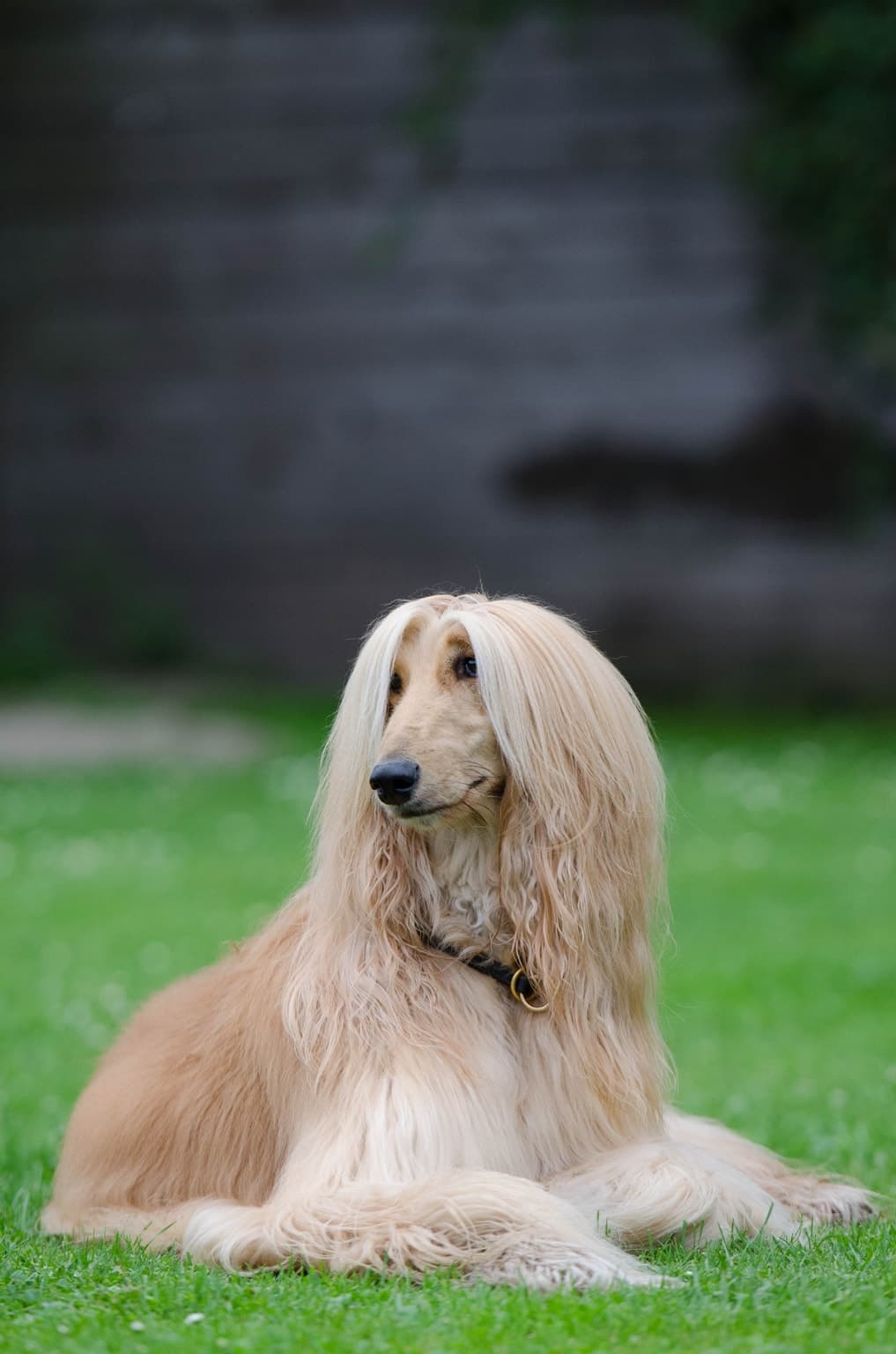
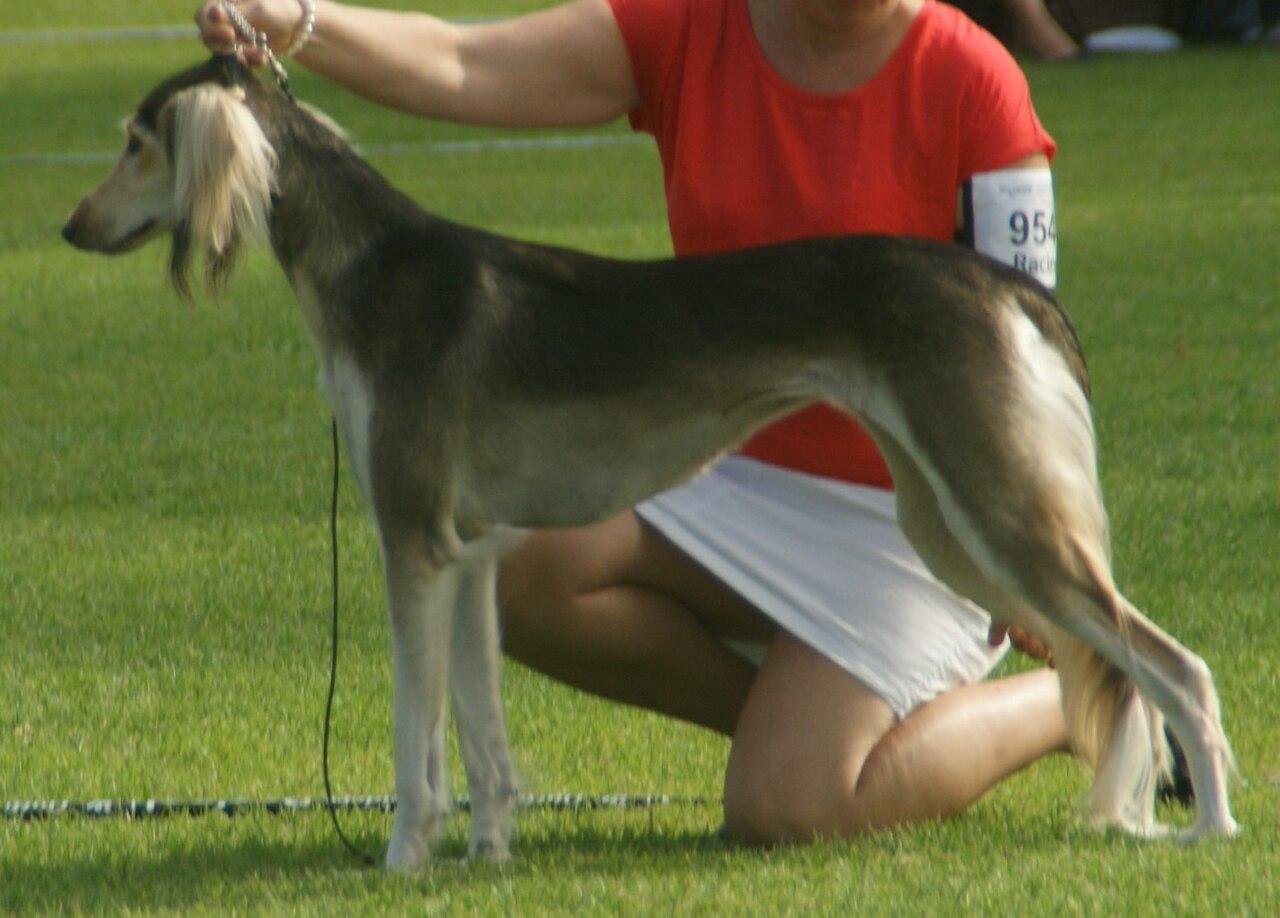
Photo by Canarian · CC BY-SA 4.0
Quick facts
| Fact | Afghan Hound | Saluki |
|---|---|---|
| Group | Hound | Hound |
| Size | large | large |
| Height | 25-27 in | 23-28 in |
| Weight | 50-60 lbs | 40-65 lbs |
| Lifespan | 12-18 years | 10-17 years |
| Temperament | Independent, Dignified, Sensitive, Athletic | Gentle, Independent, Quiet, Athletic |
How to tell them apart
Read the rows top to bottom. The first two or three traits usually settle it; the rest confirm.
| Trait | Afghan Hound | Saluki |
|---|---|---|
| Coat | Thick, silky hair of very fine texture on the hindquarters, flanks, ribs, forequarters and legs, with a short, close saddle along the back in mature dogs. The standard asks for the coat to be shown unclipped. | Smooth and silky on the body, with slight feather on the legs and at the back of the thighs. The smooth variety has no feathering. |
| Head and ears | Refined, with little or no stop, a slightly Roman nose, a very prominent occiput and a topknot of long silky hair. Ears reach nearly to the end of the nose and are covered with long silky hair. | Long and narrow, moderately wide between the ears, not domed, with a stop that is not pronounced; the standard mentions no topknot. Long, mobile ears hang close to the skull, covered with long silky hair. |
| Tail | Set not too high, with a ring or curve at the end; never bushy, and never curled over or resting on the back. | Long, set low and carried naturally in a curve, well feathered on the underside with long silky hair, not bushy. |
| Feet and hips | Large feet, both long and wide, with unusually large pads and a covering of long, thick hair. Very prominent hipbones. | Feet of moderate length with long, well arched toes, feathered between the toes. Hipbones set well apart. |
| Size | 25 to 27 in and 50 to 60 lbs. Males 27 in, plus or minus an inch, and about 60 lbs; females 25 in and about 50 lbs. Height at the shoulder equals body length. | 23 to 28 in and 40 to 65 lbs. The standard gives 23 to 28 in for males and says females may be considerably smaller; it lists no weight. |
| Colour, eyes and nose | All colours are permitted; white markings, especially on the head, are undesirable. Dark, almond-shaped, almost triangular eyes and a black nose. | White, cream, fawn, golden, red, grizzle and tan, tricolour (white, black and tan) and black and tan. Large, oval eyes, dark to hazel, and a black or liver nose. |
| AKC group and origin | Hound Group. A hunting companion of the mountain kingdoms of the region that is now Afghanistan, India and Pakistan, where the coat protected it from a harsh climate. | Hound Group. A favourite of royal families of the Middle East, Egypt and Asia, used by the Arabs to run down gazelle. |
What the photo detector sees
A full-coated adult Afghan Hound is hard to mistake, yet the two breeds sit close together for an AI model. In the saved benchmark runs for this project, none of the fifteen answers for Afghan Hound reference photos named Saluki first, but Saluki was the second choice in all fifteen. The runs did not include Saluki reference photos.
The hard photos are the ones where the Afghan's coat is missing. The AKC notes that Afghan puppies have short, fuzzy coats before the long hair grows in, and an Afghan Hound that has been clipped short loses its main tell too. A view from above or behind shows mostly the short saddle. In those cases check for the topknot, the large hairy feet and the ring at the end of the tail. A smooth Saluki has no ear or tail feathering, so with that variety the coat gives fewer clues and the long, narrow head and overall proportions matter more.
Living with them
Both are independent sighthounds that chase by sight, so neither is a dog to walk off the lead. The AKC describes Afghan Hounds as independent, dignified and aloof in general, but affectionate and extremely loyal to the people they have bonded with, and advises a large enclosed area with a high, secure fence where they can run flat out several times a week. It describes the Saluki as dignified, gentle and independent-minded, recommends daily walks always on a leash and a well-fenced yard, and warns that a bored Saluki can become an escape artist or a destructive chewer.
Grooming is the big practical difference. An adult Afghan Hound's coat needs several hours of brushing a week plus regular bathing with shampoo and conditioner. Both Saluki coat types are groomed with a weekly brushing, with a little more attention for long ear and tail feathering. The AKC notes that Afghans tend to be sensitive to anaesthesia and that bloat can occur in both breeds. The profiles list a lifespan of 12 to 18 years for the Afghan Hound and 10 to 17 years for the Saluki.
Not sure which one you have?
Upload a clear photo and the detector returns a ranked shortlist, so you can check the top matches against the tells above instead of guessing from one label.
Upload a photo and get a ranked shortlistFAQ
What is the difference between an Afghan Hound and a Saluki?
The coat. An Afghan Hound has thick, silky hair over its legs and sides, a topknot on its head and a short saddle along the back. A Saluki is smooth-coated, with long hair only on the ears and tail and slight feather on the legs, or none at all in the smooth variety.
Are Afghan Hounds and Salukis related?
Both are sighthounds in the AKC Hound Group, and the AKC describes each as a very old breed. The AKC material this page relies on does not record a direct line from one to the other. They are separate breeds with separate standards.
Which is bigger, an Afghan Hound or a Saluki?
They overlap. The Afghan Hound standard gives 27 in and about 60 lbs for males and 25 in and about 50 lbs for females. The Saluki standard gives 23 to 28 in for males and says females may be considerably smaller, and the Saluki profile lists 40 to 65 lbs.
Do all Salukis have feathered ears and tails?
No. The AKC standard covers two coats. The feathered Saluki has long silky hair on the ears and the underside of the tail, with slight feather on the legs. The smooth variety is the same dog in every other point but has no feathering.
Which needs more grooming?
The Afghan Hound, by a wide margin. The AKC says an adult Afghan's coat needs several hours of brushing a week and regular baths, while a Saluki of either coat type is groomed with a weekly brushing and bathed only when dirty.
Full profiles
Browse every pair in the breed comparison index.