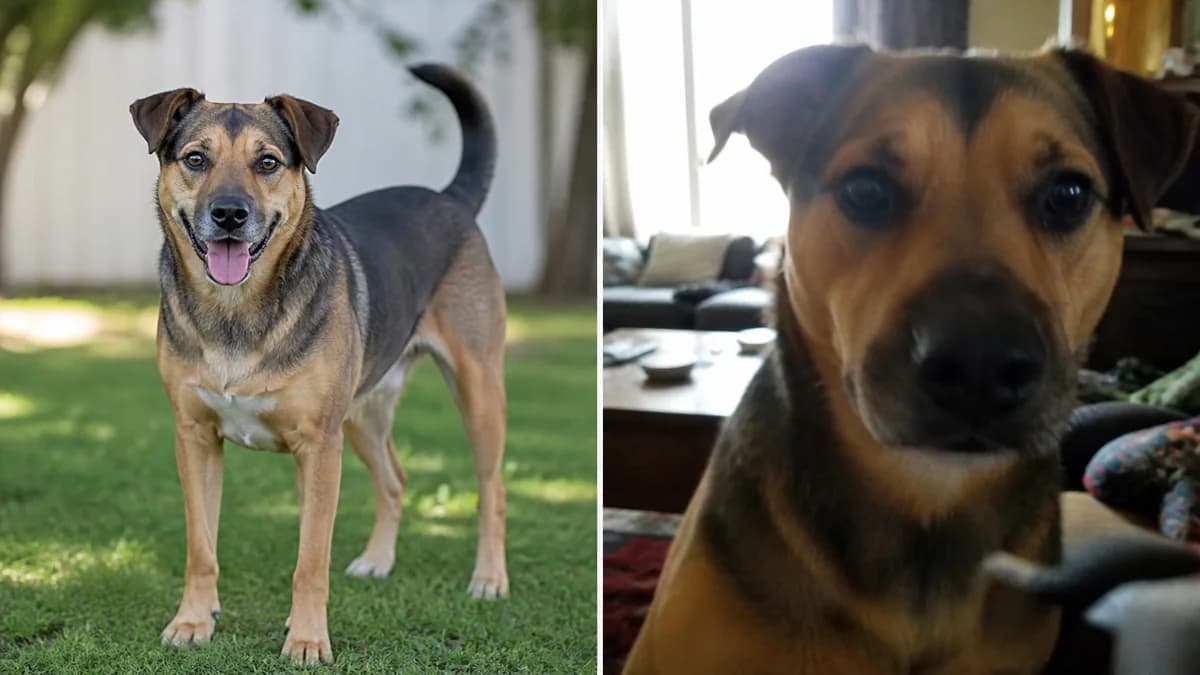
Can AI tell me what breed my dog is? How AI Dog Breed Detection Works
AI & Technology • By Dog Breed Detector Editorial Team • 2025-11-20 (Updated 2026-09-09)
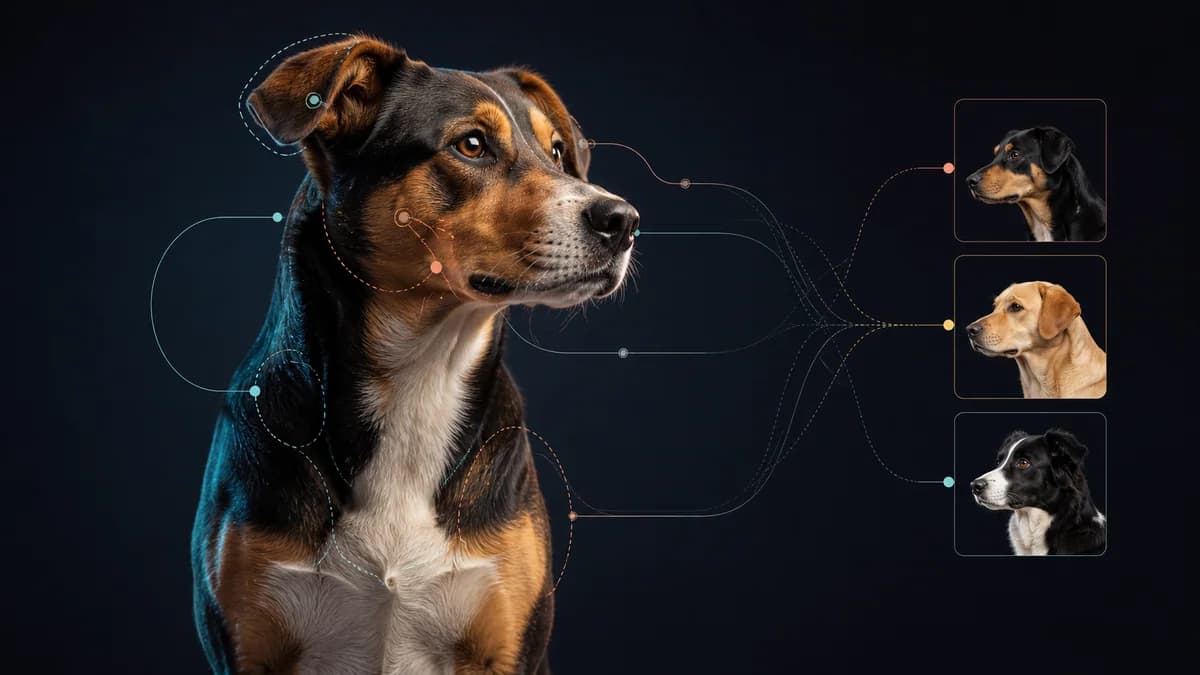
Yes, AI can usually tell you what breed your dog looks like from a photo. What it cannot do is tell you what your dog is in the genetic sense. That distinction is the reason this article exists. Below we explain what the model actually looks at, why it hands you a ranked shortlist instead of one answer, how our pipeline is put together, how we test it, and where it still gets things wrong. If you have ever asked what breed is my dog, this is the honest version of how a photo tool tries to answer.
What the model actually looks at
AI breed detection is pattern recognition. A vision model has been shown a very large number of dog photos and has learned which visual signals tend to appear together for each breed. When you upload a picture, it is not thinking in words like “fluffy” or “sweet.” It is weighing a handful of structural and surface cues against everything it has learned:
- Silhouette: the overall outline, including chest depth, back length, leg length, and how the tail is carried.
- Head and ear structure: skull width, the step between forehead and muzzle, muzzle length, and whether the ears are pricked, folded, or dropped.
- Coat texture: smooth, wiry, curly, corded, double coated, or feathered. Texture often separates breeds that share a silhouette.
- Color pattern: masks, saddles, brindle, merle, ticking, and where the white sits. Pattern is a clue, not a verdict, because most patterns show up in many breeds.
- Proportions: the ratios between those parts, such as leg length to body length. Proportions are usually more reliable than color.
Some signals are “louder” than others. A distinctive mask or a pair of upright ears can pull the model’s attention even when the body underneath tells a more complicated story. That is one reason the same dog can score differently across photos taken from different angles.
Why you get a ranked shortlist, not one answer
A single verdict would feel more satisfying, but it would hide how the model works. For any photo, the model produces a strength of match for many breeds at once. Our detector shows the top candidates in order, each with a confidence value, because many photos are genuinely ambiguous. Two or three close scores tell you the photo sits between breeds, which is common with mixes, puppies, or unusual angles. One score far ahead of the rest tells you the visual evidence points clearly one way.
Confidence is match strength, not ancestry. A 70% result means the first candidate was the strongest visual match in that response. It does not mean your dog is genetically 70% that breed, and it does not mean the model knows anything about your dog’s parents. Two ways to read the number:
- Relative confidence: the top result is the best match among the candidates, not necessarily a perfect match to a breed standard.
- Clue strength: a tight cluster of similar scores means the photo is ambiguous; a wide gap means it is easier to read.
To go deeper than the first line, open the top two or three matches in the breed directory and compare structure, coat, and typical size side by side.
How this site’s pipeline works
Most photo breed tools follow the same rough shape. Here is how ours is arranged, at a high level.
- Consent and upload: before anything is analyzed, the site asks for permission. To find breed matches, we send the photo to our server and to OpenAI. Our app does not add uploaded photos to a long-term photo store or application logs, and the mobile app keeps your scan history on your device.
- Dog or not a dog: a quick, low-detail check runs first to decide whether the image contains a dog at all. It is cheap and fast, and it stops the detailed stage from confidently describing a cat, a stuffed toy, or an empty sofa.
- Detailed analysis: if a dog is found, a second stage looks carefully and returns a structured response: a shortlist of breeds, a confidence value for each, and a short note on the visible traits behind the ranking. The response follows a fixed contract so the app can display it reliably and so we can measure it.
- A narrow second look: for one look-alike family, a group of upright-eared working breeds the benchmark showed were easy to swap, an uncertain result gets a second pass. There is no generic “try again until it sounds confident” retry.
- Your result: the shortlist is shown with confidence values, and the copy describes visual resemblance rather than DNA or ancestry.
Each stage answers a different question and can be tested separately. A model that is great at spotting dogs is not automatically great at telling a Malinois from a German Shepherd Dog, so we do not let one number stand in for both.
How we test it
It is easy to say a tool is accurate. We would rather show the work. Our methodology page describes the full process; here is the shape of it.
A reviewed benchmark, not a pile of downloads
The primary benchmark covers 100 breeds with 500 accepted photographs, five per breed, sourced from Wikimedia Commons with recorded author, license, original URL, and a file hash for every image. Each accepted photo must show one meaningful dog subject with visible breed structure. Near duplicates, wrong breeds, multiple dogs, weak visibility, and non-photographic media are rejected. Across the review rounds, 254 candidates were rejected and kept on record with their reason rather than silently discarded. Breed names and aliases are aligned against the AKC directory and FCI nomenclature so that “Alsatian” and “German Shepherd Dog” count as the same answer.
Development, regression, and holdout splits
Each breed’s five photos are split on purpose: three development photos for iterating on the prompt and response format, one regression photo for routine checks whenever the model or prompt changes, and one holdout photo that is never used for tuning and is reserved for final release decisions. Keeping the holdout untouched is what stops us from quietly teaching to the test.
Fifteen look-alike groups
The benchmark tags 15 look-alike breed families, such as shepherds, northern spitz breeds, sighthounds, corgis, mastiff types, retrievers, and schnauzers. When the model gets a photo wrong, we check whether the mistake stayed inside one of these families or jumped somewhere surprising. A Husky called a Malamute is a very different error from a Husky called a Poodle. Our look-alike breed group guide describes those curated families and states whether per-group results have been published. The groups are not a ranking of measured error frequency.
Release gates
A production candidate has to clear accuracy, response, stability, and latency gates before it replaces the live model. The production release evaluated on August 19, 2026 produced the following on repeated clear-breed cases:
- 94.4% top-1 accuracy across 90 repeated clear-breed calls.
- 100% top-3 accuracy and 100% response-contract compliance.
- 96.7% repeated-run stability.
- 2.645 second median latency and 7.692 second p95 latency.
The dog-or-not stage is gated separately: a 108-call subject-classifier check reached 100% dog recall and 100% non-dog specificity on its reviewed fixtures. A 60-call mixed-dog robustness gate reached 100% dog detection and response-contract compliance without making any ancestry claims.
One caveat belongs next to those numbers. They are benchmark measurements on reviewed, clear photographs, not a promise that 94.4% of every real-world upload will be correct. Phone snapshots, puppies, unusual grooming, poor light, and breeds outside the evaluation set can all be harder.
Where it fails
Knowing the failure modes is at least as useful as knowing the headline accuracy. These are the situations where a photo tool, ours included, is most likely to be wrong or uncertain:
- Puppies: proportions, ear set, and coat change a lot before adulthood, so a puppy often looks like a different breed than the adult it will become.
- Senior dogs: greying muzzles, changed muscle tone, and thinner coats drift away from the adult reference look.
- Unusual coat colors: a breed in a rare or non-standard color can confuse a model that has mostly seen the common one.
- Poor light: harsh shadows, backlighting, and grainy indoor shots hide texture and outline.
- Face-only crops: a close headshot removes body proportions, and a wide-angle phone lens up close can stretch the muzzle.
- Multiple dogs: with two or more animals in frame, the subject is ambiguous and the result may describe the wrong one.
- Look-alike pairs: closely related breeds share structure, coat, and expression. Malinois and German Shepherd Dog, or Husky and Malamute, will always be harder than a Dachshund next to a Great Dane.
- Mixed dogs: a mix blends traits in ways that match no single breed’s pattern. The shortlist can still be a good set of clues, but it cannot see the family tree. Our mixed breed dog identifier guide explains how to read results for a mix, and dog DNA test accuracy covers what a lab test can and cannot add.
Photo AI versus a DNA test
People often ask which one is “right.” They answer different questions, so the fair comparison is about what each is for.
- What it measures: photo AI measures visible resemblance to breed patterns. A DNA test measures genetic markers against reference breed populations.
- What the result means: photo AI gives a ranked shortlist with match strength. A DNA test gives estimated ancestry percentages.
- Time and cost: photo AI takes seconds and is free to try. A DNA test needs a swab, a mailed kit, typically a few weeks, and money.
- Mixed dogs: photo AI is least reliable here. A DNA test is designed for exactly this case.
- Look-alike breeds: photo AI can struggle when two breeds share structure. A DNA test can separate them when its reference panel includes both.
- Puppies and seniors: photo AI is affected by age because appearance changes. DNA does not change with age.
- Health information: photo AI offers none. Many DNA tests include screening for inherited conditions.
- Best used for: photo AI for a fast first look and narrowing a shortlist. A DNA test when ancestry evidence or health screening matters.
The two work well together. Get a shortlist in seconds, then decide whether the question is important enough to justify a dog DNA test.
How to get a better result
You cannot change your dog, but you can change the photo:
- Use bright, even light: daylight or an evenly lit room, without harsh shadows or a window behind the dog.
- Show structure: a full-body standing shot from the side reveals proportions that a face shot hides.
- Step back: avoid the close-up lens distortion that exaggerates the muzzle or forehead.
- Try more than one angle: two or three photos usually beat one “perfect” one. Look for the breeds that keep appearing across all of them.
- Keep it natural: skip filters and heavy edits that change color and texture.
For a step-by-step guide, see How to Take the Perfect Photo for Dog Breed Detection.
Use the result the smart way
AI is at its best as a starting point. Once you have a shortlist, use it to guide practical decisions rather than treating it as a certificate: likely exercise needs, grooming expectations, and a sensible training style. A herding-leaning result such as a Border Collie usually points toward structured mental work, while many companion breeds do better with short sessions and steady routines. If the shortlist is all over the place, that is information too: it usually means a mix, an unusual photo, or both.
Frequently asked questions
Can AI tell what breed my dog is from one photo?
Often, yes, for a clear adult dog of a distinctive breed. For look-alike breeds, puppies, or mixes, one photo is frequently not enough, and the shortlist will show that with close scores. Two or three photos from different angles are more reliable than one.
Is the confidence percentage the same as a DNA percentage?
No. Confidence is how strongly the photo matched the visual pattern for a breed compared with the other candidates. It says nothing about ancestry. Only a laboratory DNA test estimates genetic breed makeup.
What happens to my photo after I upload it?
With your permission, the photo is sent to our server and to OpenAI to generate the result. Our app does not add uploaded photos to a long-term photo store or application logs. OpenAI may retain request content for abuse monitoring for up to 30 days. Scan history in the mobile app is stored on your device.
How accurate is the detector really?
On the reviewed clear-breed benchmark, the current release measured 94.4% top-1 and 100% top-3 accuracy across 90 repeated calls. Real-world photos are harder, so treat those numbers as a controlled measurement rather than a guarantee. The full details, including limits, are on the methodology page.
Ready to see what the model makes of your dog? Try the Dog Breed Detector, then compare the top matches side by side in the breed directory.