American Staffordshire Terrier vs Staffordshire Bull Terrier
The American Staffordshire Terrier and the Staffordshire Bull Terrier share a name, an origin in the bull-and-terrier dogs of nineteenth-century England, and the same broad, smiling, heavily muscled look. Both have short glossy coats, wide chests, pronounced cheek muscles, and small rose or half-pricked ears. In a photo with nothing to show scale, an AmStaff standing in a garden and a Staffy standing in a garden can look like the same dog at two distances. Many family photos of either breed are labelled online simply as a pit bull, which muddies the picture further.
The fastest tell is scale, and the way to read scale without a ruler is leg length and head-to-body ratio. A Staffordshire Bull Terrier is a low, close-coupled dog of 14 to 16 inches at the shoulder whose head looks large for its body, with very wide cheeks and a short foreface. An American Staffordshire Terrier stands 17 to 19 inches, carries noticeably more leg under a longer body, and has a medium-length muzzle that makes the head look in proportion rather than oversized.
If the dog is standing next to a person, the job is easy: a Staffy reaches about knee height and an AmStaff reaches mid-thigh. If the ears have been cropped, the dog is far more likely to be an AmStaff, since cropping is permitted in that standard and not in the Staffy standard.
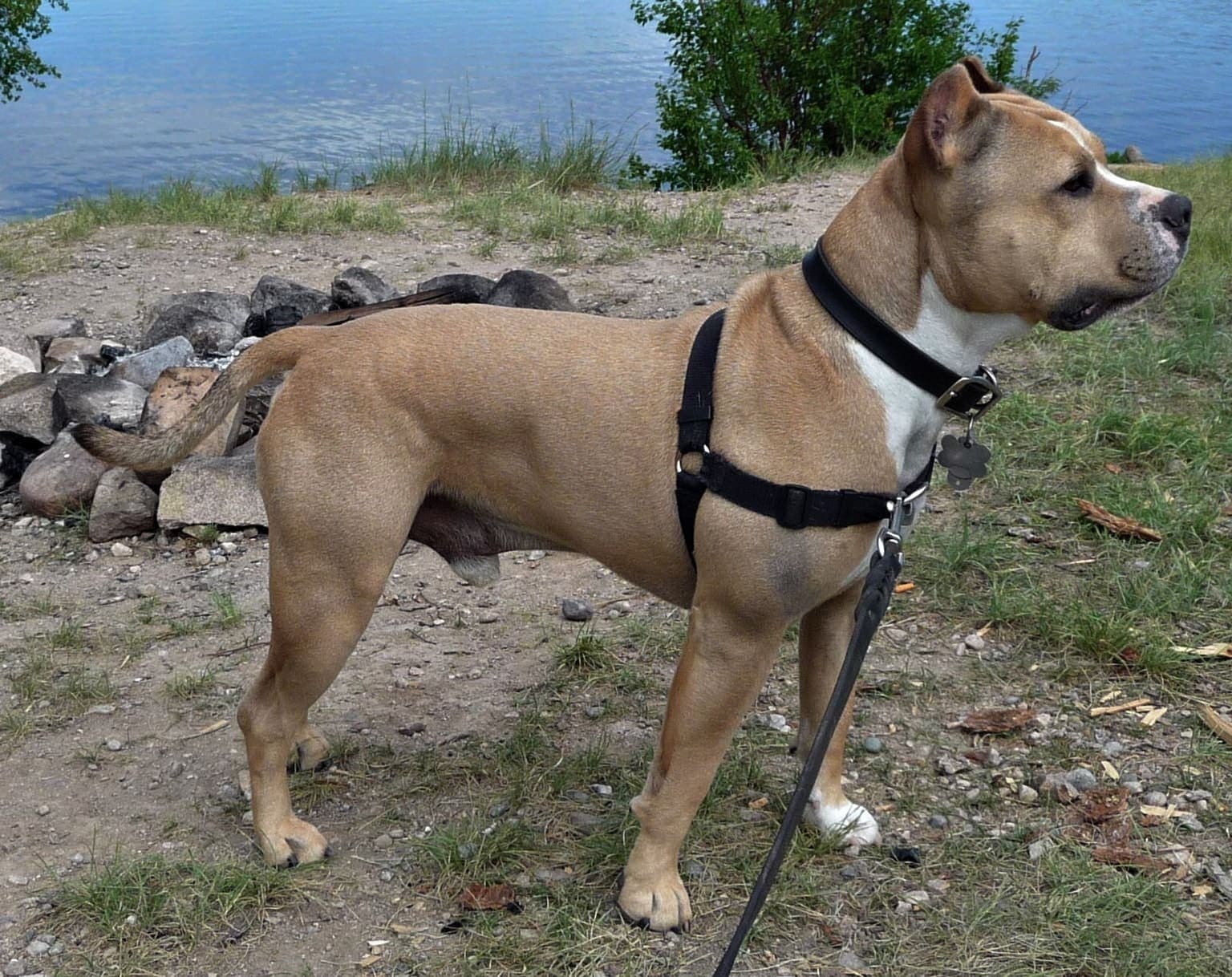
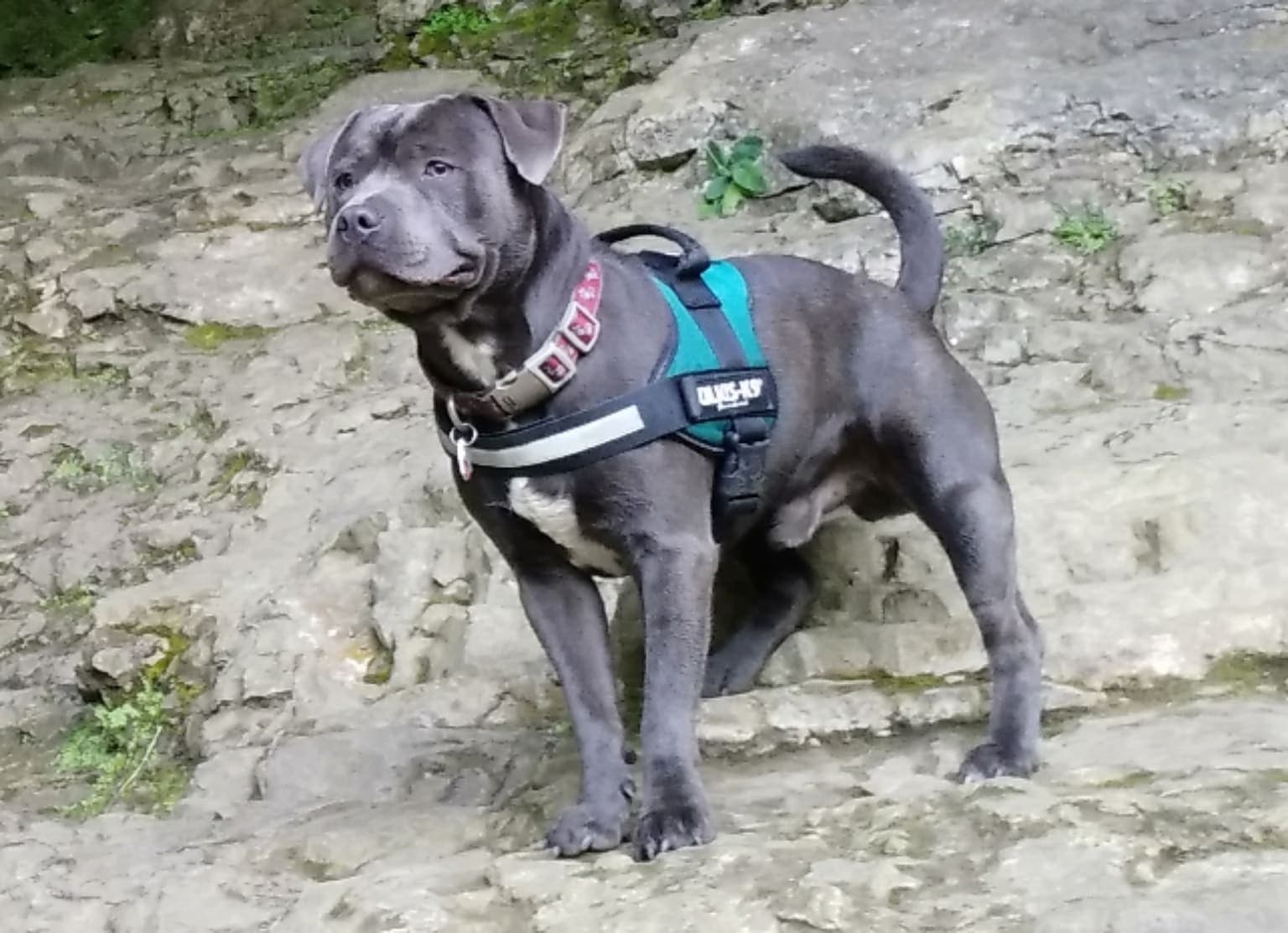
Quick facts
| Fact | American Staffordshire Terrier | Staffordshire Bull Terrier |
|---|---|---|
| Group | Terrier | Terrier |
| Size | medium | medium |
| Height | 17-19 in | 14-16 in |
| Weight | 40-70 lbs | 24-38 lbs |
| Lifespan | 12-16 years | 12-14 years |
| Temperament | Confident, Loyal, Friendly, Courageous | Affectionate, Brave, Loyal, Playful |
How to tell them apart
Read the rows top to bottom. The first two or three traits usually settle it; the rest confirm.
| Trait | American Staffordshire Terrier | Staffordshire Bull Terrier |
|---|---|---|
| Head and muzzle | Medium-length head, broad skull, distinct stop and a muzzle of medium length that is rounded on top, so the head looks balanced with the body. | Short, deep head with a broad skull, very pronounced cheek muscles, distinct stop and a short foreface, so the head looks large and wide for the frame. |
| Ears | Set high and either cropped or natural; natural ears are rose or half-prick and are preferred in the ring. | Always natural, rose or half-pricked and not large; fully erect or fully dropped ears are serious faults in the standard. |
| Eyes and expression | Dark, round eyes set low in the skull and far apart, with a confident, keenly alive expression. | Dark, round, medium-sized eyes set to look straight ahead, with a bold and cheerful expression. |
| Body proportions and topline | Fairly short back sloping slightly from withers to rump, deep chest and well-sprung ribs, with more leg under the body than a Staffy. | Close-coupled with a level topline, wide front, deep brisket and legs set fairly wide apart, so the whole dog looks low and stocky. |
| Coat | Short, close, stiff to the touch and glossy. | Smooth, short and close, lying flat against the skin. |
| Colour and markings | Any colour, solid, parti or patched; all white or mostly white, black and tan, and liver are not encouraged. | Red, fawn, white, black or blue, any of these with white, or any shade of brindle with or without white; black and tan and liver are disqualified. |
| Size | About 17 to 19 inches at the shoulder and 40 to 70 pounds, with males at the top of both ranges. | About 14 to 16 inches at the shoulder and 24 to 38 pounds, roughly half the weight of a large AmStaff. |
| Tail and gait | Short for the size of the dog, low set, tapering to a fine point, never curled or carried over the back; the gait is springy without roll or pace. | Medium length, low set, tapering, carried low like an old-fashioned pump handle; the gait is free, powerful and agile with economy of effort. |
What the photo detector sees
For this pair the photo detector keys on head mass relative to the body, muzzle length, ear carriage, and how much leg shows under the chest. A wide-cheeked head that looks large for a short, low body pushes the result toward Staffordshire Bull Terrier. Longer legs, a longer muzzle and a taller outline push toward American Staffordshire Terrier, and cropped ears are a strong AmStaff signal because they never appear on a show Staffy. Colour is little help here, since both breeds come in brindle, fawn, red, black and white in similar patterns.
The tool hesitates when there is nothing in the frame to give scale, when the face fills the whole photo, and with puppies, whose proportions have not settled. It also hesitates with the many dogs that fall between the two standards: American Pit Bull Terriers, bully-type mixes and shelter dogs described as pit bull mixes. In those cases you will often see both breeds near the top of the list. The detector returns confidence-ranked visual matches and cannot determine ancestry, so a result is a description of what the dog looks like, not a pedigree.
Living with them
Both breeds are people-oriented, playful and physically strong, and both do best with early socialisation, reward-based training and a structured outlet like obedience, tug with rules or scent games. The practical differences come down to size and energy. An AmStaff is a medium-large athlete that needs daily vigorous exercise and confident leash handling, since a 60-pound dog that pulls is hard work. A Staffy has high energy for its size but fits more easily into a small home and is easier to manage physically, though it is just as strong-willed and just as likely to have a strong prey drive around cats and wildlife.
Grooming is minimal for either, with a quick weekly brush and attention to skin, since allergies and sensitivities show up in both breeds. Neither is flat-faced enough to struggle badly in warm weather, but a Staffy's shorter foreface means a little more care in heat. Lifespan is similar, at 12 to 16 years for an AmStaff and 12 to 14 for a Staffy. Both are enthusiastic greeters, so teach calm greetings early to prevent jumping.
Not sure which one you have?
Upload a clear photo and the detector returns a ranked shortlist, so you can check the top matches against the tells above instead of guessing from one label.
Upload a photo and get a ranked shortlistFAQ
Can a photo tell an American Staffordshire Terrier from a Staffordshire Bull Terrier?
Often, provided the photo shows the whole dog and something that gives scale, such as a person, a step or a door frame. The detector reads head-to-body proportion, leg length, muzzle length and ear shape and returns confidence-ranked matches. Head-only crops and dogs of intermediate size are where it is most likely to list both.
Is an AmStaff or a Staffy a pit bull?
Pit bull is a label for a type of dog, not a single registered breed. It is commonly applied to the American Pit Bull Terrier, the American Staffordshire Terrier, the Staffordshire Bull Terrier and mixes that resemble them. The AmStaff and the American Pit Bull Terrier share close ancestry, while the Staffy is a smaller relative. Breed-specific rules that use the label vary by country, state and city, so check the definition that applies where you live.
Which is bigger, the American Staffordshire Terrier or the Staffordshire Bull Terrier?
The AmStaff, by a wide margin. It stands 17 to 19 inches and weighs 40 to 70 pounds, while a Staffy stands 14 to 16 inches and weighs 24 to 38 pounds. Put simply, a Staffy is about knee height and an AmStaff reaches mid-thigh on an average adult.
What does an AmStaff and Staffy mix look like?
Usually a dog of in-between height, with a broad head, short coat and any of the shared colours. Because the parent breeds are so alike, a mix tends to look like a slightly tall Staffy or a slightly short AmStaff. Photos of these dogs typically return both breeds near the top, and the detector cannot confirm the cross from an image.
Are Staffordshire Bull Terriers good with children?
Well-socialised Staffies are known for being affectionate, patient and eager to be part of family life, and the same is true of well-raised AmStaffs. Both are strong, enthusiastic dogs, so supervision with small children and early training for calm greetings matter as they do with any breed. Temperament always comes down to the individual dog, its upbringing and its training.
Full profiles
Browse every pair in the breed comparison index.