Bernese Mountain Dog vs Greater Swiss Mountain Dog
The Bernese Mountain Dog and the Greater Swiss Mountain Dog are large, heavy-boned Swiss draft and droving breeds in the same tricolour: a black coat with rich rust over each eye, on the cheeks, chest and legs, and a white blaze, muzzle, chest, feet and tail tip. Their standards describe the ears in almost the same words: medium-sized, triangular, set high and hanging close to the head. The AKC calls the two closely related, and a head-on photo of the face can fit either breed.
Coat length is the fastest tell. A Bernese has a thick, moderately long coat that is straight or slightly wavy, with a bushy tail. A Greater Swiss has a dense topcoat only about 1.25 to 2 in long over an undercoat, so the outline of the body, legs and tail is clean and the tail looks thick and smooth, not bushy. The AKC notes that the Bernese is the only one of the four Swiss mountain dog breeds with a long, silky coat.
When the coat is wet, or the photo is too distant to judge it, use size and the head. The Greater Swiss is the heavier dog, 85 to 140 lbs against 70 to 115 lbs, and stands slightly taller. Its skull has only a slight stop and its muzzle is large and blunt, while the Bernese has a well-defined stop. White on the neck is another clue: patches or a collar of white are acceptable on a Greater Swiss, but a white collar is a serious fault in the Bernese standard.
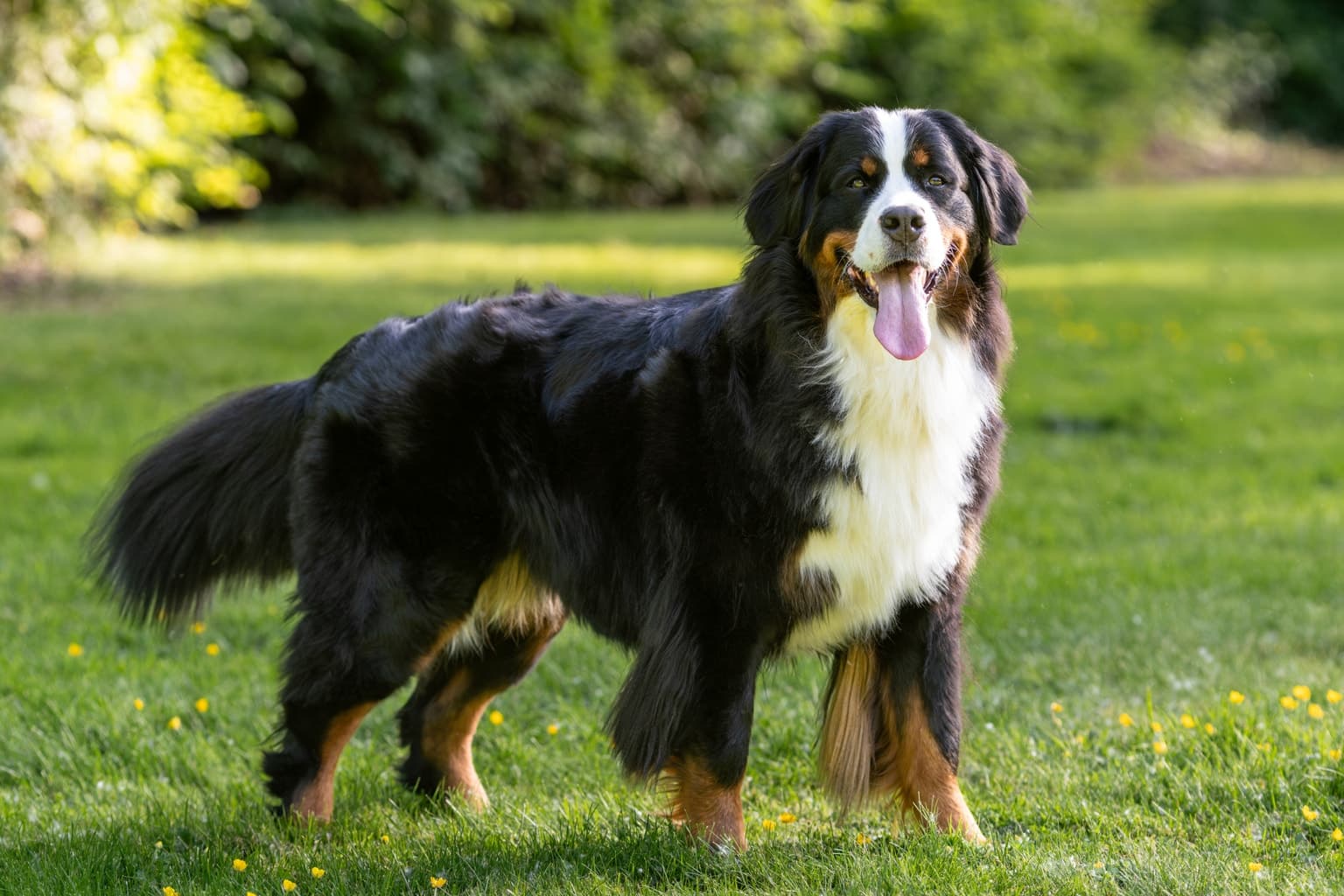
Photo by FriendlyToaster · CC BY 4.0
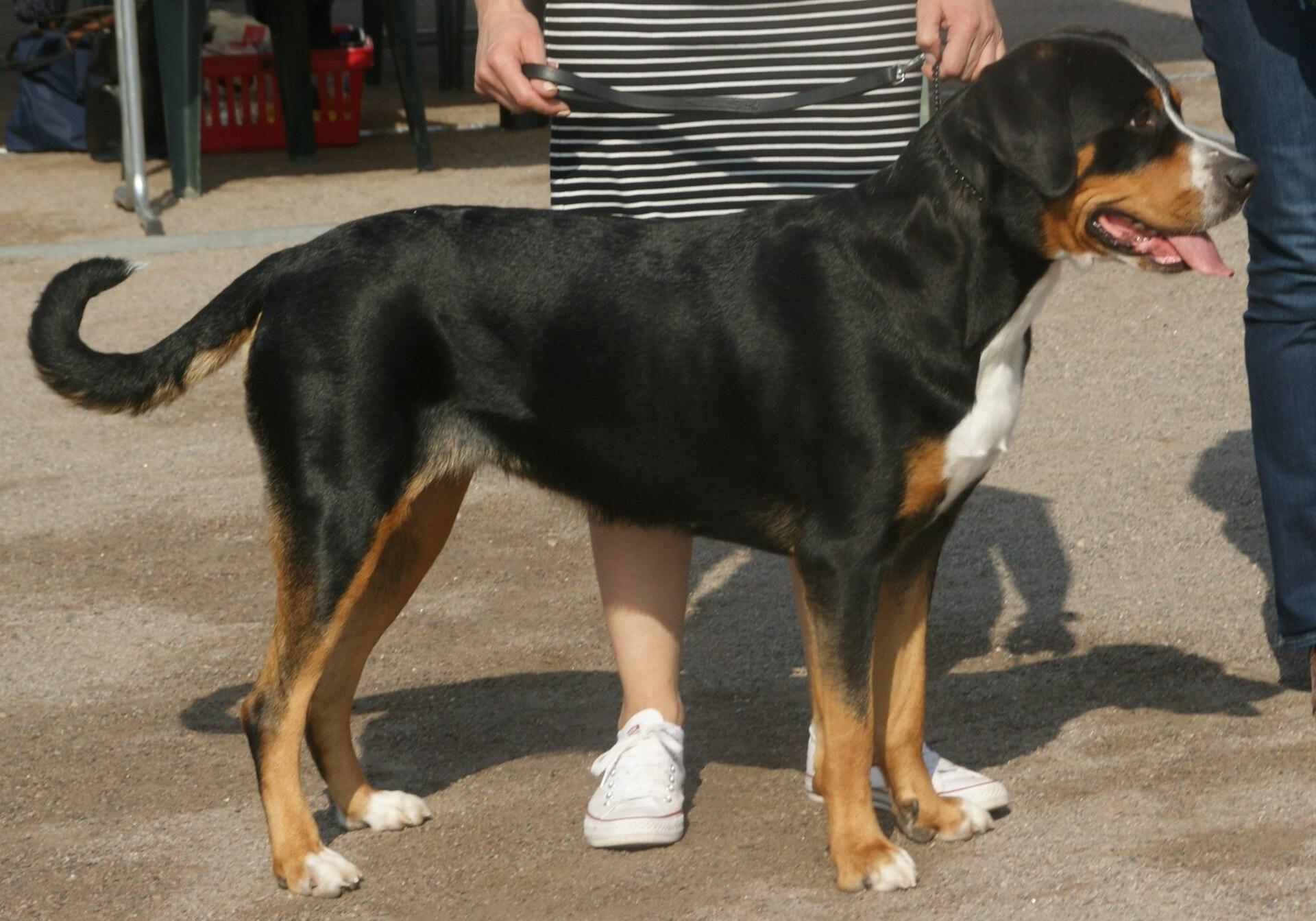
Photo by Canarian · CC BY-SA 4.0
Quick facts
| Fact | Bernese Mountain Dog | Greater Swiss Mountain Dog |
|---|---|---|
| Group | Working | Working |
| Size | giant | giant |
| Height | 23-27.5 in | 23.5-28.5 in |
| Weight | 70-115 lbs | 85-140 lbs |
| Lifespan | 7-10 years | 8-11 years |
| Temperament | Gentle, Affectionate, Calm, Good-natured | Steady, Loyal, Confident, Good-natured |
How to tell them apart
Read the rows top to bottom. The first two or three traits usually settle it; the rest confirm.
| Trait | Bernese Mountain Dog | Greater Swiss Mountain Dog |
|---|---|---|
| Coat | Thick and moderately long, straight or slightly wavy, with a bright natural sheen. Shown in a natural, untrimmed coat. | Dense topcoat about 1.25 to 2 in long over an undercoat that may show at the neck. The undercoat ranges from dark grey to light grey or tawny. |
| Size | 23 to 27.5 in and 70 to 115 lbs. The standard gives 25 to 27.5 in for males and 23 to 26 in for females. | 23.5 to 28.5 in and 85 to 140 lbs. The standard gives 25.5 to 28.5 in for males and 23.5 to 27 in for females. |
| Tail | Bushy, reaching the hock or below and carried low at rest. It may swirl upward when the dog is alert but never curls or goes over the back. | Thick from root to tip, tapering slightly, reaching the hocks and carried down at rest. It may rise and curve slightly upward in movement but should not curl over the back. |
| Head and muzzle | Flat, broad skull with a slight furrow and a well-defined but not exaggerated stop; strong, straight muzzle. | Flat, broad skull with a slight stop; large, blunt, straight muzzle, most often with a slight rise before the end. The backskull is about twice the width of the muzzle. |
| Eyes | Dark brown and slightly oval, with close-fitting lids. Blue eye colour is a disqualification. | Almond-shaped and brown, with dark brown preferred, and black eye rims. A blue eye or eyes is a disqualification. |
| White markings | White blaze and muzzle band, a chest marking that typically forms an inverted cross, and a white tail tip. White on the feet should not rise above the pasterns. White legs or a white collar are serious faults. | White blaze of varying width, white running unbroken from throat to chest, white feet and tail tip. The blaze may run over the skull and meet a white patch or collar on the neck, which is acceptable. |
| AKC group and origin | Working Group, recognised in 1937. A farm dog of the canton of Bern in Switzerland, used for droving cattle, guarding farmyards and pulling carts. | Working Group, recognised in 1995. Described by the AKC as the oldest and largest of the Swiss mountain dogs, used as a farm and pasture dog that hauled loads to market in dogcarts. |
What the photo detector sees
A side-on photo of the whole dog shows the coat and the tail, which is enough for most adult dogs. A face-only photo is much harder, because the head markings follow the same pattern in both breeds. Wet coats lie flat and hide the Bernese's length of hair, and with no person or object for scale the size difference is lost. In the saved benchmark runs for this project, none of the answers for Bernese Mountain Dog reference photos named the Greater Swiss Mountain Dog first, but it was the runner-up in all fifteen of them.
If the coat cannot be judged, check the tail and the neck. A bushy tail indicates a Bernese; a smooth tail that is thick to the tip indicates a Greater Swiss, and so does a white collar. The AKC describes four Swiss mountain dog breeds that share this colouring, and the Greater Swiss is the largest of them, so a short-coated tricolour dog that is clearly smaller may be one of the other two. The detector reports visual similarity, not ancestry.
Living with them
Both are steady working breeds. The Bernese standard describes a self-confident, alert and good-natured dog that may remain aloof with strangers, and the AKC describes Berners as eager to please, usually easy to train and easily hurt by harsh correction. The Greater Swiss standard asks for a bold, faithful, willing worker that is alert and vigilant. The AKC describes the breed as very food motivated with a stubborn streak, and it advises against harness-type training devices because a draft breed tends to pull harder in a harness.
Both need moderate daily exercise. The AKC suggests at least half an hour a day for a Bernese, which enjoys long walks and hikes, and says the Greater Swiss suits a hiker better than a runner. Grooming differs with the coat: the AKC recommends weekly brushing for a Bernese, daily in the twice-yearly shedding season, and calls the Greater Swiss basically a wash-and-wear breed that needs an occasional bath and brushing, plus a thorough brush-out when it sheds its undercoat. The AKC advises owners of both breeds to learn the signs of bloat. The profiles list a lifespan of 7 to 10 years for the Bernese Mountain Dog and 8 to 11 years for the Greater Swiss Mountain Dog.
Not sure which one you have?
Upload a clear photo and the detector returns a ranked shortlist, so you can check the top matches against the tells above instead of guessing from one label.
Upload a photo and get a ranked shortlistFAQ
What is the difference between a Bernese Mountain Dog and a Greater Swiss Mountain Dog?
The coat. A Bernese Mountain Dog has a thick, moderately long coat and a bushy tail. A Greater Swiss Mountain Dog has a dense coat only about 1.25 to 2 in long, and it is the heavier dog at 85 to 140 lbs against 70 to 115 lbs. Both are black, rust and white.
Are Bernese Mountain Dogs and Greater Swiss Mountain Dogs related?
Yes. The AKC describes the Greater Swiss as closely related to the Bernese Mountain Dog, and both belong to the group of four Swiss mountain dog breeds, the Sennenhund, that share the black, rust and white colouring. The AKC registers them as separate breeds, the Bernese since 1937 and the Greater Swiss since 1995.
Which is bigger, a Bernese Mountain Dog or a Greater Swiss Mountain Dog?
The Greater Swiss Mountain Dog. It weighs 85 to 140 lbs and stands 23.5 to 28.5 in, while the Bernese Mountain Dog weighs 70 to 115 lbs and stands 23 to 27.5 in. The height ranges overlap, so weight and substance show the difference more than height does.
Is a Greater Swiss Mountain Dog a short-haired Bernese Mountain Dog?
No. They are separate AKC breeds with separate standards. The Bernese standard describes a moderately long coat and has no short-coated variety, and the Greater Swiss standard describes a topcoat of about 1.25 to 2 in. The two also differ in size, in the stop and muzzle, and in how much white is accepted on the neck.
Which needs more grooming?
The Bernese Mountain Dog. The AKC recommends brushing it weekly, and daily during shedding season, which comes twice a year. It describes the Greater Swiss as a wash-and-wear breed that needs an occasional bath and brushing, with a thorough brush-out when the undercoat is shed, usually twice a year.
Full profiles
More look-alikes
Other comparisons that include one of these breeds or come from the same look-alike group:
Browse every pair in the breed comparison index.