Boston Terrier vs French Bulldog
Boston Terriers and French Bulldogs are the two small flat-faced companions most often mistaken for each other. Both weigh under 30 pounds, both carry erect ears, both have a short square muzzle with large round eyes, and both come in brindle with white. Seen from the front on a sofa, a dark brindle Frenchie with a white chest and a brindle Boston can look like the same dog. They also share ancestry: the Boston Terrier was developed in the United States from bulldog and terrier crosses, while the French Bulldog descends from small English bulldogs refined in France, so the family resemblance is real.
The fastest tell is the ears. A Boston Terrier has small, thin ears that sit at the corners of the skull and come to a fairly narrow tip. A French Bulldog has the famous bat ear: wide at the base, long, and rounded at the top, set high and carried straight up. If the ears look like rounded paddles, you are almost certainly looking at a Frenchie.
The second tell is the outline. A Boston stands square and upright on comparatively long legs with a level back, which gives it the neat tuxedo silhouette people describe. A Frenchie is lower, heavier in front, and its back rises slightly toward the loin, so the whole dog reads as a compact wedge rather than a square.
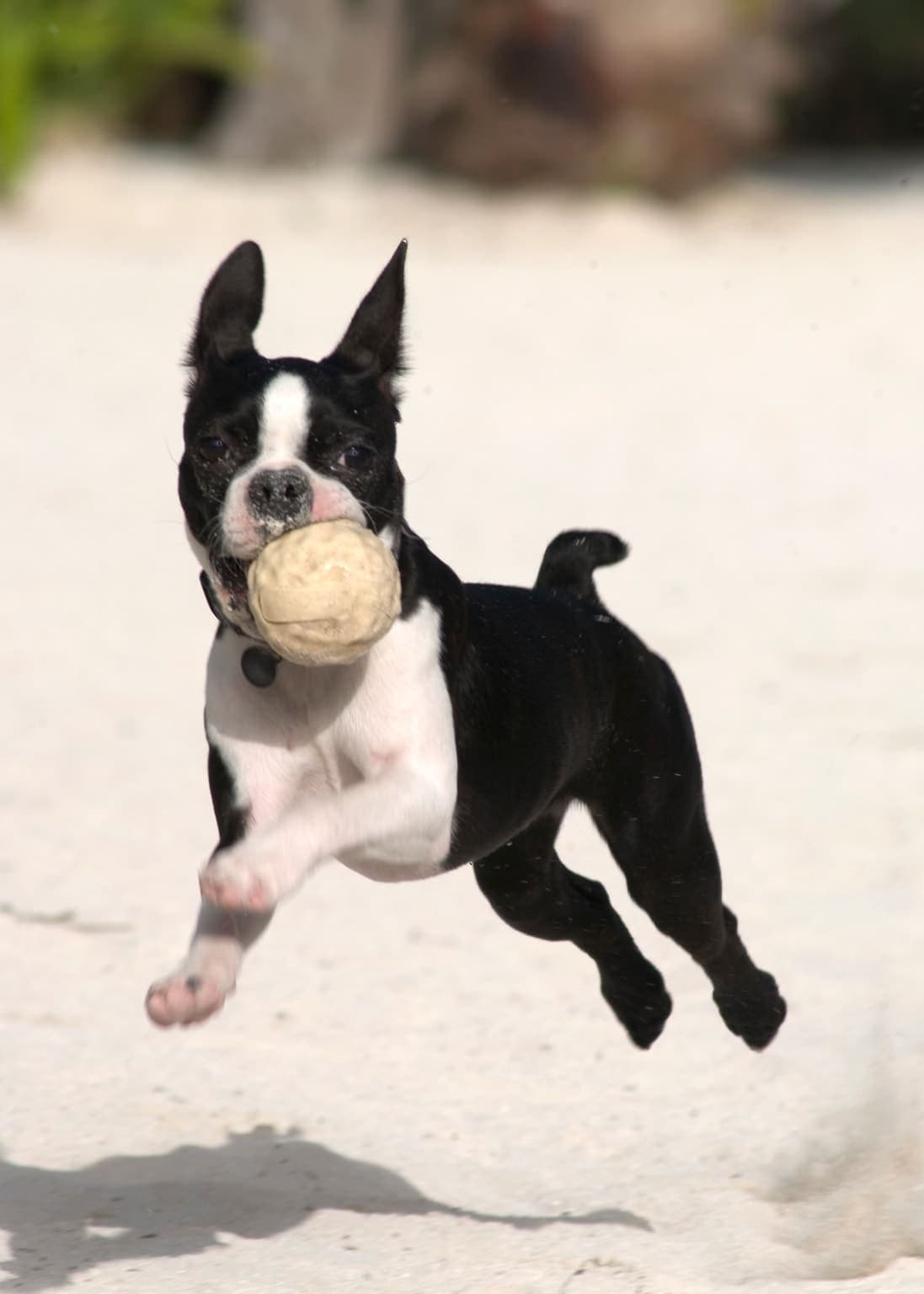
Photo by Ed Siasoco · CC BY 2.0
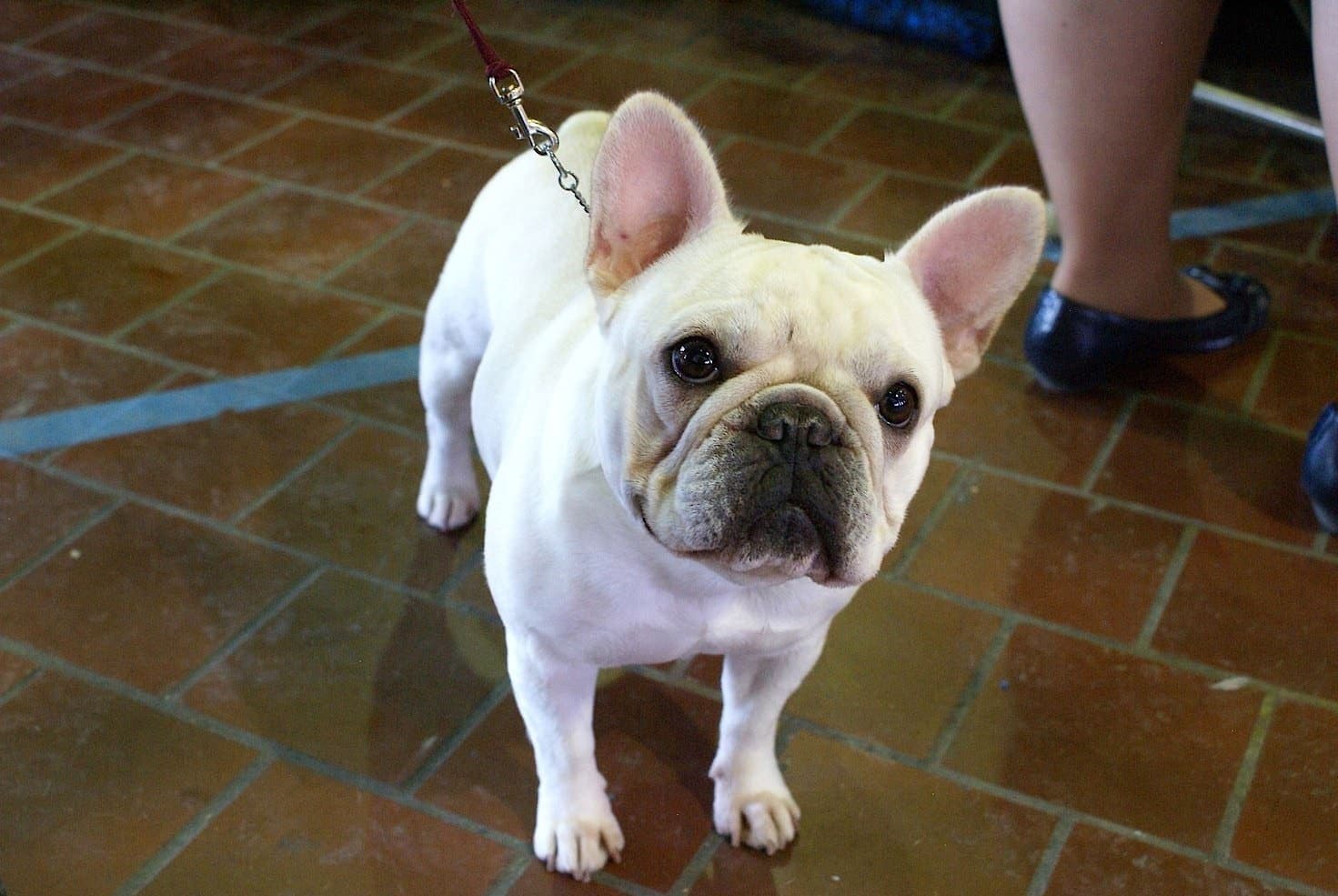
Photo by Pets Adviser from Brooklyn, USA · CC BY 2.0
Quick facts
| Fact | Boston Terrier | French Bulldog |
|---|---|---|
| Group | Non-Sporting | Non-Sporting |
| Size | small | small |
| Height | 15-17 in | 11-13 in |
| Weight | 12-25 lbs | 16-28 lbs |
| Lifespan | 11-13 years | 10-12 years |
| Temperament | Friendly, Lively, Smart, People-oriented | Affectionate, Playful, Adaptable, People-oriented |
How to tell them apart
Read the rows top to bottom. The first two or three traits usually settle it; the rest confirm.
| Trait | Boston Terrier | French Bulldog |
|---|---|---|
| Head and muzzle | Square, flat-topped skull with a short, wide muzzle and a smooth face free of wrinkles, so the expression looks clean and alert. | Large square head with a slightly domed forehead, a broad deep muzzle, and heavy wrinkles above the nose and along the flews. |
| Ears | Small and thin, set at the corners of the skull, held erect and tapering toward a narrower tip. | Bat ears: broad at the base, elongated, rounded at the top, set high on the head and carried straight up. |
| Eyes and expression | Large, round, dark eyes set wide apart and square to the front, giving a bright, kind, slightly surprised look. | Dark round eyes set wide and low on the skull, with the wrinkle above the nose adding a more serious, questioning expression. |
| Body proportions and topline | Short, square body with a level topline and longer legs, so height at the shoulder roughly matches body length. | Short, heavy-fronted body with a slight dip behind the shoulders and a gentle rise to the loin, so the rear sits higher than the withers. |
| Coat | Short, smooth, fine coat with a bright sheen that lies flat and shows the tuxedo pattern crisply. | Short, smooth, fine coat that is soft to the touch and loose enough at the head and shoulders to form wrinkles. |
| Colour and markings | Brindle, seal, or black, always with white markings: a white muzzle band, a blaze between the eyes, and a white forechest are the classic pattern. | Fawn, cream, white, brindle, or pied, often with a black mask; solid fawn with no white at all is common and never occurs in a Boston. |
| Size | About 15 to 17 inches at the shoulder and 12 to 25 pounds, split into three weight classes in the show ring. | About 11 to 13 inches at the shoulder and 16 to 28 pounds, so shorter but denser than a Boston of the same weight. |
| Tail and gait | Short, low-set tail that may be straight or screw, and a sure-footed, straight, springy gait on longer legs. | Short, thick-rooted tail that is straight or screwed and hangs low, and a free, rolling gait with the front doing the heavy work. |
What the photo detector sees
For this pair the photo detector relies mostly on ear silhouette, the shape of the topline, and colour pattern. Bat ears against a fawn or cream coat push a result strongly toward French Bulldog. A white blaze and muzzle band on a black or seal body with narrow erect ears push toward Boston Terrier. Overall proportion helps too: the longer legs and squarer frame of a Boston are visible even in casual photos when the whole dog is in frame.
The tool hesitates most on brindle-and-white dogs photographed head-on with a tight crop, because the colour pattern is shared and the topline is hidden. Puppies are harder still, since both breeds are born with folded ears that stand at different ages, and a young Frenchie with ears half up can look a lot like a Boston. Frenchton mixes and other small brachycephalic crosses tend to produce a split result. The detector returns confidence-ranked visual matches, not a statement of ancestry, so treat a close call as a prompt to look at the ears and back yourself.
Living with them
Temperament separates them more than looks do. Boston Terriers are lively and quick, happy with short bursts of play, trick training, and brain games, and they tend to be sociable greeters who enjoy a bit of running. French Bulldogs are calmer and more sedentary, content with moderate walks and a long stretch on the couch, and very focused on their people. Both are affectionate companion dogs that do well in apartments, but a Boston will ask for more activity and a Frenchie will ask for more company.
Both breeds are flat-faced and sensitive to heat, so summer exercise needs cool-down breaks and a harness rather than a collar. The Frenchie generally has the shorter airway and heavier body, which makes overexertion and swimming bigger concerns, and its facial folds need regular gentle cleaning. Bostons have prominent eyes that need protecting from scratches and dust. Grooming is light for both, with weekly brushing and modest shedding. Typical lifespan is 11 to 13 years for a Boston and 10 to 12 for a Frenchie.
Not sure which one you have?
Upload a clear photo and the detector returns a ranked shortlist, so you can check the top matches against the tells above instead of guessing from one label.
Upload a photo and get a ranked shortlistFAQ
Can a photo tell a Boston Terrier from a French Bulldog?
Usually yes, when the photo shows the ears and the full body from the side or a three-quarter angle. The detector keys on bat ears, the rise toward the loin, and coat colour, and returns its closest visual matches with confidence scores. Tight face crops and brindle dogs with white chests are where it is most likely to list both breeds.
What is the single fastest way to tell them apart?
Look at the ears. Rounded, paddle-shaped bat ears mean French Bulldog; small, thinner ears with a narrower tip at the corners of the skull mean Boston Terrier. If the ears are ambiguous, look at the back: a Boston's is level and a Frenchie's rises slightly toward the rear.
Which is bigger, a Boston Terrier or a French Bulldog?
A Boston Terrier is taller at 15 to 17 inches, while a French Bulldog is 11 to 13 inches. Weight overlaps, with Bostons at 12 to 25 pounds and Frenchies at 16 to 28 pounds, so a Frenchie is the shorter, heavier, more compact dog and a Boston is the leggier one.
What does a Boston Terrier and French Bulldog mix look like?
A Frenchton usually lands in between, with ears wider than a Boston's but not fully bat-shaped, a moderate wrinkle, and any of the colours from either parent. Photos of mixes typically produce a split result with both breeds ranked near the top. The detector reports visual similarity, so it cannot confirm the cross itself.
Are Boston Terriers or French Bulldogs better in hot weather?
Neither copes well with heat, but a Boston tends to have a slightly longer muzzle and a lighter frame, so it recovers a little faster. Both should skip midday summer walks, have shade and water, and be watched closely for noisy breathing. If you live somewhere hot, plan on indoor cooling for either breed.
Full profiles
Browse every pair in the breed comparison index.