Miniature vs Standard vs Giant Schnauzer
The three Schnauzers are separate breeds, not size varieties of one, but they share a template: a square, sturdy dog with a rectangular head, a hard wiry coat in salt and pepper or black, bushy eyebrows and a beard. Side by side, nobody confuses them. Photographed alone, the outline is almost identical and the only honest difference is scale.
So the fastest tell is anything in the frame that gives you size. A Miniature stands 12 to 14 inches at the shoulder, a Standard 17.5 to 19.5 and a Giant 23.5 to 27.5, which makes a Giant roughly twice the height and four times the weight of a Miniature. A hand, a doorway, a kerb or another dog in the picture usually settles it.
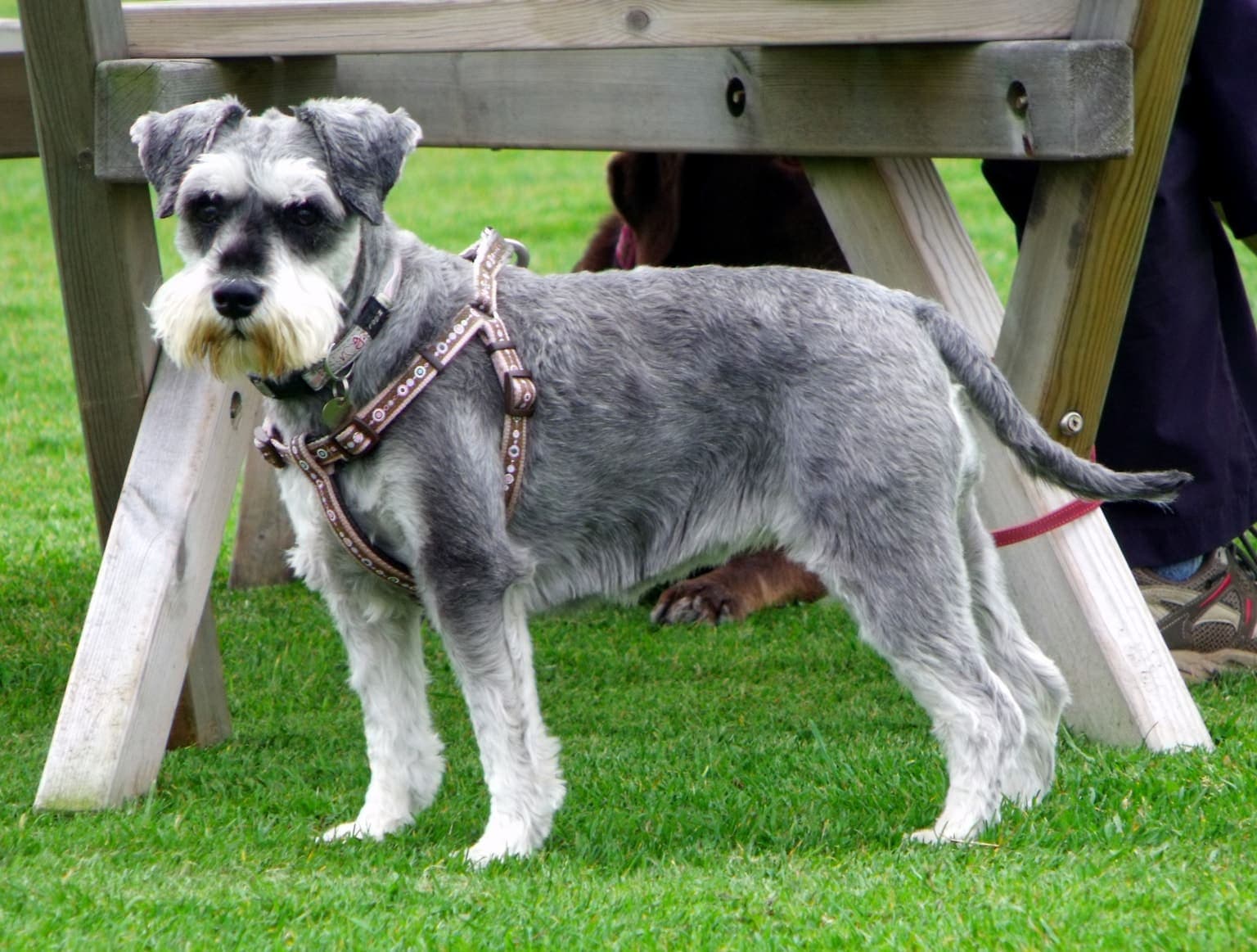
Photo by grassrootsgroundswell · CC BY 2.0
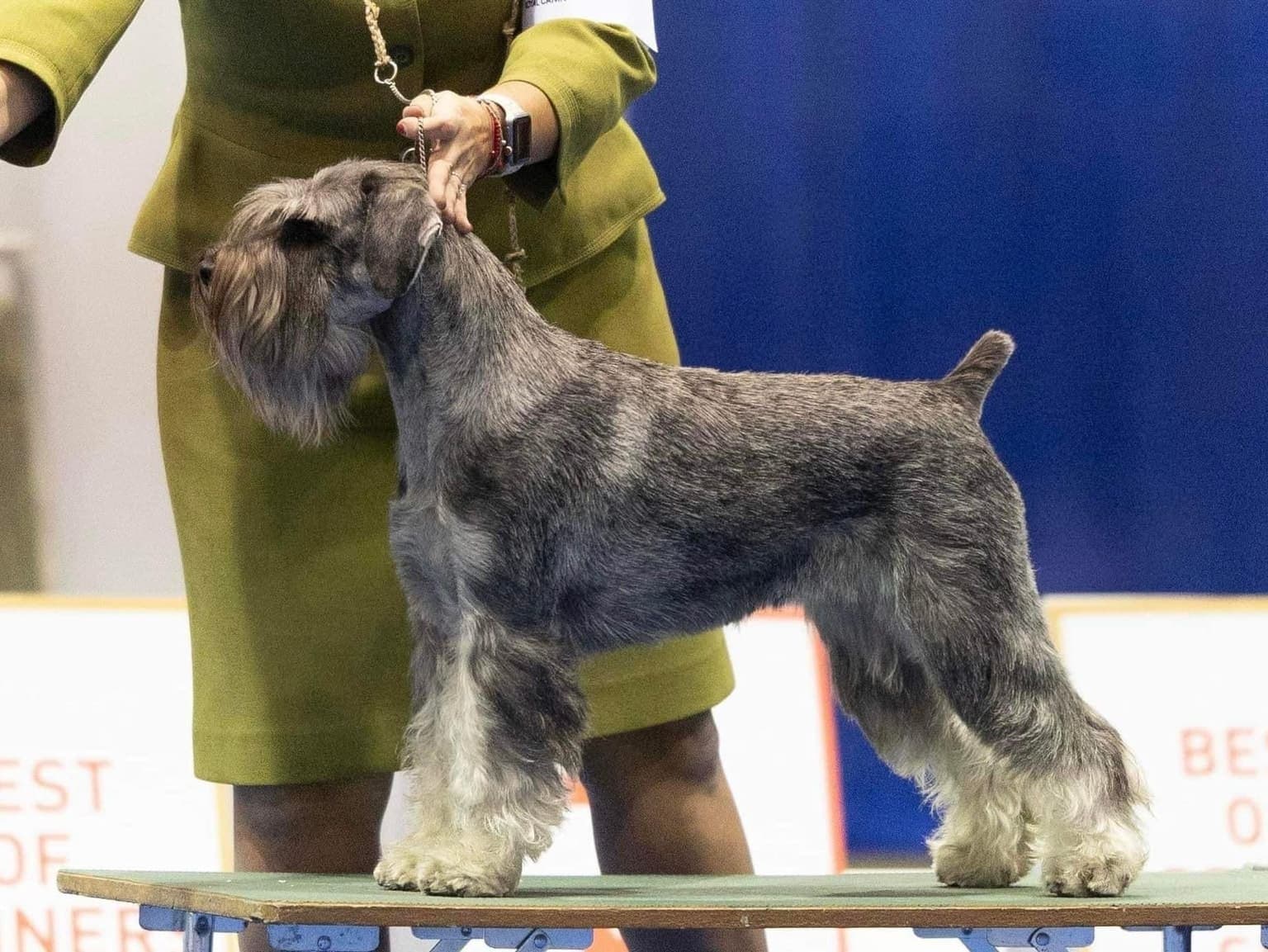
Photo by Standardschnauzer1 · CC0
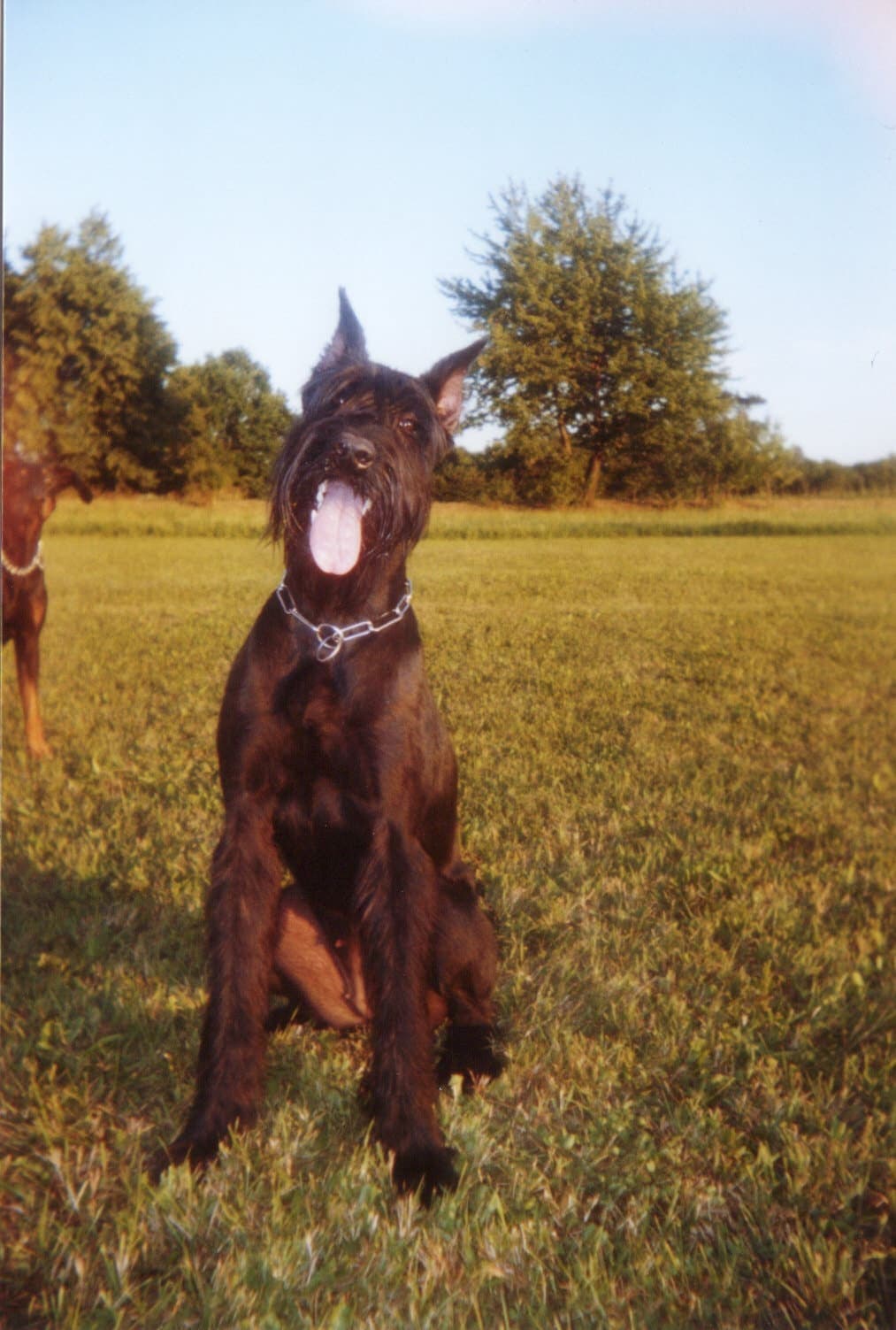
Photo by Dances · CC BY-SA 3.0
Quick facts
| Fact | Miniature Schnauzer | Standard Schnauzer | Giant Schnauzer |
|---|---|---|---|
| Group | Terrier | Working | Working |
| Size | small | large | large |
| Height | 12-14 in | 17.5-19.5 in | 23.5-27.5 in |
| Weight | 11-20 lbs | 30-50 lbs | 55-85 lbs |
| Lifespan | 12-15 years | 13-16 years | 12-15 years |
| Temperament | Alert, Friendly, Spirited, Trainable | Intelligent, Alert, Spirited, Protective | Strong, Driven, Intelligent, Protective |
How to tell them apart
Read the rows top to bottom. The first two or three traits usually settle it; the rest confirm.
| Trait | Miniature Schnauzer | Standard Schnauzer | Giant Schnauzer |
|---|---|---|---|
| Head and expression | Strong rectangular head that looks short and compact against the body, a blunt muzzle under a full beard, and small dark oval eyes for a bright, busy terrier expression. | Long rectangular head about half the length of the back, narrowing from ears to nose, with deep-set dark oval eyes and a keen but calmer look. | The heaviest head of the three: long and powerful, with a broad skull, strong cheeks under the beard, a muzzle as long as the skull and eyes shaded by heavy brows. |
| Ears | Natural ears are small and V-shaped, folding close to the skull; cropped ears are small, pointed and set high. | Natural ears are medium, V-shaped and carried forward; cropped ears are tall and evenly upright, the same shape as a Giant's on a smaller head. | Natural ears are V-shaped and drop forward close to the cheeks; cropped ears are the tallest in the group and still common on working Giants. |
| Body and bone | Square outline with a short back, compact and sturdy but plainly fine-boned next to the others. | Square outline with a topline that slopes very slightly from withers to tail, medium bone and clean, athletic lines. | Square and imposing with heavy bone, a deep broad chest and a muscular hindquarter: Rottweiler substance in a wire coat. |
| Coat | Hard wiry outer coat over a close undercoat; pet Minis are usually clipped, which softens the texture and lightens the colour to a pale, fluffy grey. | Tight, hard, wiry outer coat with a soft undercoat; a hand-stripped Standard shows the banded salt and pepper pattern. | Dense, harsh, wiry coat, the coarsest of the three, with a thicker beard and eyebrows; a black Giant can look almost bristly in sunlight. |
| Colour | Salt and pepper, black and silver, or solid black; black and silver occurs only in the Miniature. | Salt and pepper or solid black; black and silver is not a Standard colour. | Solid black is by far the most common; salt and pepper is correct but uncommon, so a salt and pepper dog is more likely a Mini or Standard. |
| Size | 12 to 14 inches and 11 to 20 pounds, a small dog you can lift with one arm. | 17.5 to 19.5 inches and 30 to 50 pounds, a medium dog whose back reaches roughly an adult's knee. | 23.5 to 27.5 inches and 55 to 85 pounds, a large dog whose head reaches an adult's hip. |
| Tail and gait | Tail set high and carried up, docked short in the United States or natural in a gentle curve; the gait is quick and busy with short strides. | Tail set high and carried erect, docked to moderate length or natural as a sabre; the trot is balanced with good reach and drive. | Tail set high, docked or natural and carried up in a sabre; the trot is powerful and ground-covering with a visibly longer stride. |
What the photo detector sees
The detector recognises Schnauzer type easily: the square outline, rectangular bearded head and eyebrow furnishings are a strong, consistent signal, so the top three matches for any Schnauzer are usually the three Schnauzers. Splitting them is a scale problem. The model infers size from coat grain, the proportion of eyes and nose to head, muzzle heaviness, leg thickness and any reference object. Solid black with cropped ears and a heavy head pulls toward Giant; a pale, softly clipped coat with a compact head pulls toward Miniature; black and silver is a strong Miniature signal.
It hesitates most on a lone, well-groomed salt and pepper adult with nothing for scale, because a well-stripped Miniature and a Standard are hard to separate on outline alone. Puppies are difficult, since a four-month Giant is the size of an adult Standard with a puppy's soft coat. Pet clips that remove the furnishings change both head shape and colour. Schnoodles and Schnauzer-terrier mixes keep the beard but lose the square body, and the result is typically split between a Schnauzer and a poodle or terrier. The ranking describes what the dog looks like, not who its parents were.
Living with them
These are three different dogs to live with. The Miniature Schnauzer is a bright, sociable small dog happy in an apartment with daily walks and games, though it is vocal and keeps a real prey drive for rodents. The Standard Schnauzer is a medium working dog with a strong opinion, more territorial than the Mini, needing an hour of exercise plus training or a job to stay pleasant. The Giant Schnauzer is a serious, driven guardian for experienced owners who want a training partner, with high exercise needs and a protective streak that needs early and ongoing socialisation.
Grooming is similar in kind and different in scale: brushing several times a week, a beard wipe after meals, and either hand-stripping to keep the hard coat or clipping every six to eight weeks. Shedding is low across the board. Lifespans run 12 to 15 years for the Mini, 13 to 16 for the Standard and 12 to 15 for the Giant. The Giant needs a securely fenced yard and a car it fits in; the Mini adapts to almost any home.
Not sure which one you have?
Upload a clear photo and the detector returns a ranked shortlist, so you can check the top matches against the tells above instead of guessing from one label.
Upload a photo and get a ranked shortlistFAQ
Can a photo tell a Miniature Schnauzer from a Standard Schnauzer?
Often, but this is the hardest pair in the group because the outlines match so closely. Black and silver settles it as a Miniature, and a soft, pale clipped coat leans that way too. For a salt and pepper adult, include something for scale, like a person's legs or a doorway.
Can a photo tell a Standard Schnauzer from a Giant Schnauzer?
Usually, yes. The Giant's heavier head, thicker bone and typically solid black coat give the model more to work with. Puppies and photos with no scale are the exceptions, since a young Giant looks like an adult Standard with a softer coat.
Are the three Schnauzers the same breed in different sizes?
No. The Standard Schnauzer is the original German farm dog. The Miniature was bred down from small Standards with help from breeds such as the Affenpinscher, and the Giant was bred up from Standards and larger cattle-driving dogs. The AKC even places the Miniature in the Terrier Group and the other two in Working.
What if my dog is a Schnauzer mix?
Schnoodles and Schnauzer-Yorkie crosses are common, and the beard usually survives even when the body shape does not. Expect the detector to rank a Schnauzer alongside a poodle or terrier with split confidence. That is a visual resemblance, not a parentage result; a DNA test confirms ancestry.
Do all Schnauzers have cropped ears and docked tails?
No. Cropping and docking are optional in the United States and banned in many other countries, so natural folded ears and full tails are common, and the detector handles both looks.
Full profiles
Browse every pair in the breed comparison index.