Rottweiler vs Doberman Pinscher
Rottweilers and Doberman Pinschers are both large German working breeds with a close-lying coat that is typically black with the same pattern of rust markings: a spot over each eye, on the muzzle, on the throat and chest, on the legs and feet and under the tail. Both are traditionally shown with a docked tail in the United States. From colour alone, a black-and-rust dog could be either.
Build is the fastest tell. A Rottweiler is broad, deep-chested and heavy-boned, slightly longer than tall, and weighs 80 to 135 lbs. A Doberman is square, lean and elegant, with a tucked-up belly and a proudly carried, arched neck, and weighs 60 to 100 lbs at a similar or greater height. Side by side, the Rottweiler looks like a weightlifter and the Doberman like a sprinter.
The head agrees with the body. The Rottweiler's head is broad between the ears with a well-developed stop and a broad muzzle. The Doberman's head is long and dry, a blunt wedge seen from the front or the side, with only a slight stop. Rottweiler ears are natural, triangular and hang forward. Doberman ears are often cropped to stand erect in the United States; left natural, they hang folded beside the cheek.
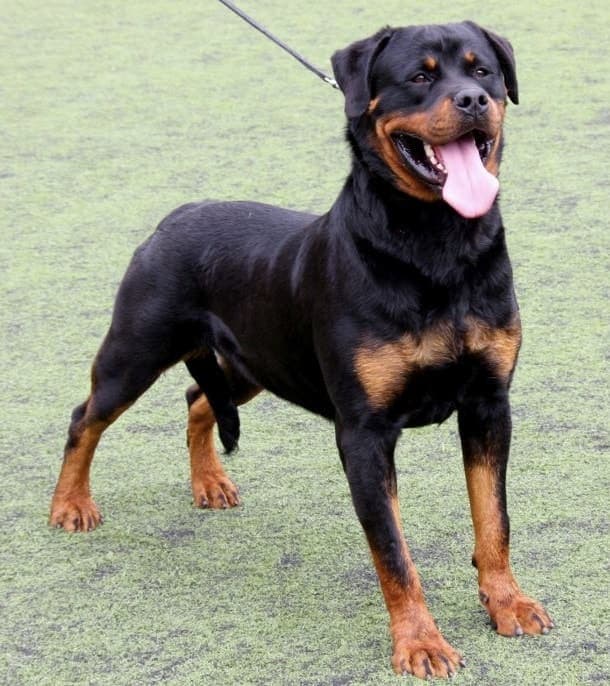
Photo by https://www.flickr.com/photos/azuaje/ · CC BY-SA 2.0
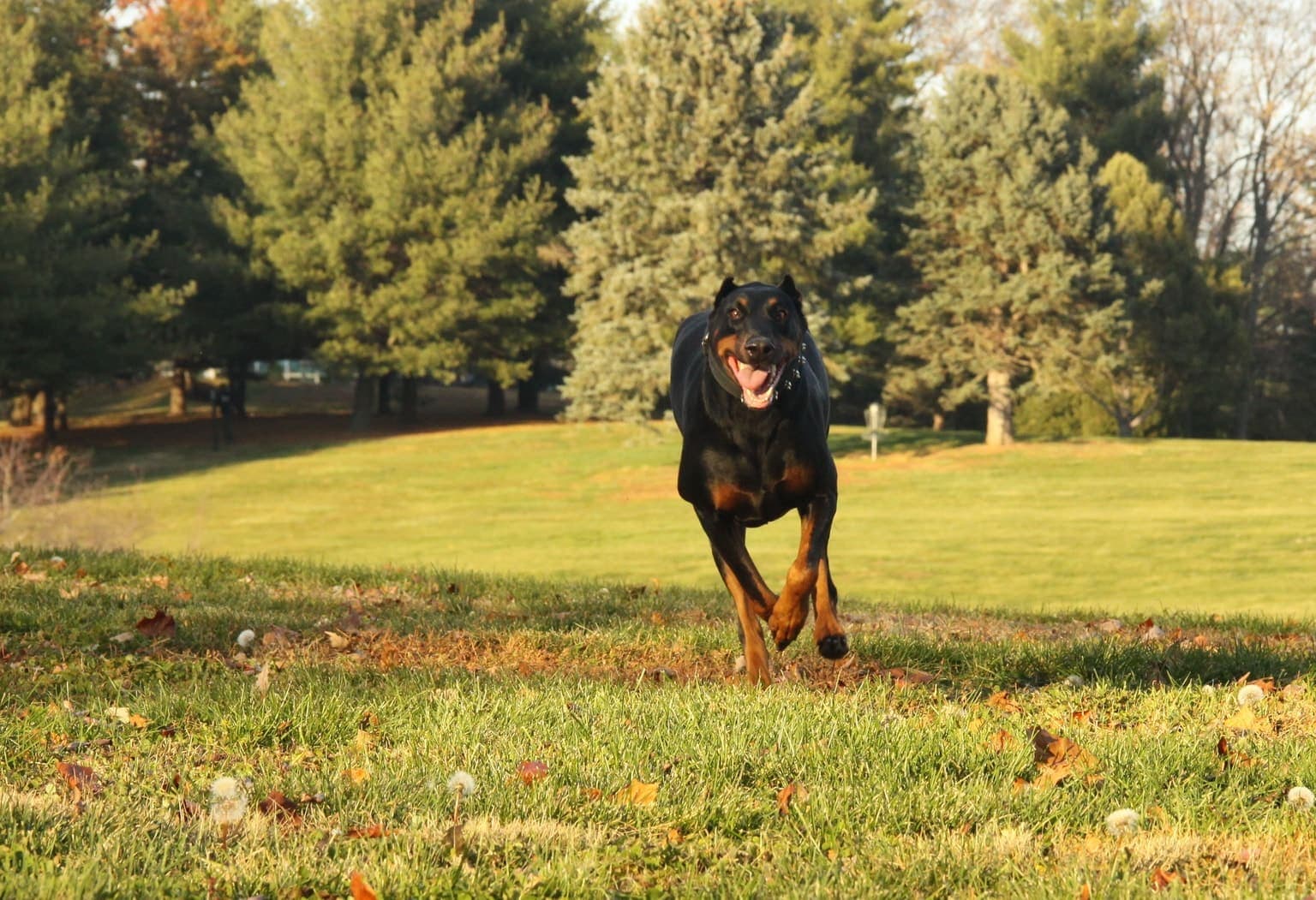
Photo by Carol Lara · CC BY 2.0
Quick facts
| Fact | Rottweiler | Doberman Pinscher |
|---|---|---|
| Group | Working | Working |
| Size | large | large |
| Height | 22-27 in | 24-28 in |
| Weight | 80-135 lbs | 60-100 lbs |
| Lifespan | 9-10 years | 10-12 years |
| Temperament | Confident, Loyal, Steady, Protective | Loyal, Alert, Athletic, Intelligent |
How to tell them apart
Read the rows top to bottom. The first two or three traits usually settle it; the rest confirm.
| Trait | Rottweiler | Doberman Pinscher |
|---|---|---|
| Build | Compact, substantial and powerful with heavy bone; body slightly longer than tall, with a broad, deep chest. | Square, compactly built, muscular and elegant; height equals length, with a well tucked-up belly. |
| Size | 22 to 27 in and 80 to 135 lbs. Males 24 to 27 in, females 22 to 25 in. | 24 to 28 in and 60 to 100 lbs. Males 26 to 28 in, females 24 to 26 in. |
| Head | Of medium length and broad between the ears, with a well-developed stop and a strong, broad muzzle. | Long and dry, resembling a blunt wedge, widening gradually toward the ears, with a slight stop. |
| Ears | Medium-sized, pendant and triangular, set well apart and lying flat against the head. | Normally cropped and carried erect in the United States; the standard does not describe uncropped ears, which hang folded beside the cheek. |
| Neck and outline | Powerful, well-muscled, moderately long neck; a level, firm back. | Well-arched, dry, well-muscled neck carried proudly; a short, firm back running in a straight line to a slightly rounded croup. |
| Coat and colour | Straight, coarse, dense outer coat of medium length lying flat, with an undercoat on the neck and thighs. Always black with rust to mahogany markings. | Smooth, short, hard, thick and close-lying. Black, red, blue or fawn (Isabella), each with sharply defined rust markings. |
| Tail | Docked short or left natural; the AKC standard describes both. An undocked tail is carried straight or curved upward and may hang at rest. | Docked at about the second joint in the AKC standard; a natural tail is long and slender. |
What the photo detector sees
A standing side view makes this pair straightforward, because proportions and bone are plain to see. The saved benchmark runs for this project do not show the tested AI models confusing the two breeds' reference photos. The harder pictures are head-on portraits of dogs with natural ears, puppies, and overweight Dobermans or lean adolescent Rottweilers, where body type is less distinct.
Colour can help. A red, blue or fawn dog with rust markings is not a Rottweiler, which is always black and rust. Many other breeds and crosses share black-and-rust markings, including the Beauceron, the German Pinscher and the Manchester Terrier, so the pattern alone is weak evidence of either breed.
Living with them
Both breeds are intelligent, loyal and naturally protective, and both need early socialisation, consistent training and an owner who can manage a strong dog. The Rottweiler is typically calm, steady and self-assured, with a wait-and-see attitude toward strangers. The Doberman is typically more energetic, quicker to react and more sensitive, and it tends to stay very close to its handler. Both do best with real work, such as obedience, tracking or carting.
The Doberman needs more running. It is built for speed and endurance and needs vigorous daily exercise, and its short coat gives little protection in cold weather. The Rottweiler needs steady daily exercise and careful weight control. Both coats need only occasional brushing; the Rottweiler sheds more. The profiles list a lifespan of 9 to 10 years for the Rottweiler and 10 to 12 years for the Doberman Pinscher.
Not sure which one you have?
Upload a clear photo and the detector returns a ranked shortlist, so you can check the top matches against the tells above instead of guessing from one label.
Upload a photo and get a ranked shortlistFAQ
What is the difference between a Rottweiler and a Doberman?
A Rottweiler is broad and heavy-boned at 80 to 135 lbs, with a wide head and hanging triangular ears. A Doberman Pinscher is lean and square at 60 to 100 lbs, with a long wedge-shaped head, an arched neck and ears that are often cropped erect. Rottweilers are always black and rust; Dobermans may also be red, blue or fawn with rust.
Which is bigger, a Rottweiler or a Doberman?
The Doberman is usually a little taller, 24 to 28 in against 22 to 27 in. The Rottweiler is heavier, 80 to 135 lbs against 60 to 100 lbs.
Why do they have the same markings?
The black-and-rust pattern is an inherited coat pattern that occurs in many breeds. The Doberman was developed in Germany in the late 1800s from several breeds, and the Rottweiler is generally listed among them, which would account for a shared look as well as a shared pattern.
Do Rottweilers have cropped ears?
No. The Rottweiler standard describes natural, pendant, triangular ears. Ear cropping is associated with the Doberman in the United States, and it is banned or restricted in many other countries, where Dobermans have natural folded ears.
Which is better with families?
Either can be a devoted family dog when well bred, socialised and trained, and either can be too much dog for an inexperienced household. Meet adult dogs of both breeds and talk to breeders or rescue groups about energy level and handling before choosing.
Full profiles
More look-alikes
Other comparisons that include one of these breeds or come from the same look-alike group:
Browse every pair in the breed comparison index.