Samoyed vs American Eskimo Dog
The Samoyed and the American Eskimo Dog are white, double-coated dogs with a wedge-shaped head, erect triangular ears, a ruff around the neck that is fuller on males, and a profusely coated tail carried loosely over the back. Both standards allow white or white with biscuit, and the AKC describes a smiling face in both breeds. In a photo with nothing for scale, the two can look like the same dog.
Size is the fastest tell. A Samoyed stands 19 to 23.5 in and weighs 35 to 65 lbs. The American Eskimo Dog comes in three sizes, and even the largest, the Standard, stands over 15 in and up to 19 in and weighs 25 to 35 lbs. An Eskie over 19 in is disqualified, and 19 in is the bottom of the Samoyed range, so a white dog of this type that is clearly taller than that is not an Eskie.
When scale is missing, use build and feet. The Samoyed is a draft dog with heavier bone than its size suggests, moderately long legs and large, long, flattish hare feet. The American Eskimo Dog is compactly built with oval, compact feet. The eyes differ too: a Samoyed's are almond-shaped and deep-set with a slanting lower lid, while an Eskie's are slightly oval and not slanted.
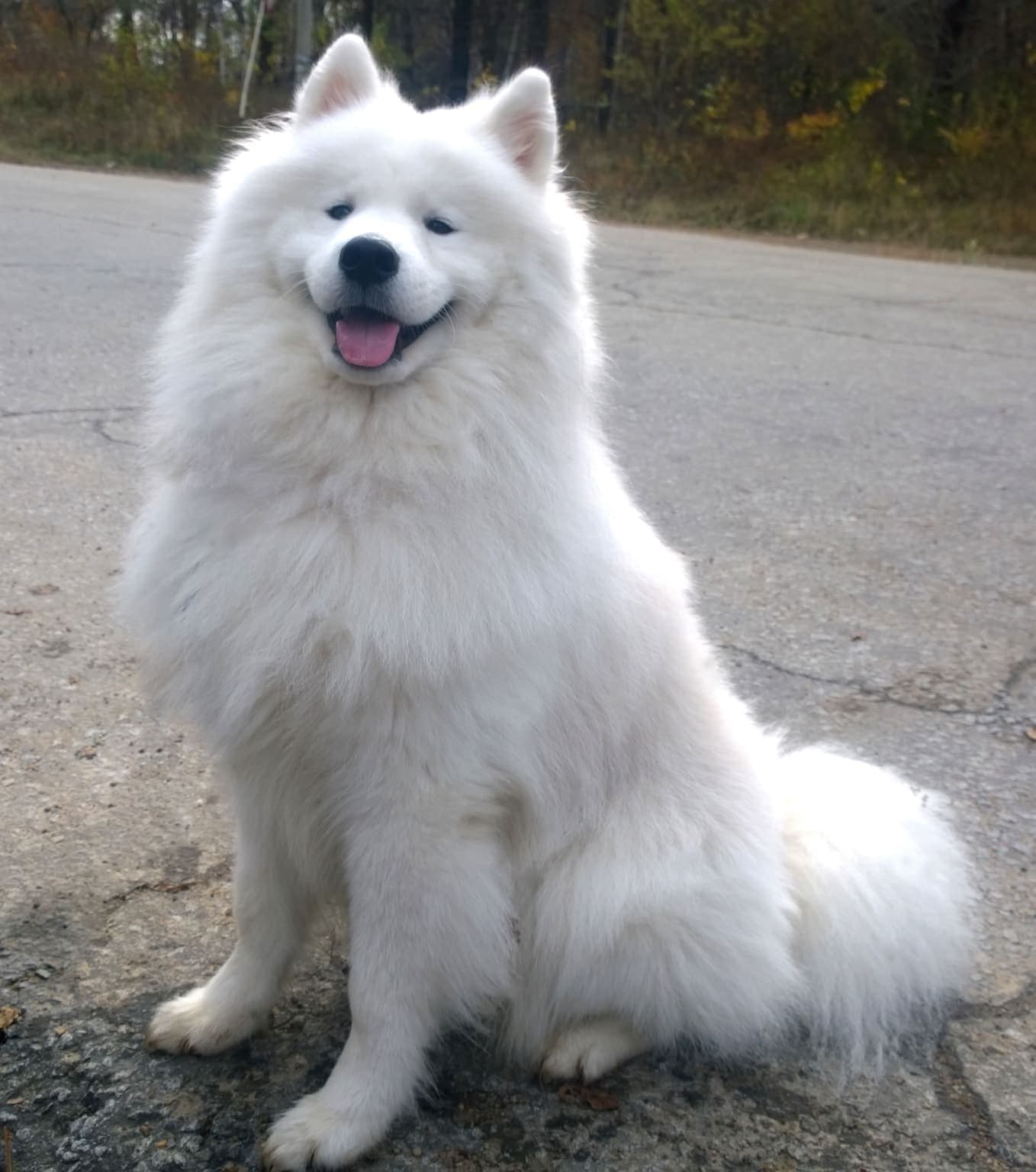
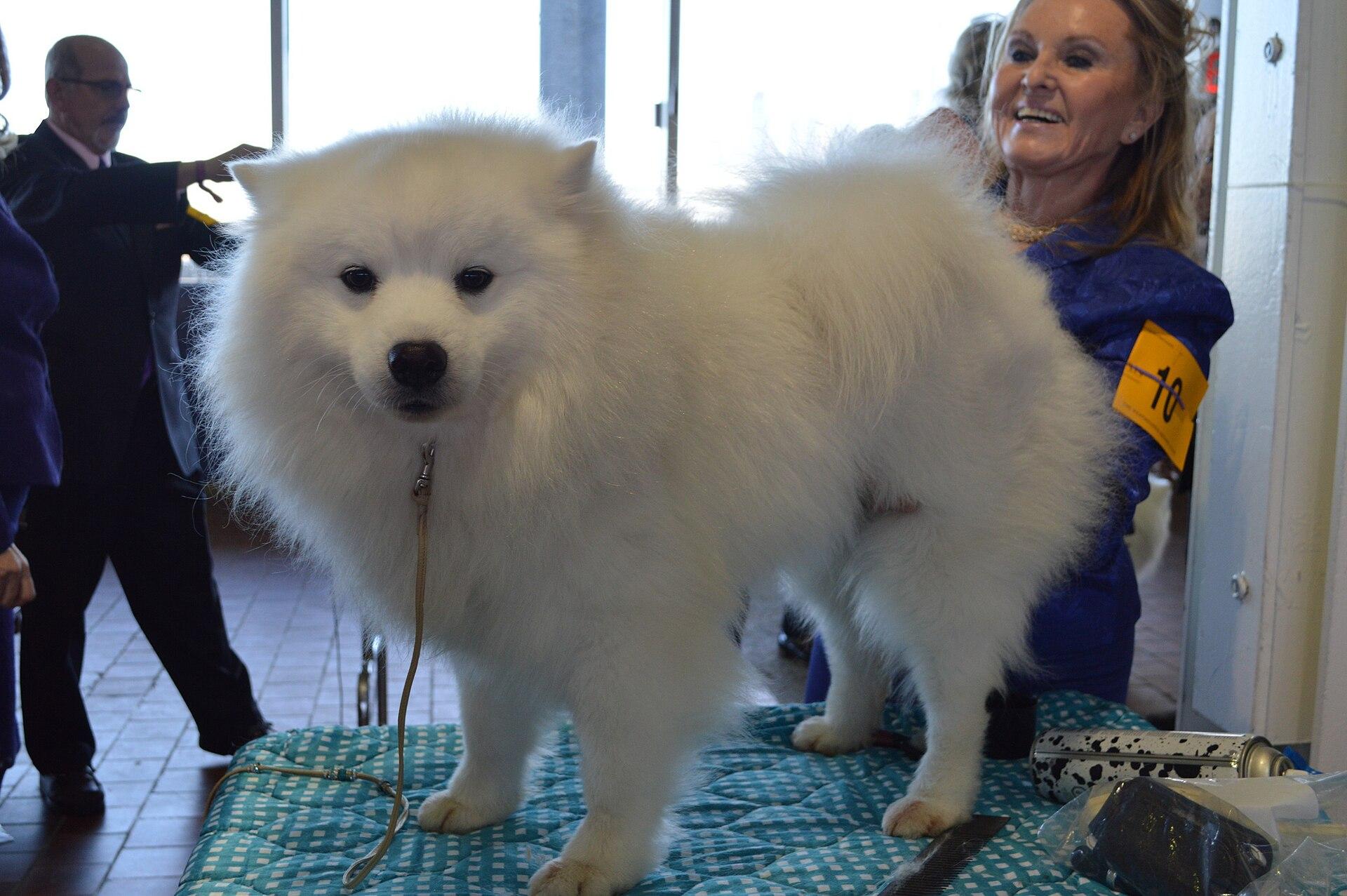
Quick facts
| Fact | Samoyed | American Eskimo Dog |
|---|---|---|
| Group | Working | Non-Sporting |
| Size | medium | medium |
| Height | 19-23.5 in | 15-19 in |
| Weight | 35-65 lbs | 25-35 lbs |
| Lifespan | 12-14 years | 13-15 years |
| Temperament | Friendly, Gentle, Playful, Social | Intelligent, Friendly, Alert, Playful |
How to tell them apart
Read the rows top to bottom. The first two or three traits usually settle it; the rest confirm.
| Trait | Samoyed | American Eskimo Dog |
|---|---|---|
| Size | 19 to 23.5 in and 35 to 65 lbs. The standard gives 21 to 23.5 in for males and 19 to 21 in for females. | Standard size: over 15 in to 19 in and 25 to 35 lbs. The standard also has a Miniature, over 12 in to 15 in, and a Toy, 9 to 12 in. Under 9 in or over 19 in is a disqualification. |
| Build and legs | Bone heavier than expected for a dog of its size, with a deep chest and moderately long legs; leg length to the elbow is about 55 per cent of height. | Strong and compactly built with adequate bone, but not cobby; leg length in proportion to the body. |
| Feet | Large, long and flattish hare feet, slightly spread, with hair between the toes. Round or cat feet are faults. | Oval, compact and tightly knit, well padded with hair. Toenails are white and pads black to dark brown. |
| Eyes and expression | Dark, deep-set, almond-shaped eyes placed well apart, with the lower lid slanting toward the base of the ear. Lips curve up slightly at the corners to form the Samoyed smile. | Slightly oval eyes, set well apart and not slanted, dark to medium brown, with white eyelashes and black to dark brown rims. Expression keen and alert. |
| Muzzle and nose | Medium length and width, tapering toward the nose, with depth. Nose black for preference, but brown, liver or Dudley is not penalised. | Broad, no longer than the skull and sometimes slightly shorter. Nose and lips black to dark brown; pink pigment is a fault. |
| Colour | Pure white, white and biscuit, cream, or all biscuit. Any other colour disqualifies. The coat should glisten with a silver sheen. | Pure white preferred; white with biscuit cream is permissible. Any other colour disqualifies. |
| AKC group and origin | Working Group, recognised in 1906. Bred by the Samoyede people of Siberia to haul sledges, hunt and later herd and guard reindeer. | Non-Sporting Group, recognised in 1994. Descended from the white German Spitz farm dogs brought to the American Midwest by German immigrants, later known for circus acts. |
What the photo detector sees
This pair depends on scale more than most. A photo with a person, a doorway or furniture in it shows whether the dog is the size of a Samoyed or of an Eskie; a portrait on snow or grass does not. In the saved benchmark runs for this project, two of the fifteen saved answers for Samoyed reference photos named the American Eskimo Dog first, and it was the runner-up in twelve others.
Puppies remove the size clue completely, since a young Samoyed passes through every Eskie height on the way up. In that case look at the feet and legs: large, long feet and heavy bone suggest a Samoyed. A full-grown dog of this type under 15 in can still be an American Eskimo Dog, because the breed has Miniature and Toy sizes. The AKC traces the Eskie to the German Spitz, so that breed can also sit close to it in a photo.
Living with them
Both are sociable dogs that do badly when left alone; the AKC warns that a neglected Samoyed becomes destructive and that an Eskie left alone too often tends to develop problem behaviours. The Samoyed standard describes a gentle, adaptable dog that is friendly but conservative, and the AKC adds that the breed has a strong urge to run and roam, so exercise is best on a leash or in a securely fenced yard. The American Eskimo Dog standard describes an intelligent, alert watchdog that barks to announce strangers, learns new tasks quickly and is eager to please. The AKC describes the Eskie as needing lots of exercise and mental challenges.
Both coats shed. The AKC says Samoyeds shed quite a bit all the time and recommends daily brushing, and says Eskies shed almost constantly and recommends a thorough brushing two or three times a week. It advises against bathing an Eskie more than once every few months. The AKC lists hip dysplasia among the conditions responsible breeders test for in both breeds. The profiles list a lifespan of 12 to 14 years for the Samoyed and 13 to 15 years for the American Eskimo Dog.
Not sure which one you have?
Upload a clear photo and the detector returns a ranked shortlist, so you can check the top matches against the tells above instead of guessing from one label.
Upload a photo and get a ranked shortlistFAQ
What is the difference between a Samoyed and an American Eskimo Dog?
Size and build. A Samoyed stands 19 to 23.5 in and weighs 35 to 65 lbs, with heavy bone and large hare feet. An American Eskimo Dog is no taller than 19 in, weighs 25 to 35 lbs in its Standard size, and is more compact with oval feet. The Samoyed is a Siberian sled dog and the Eskie an American companion breed of German Spitz descent.
Is an American Eskimo Dog a miniature Samoyed?
No. They are separate AKC breeds with different origins. The AKC traces the American Eskimo Dog to the German Spitz kept by German immigrants in the American Midwest, and the Samoyed to the dogs of the Samoyede people of Siberia. The Eskie's own standard has Toy, Miniature and Standard sizes.
Which is bigger, a Samoyed or an American Eskimo Dog?
The Samoyed. It stands 19 to 23.5 in and weighs 35 to 65 lbs. The largest American Eskimo Dog, the Standard, stands over 15 in and up to 19 in and weighs 25 to 35 lbs, and the Miniature and Toy sizes are smaller.
Are both breeds always white?
Nearly. The American Eskimo Dog standard prefers pure white and permits white with biscuit cream. The Samoyed standard allows pure white, white and biscuit, cream, or all biscuit. Any other colour is a disqualification in both, so a black, grey or patched dog is neither breed.
Which sheds more and needs more brushing?
Both shed heavily. The AKC says Samoyeds shed quite a bit all the time, more in shedding season, and recommends daily brushing. It says Eskies shed almost constantly and recommends a thorough brushing two or three times a week. The Samoyed is the larger dog, so there is more coat to work through.
Full profiles
Browse every pair in the breed comparison index.