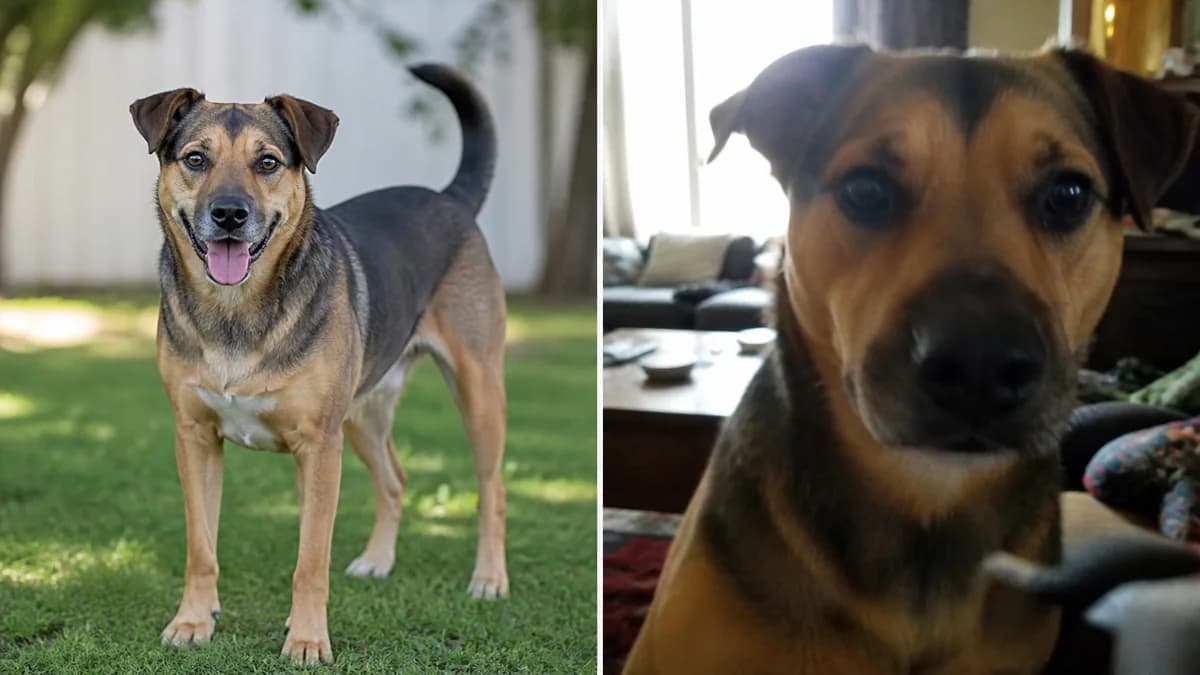
Mixed Breed vs Purebred: Understanding Your Dog’s Traits
Dog Care • By Dog Breed Detector Editorial Team • 2025-10-30 (Updated 2026-09-02)
Most dogs in homes and shelters are not purebred, and many of them do not look like any single breed. That is normal. A mixed dog can carry the coat of one ancestor, the build of another, and a temperament that matches neither. This guide explains what the labels mean, why a mix is hard to read from a photo, how to use a ranked shortlist, and when a DNA test is the better tool.
Purebred, mixed breed, designer cross, mutt: what the words mean
- Purebred describes a dog whose parents both belong to the same recognized breed, usually with registered pedigrees going back several generations. Breeds are closed populations bred toward a written standard, which is why purebred dogs look, and to a lesser degree act, in predictable ways. If you want the longer version, see our page on what a breed actually is.
- Mixed breed describes a dog with ancestors from more than one breed. That might mean two purebred parents of different breeds, or many generations of mixing where no single breed dominates.
- Designer cross is a marketing term for a deliberate first-generation cross between two purebreds, such as a Poodle bred to a Labrador Retriever. The dog is still a mixed breed. The name suggests consistency, but first crosses vary from puppy to puppy, and later generations vary more.
- Mutt is the informal word for a dog of mixed or unknown ancestry. It carries no technical meaning beyond “not purebred.” Our mutt definition page covers the history of the word and how it compares with terms like crossbreed and mongrel.
None of these labels tells you whether a dog will be a good fit for your home. A purebred label narrows the range of likely traits. A mixed label widens it. Either way, the individual dog in front of you matters more than the category.
Why a mixed dog is hard to read from a photo
People often assume a mix will look like a blend of its parents, the way mixing two paints gives you a color halfway between them. Inheritance does not work that way. Each parent passes on one copy of each gene, and some versions of a gene show up in the puppy even when only one copy is present. Those are the visually dominant traits. A single ancestor with drop ears, a dark mask, or a wiry coat can stamp that feature onto a puppy whose other ancestors looked nothing like it.
Other features land in between. Muzzle length, leg length, and body weight are shaped by many genes working together, so a puppy from a long-nosed parent and a short-nosed parent often ends up with a muzzle that is neither. Intermediate features are useful clues, but they rarely point to one breed.
Coat is where the surprises are most visible. Color, pattern, length, curl, and shedding are controlled by separate genetic switches, and a puppy can inherit any combination. A brindle pattern, the dark tiger striping seen in Boxers and many bull-and-terrier breeds, can appear on a dog with no other Boxer-like features. Merle, the mottled pattern associated with Australian Shepherds and some collies, can turn up in a mix with a completely different body type. A short, smooth coat can hide a Poodle ancestor entirely. Because coat is the first thing our eyes notice, it often pulls a photo-based guess toward whichever breed shares the same pattern.
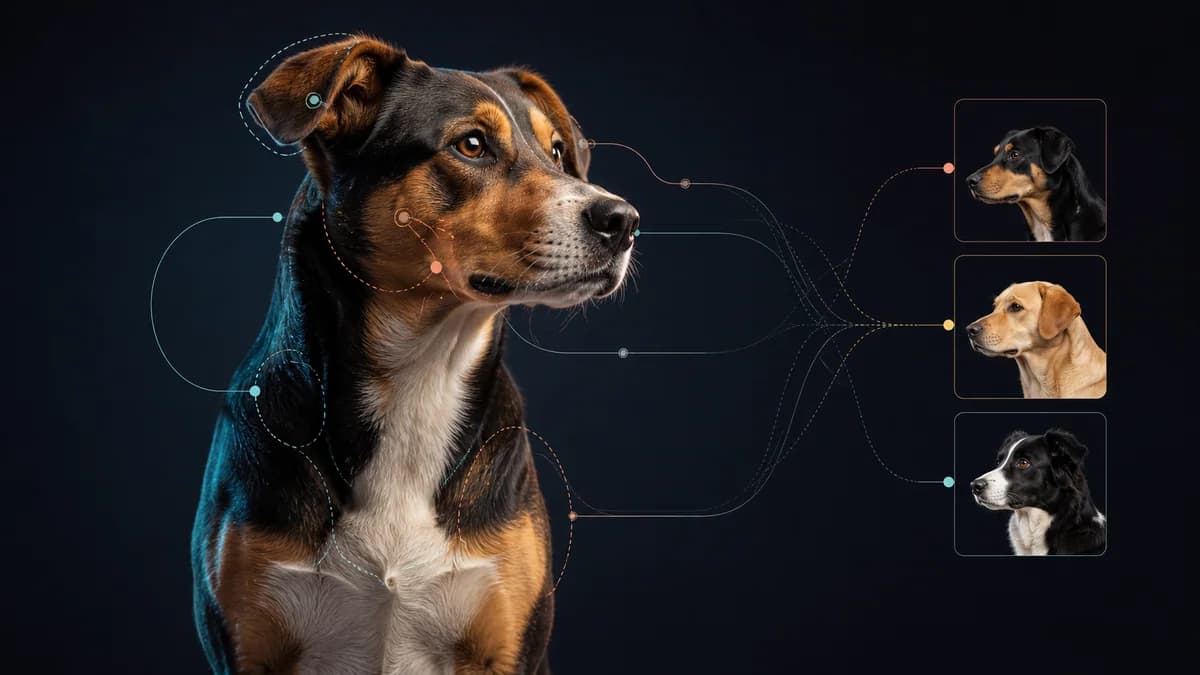
This is why a photo cannot tell you which breeds are in a dog’s ancestry. An image records the visible outcome of inheritance, not the ancestors themselves. What a photo can do is show which breeds a dog most closely resembles, and that is exactly what a visual identifier returns: a shortlist of confidence-ranked visual matches, ordered by how strongly your dog’s features resemble the patterns the model learned for each breed.
How to use a ranked shortlist for a mixed dog
For a purebred dog, the first result is usually the whole answer. For a mix, the useful information sits in the top three results together. Here is a simple way to work through them.
- Take three plausible matches seriously. If the scores are close, the model is telling you the photo is ambiguous. That is normal for mixed dogs.
- Compare structure, not color. Open the breed pages and look at head shape, ear set, chest depth, leg length, and tail carriage. Structure is harder to fake than coat, so a match that agrees with your dog’s build is more informative than one that only shares a color.
- Look for a shared theme. If all three matches come from the same broad group, such as sighthounds, herding dogs, or bull-and-terrier types, that theme is often more reliable than any single breed name.
- Repeat with a second photo. A side profile and a straight-on face shot highlight different features. Matches that survive both angles deserve more weight.
A worked example makes this concrete. Imagine a medium-sized dog of around 45 pounds with a short, smooth coat in a dark brindle pattern, a broad skull, a moderately short muzzle, a deep chest, and a tucked waist. The identifier returns Staffordshire Bull Terrier first, American Staffordshire Terrier second, and Whippet third, with the first two scores close together and the third a little further back.
Reading that shortlist, the theme is clear: two bull-and-terrier breeds and one sighthound. The brindle coat is common in all three, so color is not separating them. Structure is. The broad skull and heavy front agree with the bull-and-terrier matches. The tucked waist and the longer, lighter back end are what pulled the Whippet in. A sensible conclusion is not “this dog is a Staffordshire cross with some Whippet.” It is “this dog most resembles bull-and-terrier types in the head and front, and a sighthound in the rear.” That resemblance is real and useful for planning exercise and training, and it says nothing certain about the dog’s actual ancestors. If you started with the question what breed is my dog, a shortlist like this is the honest answer a photo can give.
When a DNA test makes sense
A DNA test answers a different question. Instead of asking what your dog looks like, it compares a sample of your dog’s genetic markers with reference samples from known breeds and estimates which breeds contributed to the ancestry. Our dog DNA test guide explains how the kits work and what the process involves.
A DNA test is worth considering when:
- You want an ancestry estimate rather than a resemblance shortlist, for example if the photo results keep changing between angles.
- Your dog’s appearance is unusual enough that no breed page feels like a close fit.
- You want to know whether your dog carries certain inherited variants that some kits screen for, and you plan to discuss the results with a vet.
It also has limits. Results are estimates, and different companies can give different answers for the same dog because they use different reference panels and methods. Breeds that are closely related, or that were recently formed from the same founding stock, are harder to separate. Very small contributions from an ancestor several generations back may be reported vaguely or not at all. And an ancestry report does not tell you how a dog will behave, how big it will get with any precision, or whether it is healthy today. Our page on dog DNA test accuracy goes into these caveats in detail, and if you decide to buy a kit, the best dog DNA test comparison looks at what each option includes.
In short, a photo identifier is free and immediate and good for exploring look-alikes, while a DNA test costs money, takes weeks, and gives you genetic evidence. Many owners use the shortlist first, then decide whether the ancestry question matters enough to test.
Health and temperament: what breed can and cannot predict
Breed carries some information about health and behavior, but less than most people expect, and the information is weaker for mixed dogs. It helps to separate the two.
Physical traits are the most predictable. Adult size, coat type and grooming needs, and the effects of body shape are strongly inherited. A dog with a very short muzzle is more likely to struggle in heat and to snore, whatever its breed label. A dog with a dense double coat needs help in hot weather and sheds seasonally. These are things you can partly read from a photo, because they are the body itself.
Inherited health conditions are only partly predictable. Some conditions are more common in some breeds, and a purebred dog from a line where they occur has a higher chance of carrying them. In a mix, the odds depend on which ancestors contributed and which variants the dog actually inherited, and neither a photo nor a breed name can tell you that. Mixed dogs are not automatically healthier than purebred dogs, and purebred dogs are not automatically less healthy; the individual dog’s genes, weight, diet, exercise, and veterinary care matter more. If you have a concern about a specific condition, your vet is the right person to ask, and a DNA test that screens for known variants can be a useful thing to bring to that conversation.
Temperament is the least predictable from a label. Breeds were developed for jobs, and tendencies from those jobs persist: herding dogs often like to control movement, scent hounds follow their noses, terriers tend to be persistent, retrievers usually like to carry things. Those tendencies are real on average. But behavior is shaped just as much by early socialization, training, health, and daily routine, and individual dogs within any breed vary widely. In a mix, the tendencies can combine in ways no breed profile describes. A dog that looks like a herding cross may have no interest in chasing, and one that looks like a couch companion may need an hour of running a day.
The practical lesson is to use breed clues to form gentle expectations, then let the dog correct them. Watch what your dog repeats: what it chases, what it ignores, how it settles, what it works for. Those observations guide training and care more reliably than any name on a shortlist.
Frequently asked questions
Can a photo tell me which breeds my mixed dog is made of?
No. A photo shows what your dog looks like, and the identifier returns the breeds it most closely resembles, ranked by confidence. It does not identify ancestors or estimate how much of each breed is present. Only a DNA test attempts that, and even DNA results are estimates.
Why does my dog get different results from different photos?
Different angles show different features. A side profile emphasizes body outline and leg length, while a face-on shot emphasizes skull width, ears, and muzzle. In a mix, those features may point to different breeds, so the top matches shift. Run two or three photos and pay most attention to breeds that appear in every result.
Is a designer cross more predictable than an ordinary mix?
Only slightly. A first-generation cross has exactly two known breeds in its background, which narrows the range of possible traits. But which traits each puppy inherits still varies within the same litter, and coat type in particular can differ from one sibling to the next. Treat a designer cross as a mixed dog with a known parent list, not as a breed with a standard.
Should I get a DNA test before deciding on training or diet?
Usually not. Training and diet should follow the dog you have: its size, coat, energy, health, and what it enjoys. A DNA test is useful if you are curious about ancestry or want to screen for inherited variants to discuss with your vet. It is not a substitute for watching your dog and talking to a professional about anything that worries you.
Ready to see your dog’s visual matches? Upload a clear photo to the free photo identifier, compare the top three results in the breed directory, and build your routine around the dog in front of you.