Australian Cattle Dog vs Australian Shepherd
The Australian Cattle Dog and the Australian Shepherd share a country in their names, a place in the AKC Herding Group and a medium-sized, muscular build. They also share a look: a mottled blue-grey or red coat that can carry tan on the face and legs. A blue Cattle Dog, also called a Blue Heeler or Queensland Heeler, and a blue merle Australian Shepherd are the usual mix-up.
The ears are the fastest tell. A Cattle Dog's ears are pricked: broad at the base, moderately pointed and set wide apart. An Australian Shepherd's ears are triangular and set high, and at attention they break forward and over, or to the side as a rose ear. Prick ears are a severe fault in the Australian Shepherd standard.
If the ears are hidden, look at the coat and the tail. The Cattle Dog has a smooth, close coat of about 1 to 1.5 in and a tail that reaches the hock and carries a good brush. The Australian Shepherd has a medium-length coat with feathering on the backs of the legs and a mane and frill, and a tail that is docked or naturally bobbed and no longer than 4 in.
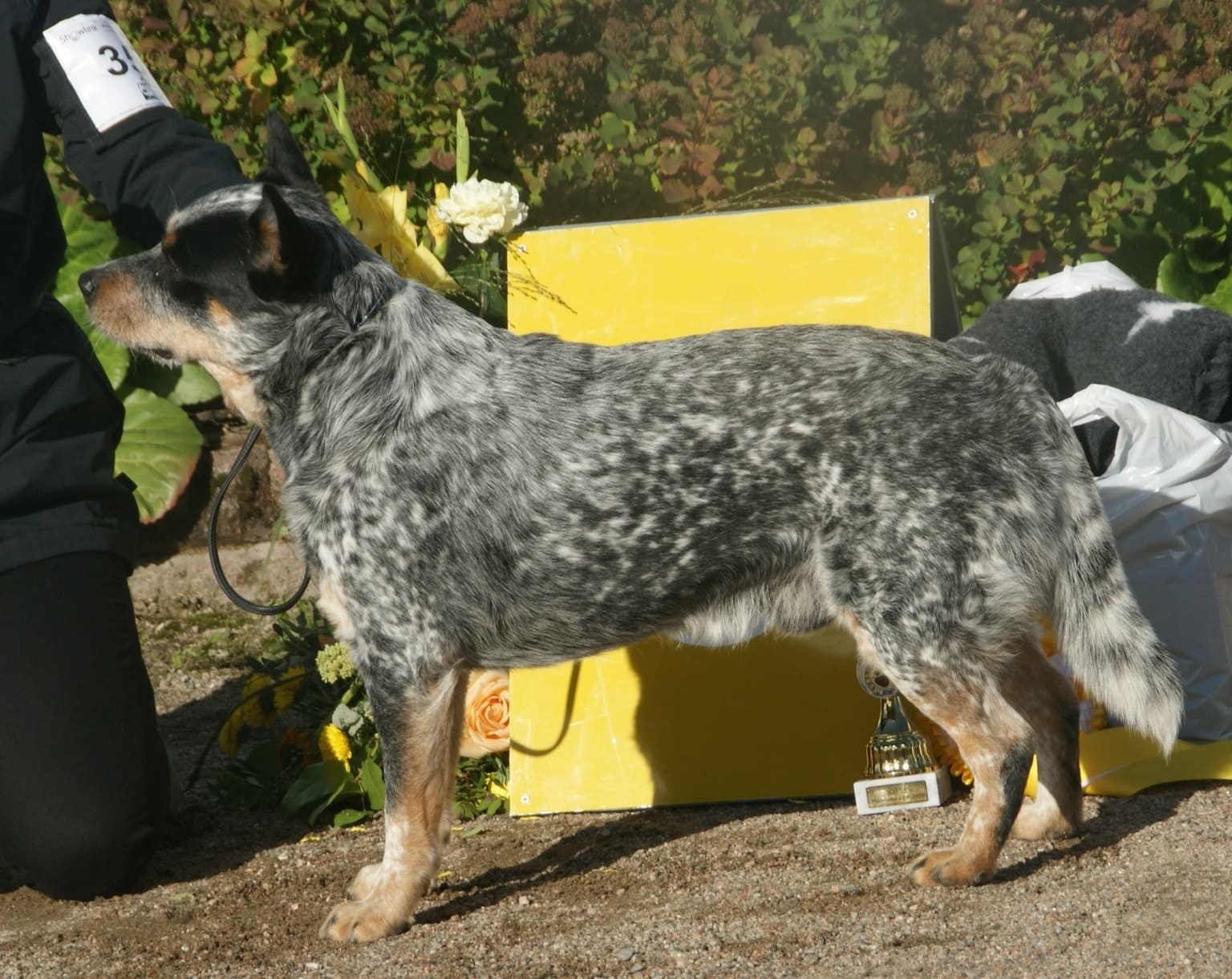
Photo by Canarian · CC BY-SA 4.0
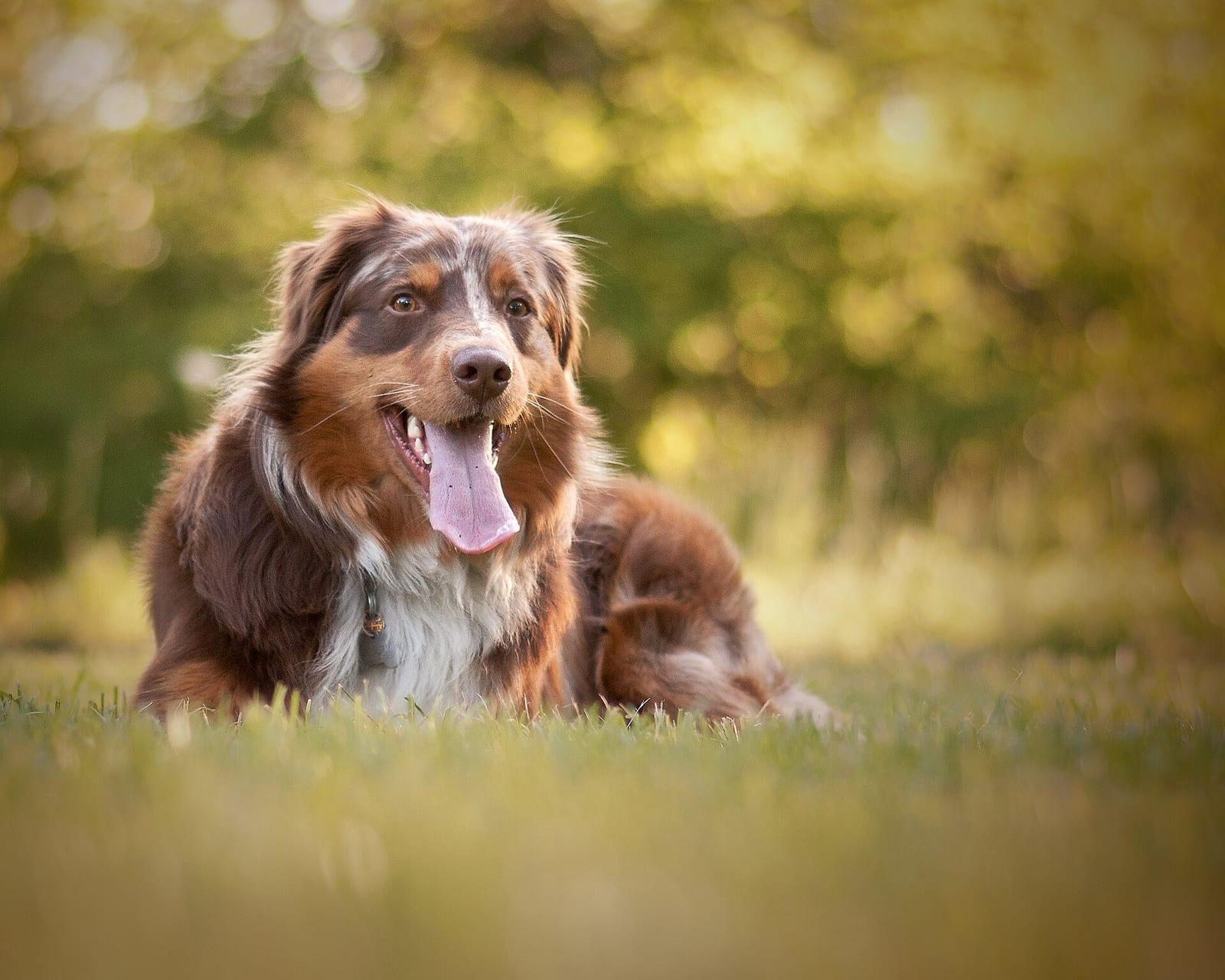
Photo by Andy · CC BY-SA 2.0
Quick facts
| Fact | Australian Cattle Dog | Australian Shepherd |
|---|---|---|
| Group | Herding | Herding |
| Size | medium | medium |
| Height | 17-20 in | 18-23 in |
| Weight | 35-50 lbs | 40-65 lbs |
| Lifespan | 12-16 years | 12-15 years |
| Temperament | Tough, Intelligent, Loyal, High-energy | Energetic, Smart, Devoted, Work-oriented |
How to tell them apart
Read the rows top to bottom. The first two or three traits usually settle it; the rest confirm.
| Trait | Australian Cattle Dog | Australian Shepherd |
|---|---|---|
| Ears | Pricked, moderately pointed and preferably small rather than large, set wide apart and inclining outwards. | Triangular and set high, breaking forward and over, or to the side as a rose ear, at full attention. Prick ears and hanging ears are severe faults. |
| Coat | Smooth double coat with a close, straight, hard outer coat lying flat, about 1 to 1.5 in on the body, longer along the neck and behind the thighs. | Medium length and medium texture, straight to wavy, with moderate feathering on the backs of the forelegs and britches and a moderate mane and frill. |
| Tail | Set moderately low, reaching approximately to the hock, hanging in a very slight curve at rest and carrying a good brush. | Straight, docked or naturally bobbed, not exceeding 4 in. |
| Colour | Blue, blue-mottled or blue speckled, with or without black, blue or tan markings on the head and tan on the legs, breast, throat and jaws; or an even red speckle all over, with or without darker red head markings. | Blue merle, black, red merle or red, all with or without white markings and tan (copper) points. White is accepted on the neck as a collar, the chest, legs, muzzle and underparts and as a blaze. |
| Eyes and nose | Oval, medium-sized, dark brown eyes. Black nose. | Almond-shaped eyes that may be brown, blue, amber or any combination, including flecks and marbling. Nose black in blue merles and blacks, liver in red merles and reds. |
| Size | 17 to 20 in and 35 to 50 lbs. Males about 18 to 20 in, females about 17 to 19 in. | 18 to 23 in and 40 to 65 lbs. Males 20 to 23 in, females 18 to 21 in. |
| AKC group and origin | Herding Group. Developed in Australia during the 1800s to move cattle, from crosses that included Smithfields, Dingoes, collies, Dalmatians and the Black and Tan Kelpie. | Herding Group. Descended from the herding dogs of Basque shepherds, who brought them from Australia to California; the breed was refined in the United States, and the AKC calls its name misleading. |
What the photo detector sees
For this pair, the saved benchmark runs for this project do not show the tested AI models confusing the two breeds' reference photos in either direction. A whole-dog photo shows three separate differences at once: the ears, the coat length and the tail. The pictures that cause trouble are close crops of a blue or red mottled face with tan points, where the tail is out of frame and the body coat cannot be seen. In those, the ears decide it, along with the eyes: a blue or marbled eye fits the Australian Shepherd standard, and the Cattle Dog standard asks for dark brown.
White helps too. A white collar, chest or blaze is accepted in the Australian Shepherd, while the Cattle Dog standard lists only black, blue, tan or red markings. The AKC notes that Cattle Dog puppies are born with a white coat that turns blue-grey or red, so a very young puppy will not yet show the adult colour. The Border Collie and the Miniature American Shepherd each have their own comparison page with the Australian Shepherd. The detector reports visual similarity, not ancestry.
Living with them
Both are high-energy working dogs that the AKC says need a job. It describes the Australian Cattle Dog as loyal, alert and wary of strangers, a dog that needs more than a quick walk and that gets bored and into mischief if it is not challenged; its standard calls it naturally suspicious of strangers. The Australian Shepherd is described as bonding strongly with its family, sometimes to the point of being territorial, easy to train, and likely to become destructive if often left alone for long periods. Its standard says it may be somewhat reserved in initial meetings. The AKC recommends early socialisation and obedience training for both.
Coat care is light for the Cattle Dog: a quick brushing once a week and an occasional bath, with a thorough brushing every few days when it sheds its undercoat twice a year. The Australian Shepherd needs weekly brushing, and an undercoat rake every two or three days in shedding season. The AKC lists deafness, progressive retinal atrophy and hip dysplasia among the conditions Cattle Dog breeders screen for, and hip dysplasia, epilepsy, cataracts and certain cancers for the Australian Shepherd. The profiles list a lifespan of 12 to 16 years for the Australian Cattle Dog and 12 to 15 years for the Australian Shepherd.
Not sure which one you have?
Upload a clear photo and the detector returns a ranked shortlist, so you can check the top matches against the tells above instead of guessing from one label.
Upload a photo and get a ranked shortlistFAQ
What is the difference between an Australian Cattle Dog and an Australian Shepherd?
An Australian Cattle Dog has pricked ears, a short, smooth, speckled coat and a long tail, and stands 17 to 20 in. An Australian Shepherd has ears that fold forward or to the side, a medium-length feathered coat in merle or solid colours, with or without white and copper trim, and a docked or bobbed tail, and stands 18 to 23 in.
Are Australian Cattle Dogs and Australian Shepherds related?
They are separate breeds. The Australian Cattle Dog was developed in Australia to move cattle. The Australian Shepherd descends from the dogs of Basque shepherds who came to California by way of Australia, and it was refined in the United States. The AKC histories mention collie crosses in the background of both.
Which is bigger, an Australian Cattle Dog or an Australian Shepherd?
The Australian Shepherd. It stands 18 to 23 in and weighs 40 to 65 lbs, while the Australian Cattle Dog stands 17 to 20 in and weighs 35 to 50 lbs.
Is a Blue Heeler the same as a blue merle Australian Shepherd?
No. Blue Heeler is another name for the Australian Cattle Dog, whose blue coat is blue, blue-mottled or blue speckled on a short, smooth coat. Blue merle is one of the Australian Shepherd's four colours, on a longer coat that may carry white markings and copper points.
Which needs more grooming?
The Australian Shepherd. Its medium-length coat needs weekly brushing and an undercoat rake every two or three days in shedding season. The Australian Cattle Dog's short coat needs a quick weekly brushing, with more when it sheds its undercoat twice a year.
Full profiles
More look-alikes
Other comparisons that include one of these breeds or come from the same look-alike group:
Browse every pair in the breed comparison index.