Basset Hound vs Bloodhound
The Basset Hound and the Bloodhound share a face. Both are scent hounds with loose skin that falls in wrinkles over the brow, extremely long ears set very low, hanging flews, a pronounced dewlap and sunken eyes with a drooping lower lid. In a head-and-shoulders photo, with nothing to show how far the dog stands off the ground, the two can pass for each other.
Height is the fastest tell. A Bloodhound stands 23 to 27 in on straight, large-boned forelegs. A Basset Hound is a short-legged dog whose standard says height should not exceed 14 in, so a Bloodhound is at least 9 in taller at the shoulder. The Bloodhound is also much the heavier dog, at 80 to 110 lbs against 40 to 65 lbs.
When the legs are out of the picture, use the head shape and the markings. A Bloodhound's head is long and narrow, flattened at the sides and nearly equal in width along its whole length. A Basset's head is of medium width with a well-domed skull. The Bloodhound standard names three colours, black and tan, liver and tan, and red, and allows only a small amount of white, while a Basset may be any hound colour with markings anywhere.
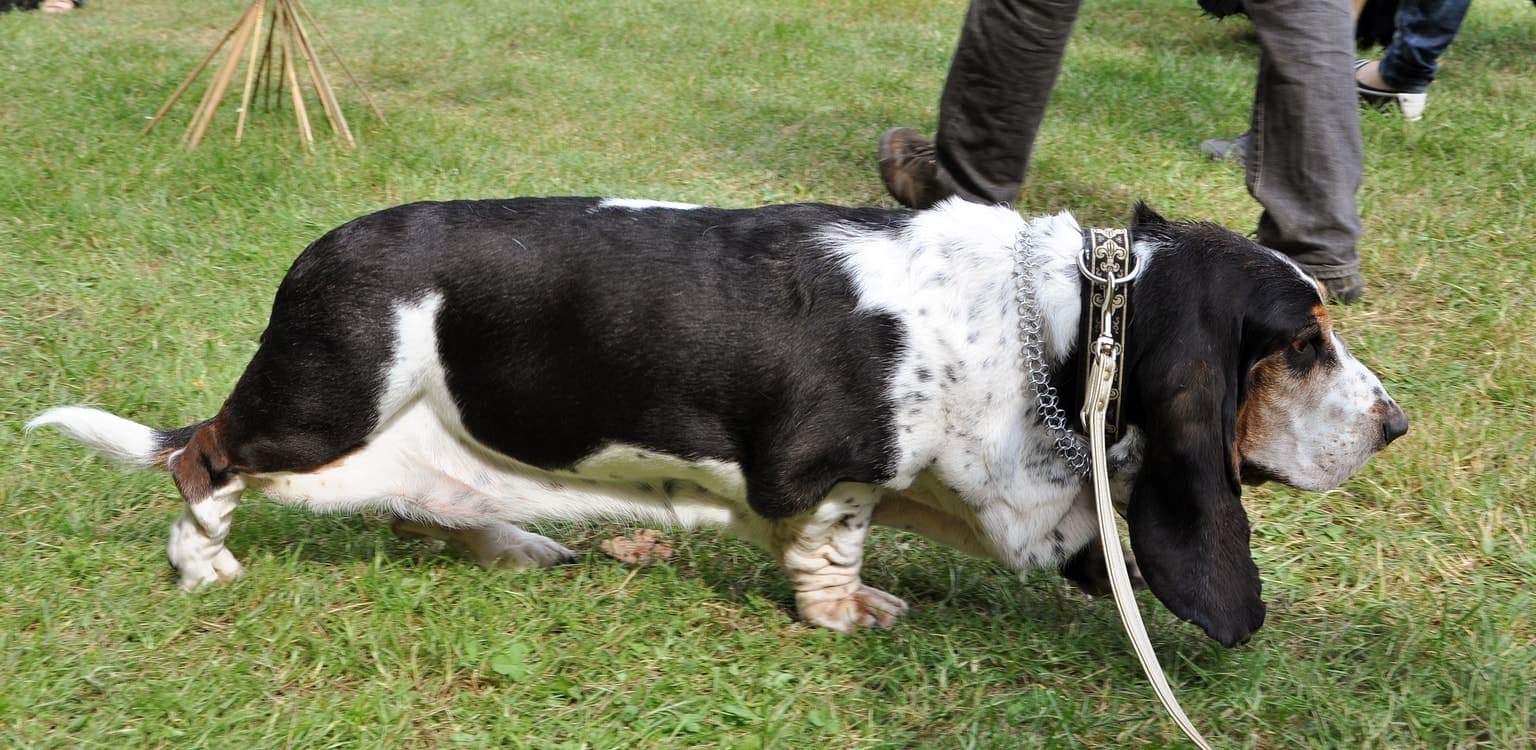
Photo by Amada44 · CC BY-SA 3.0
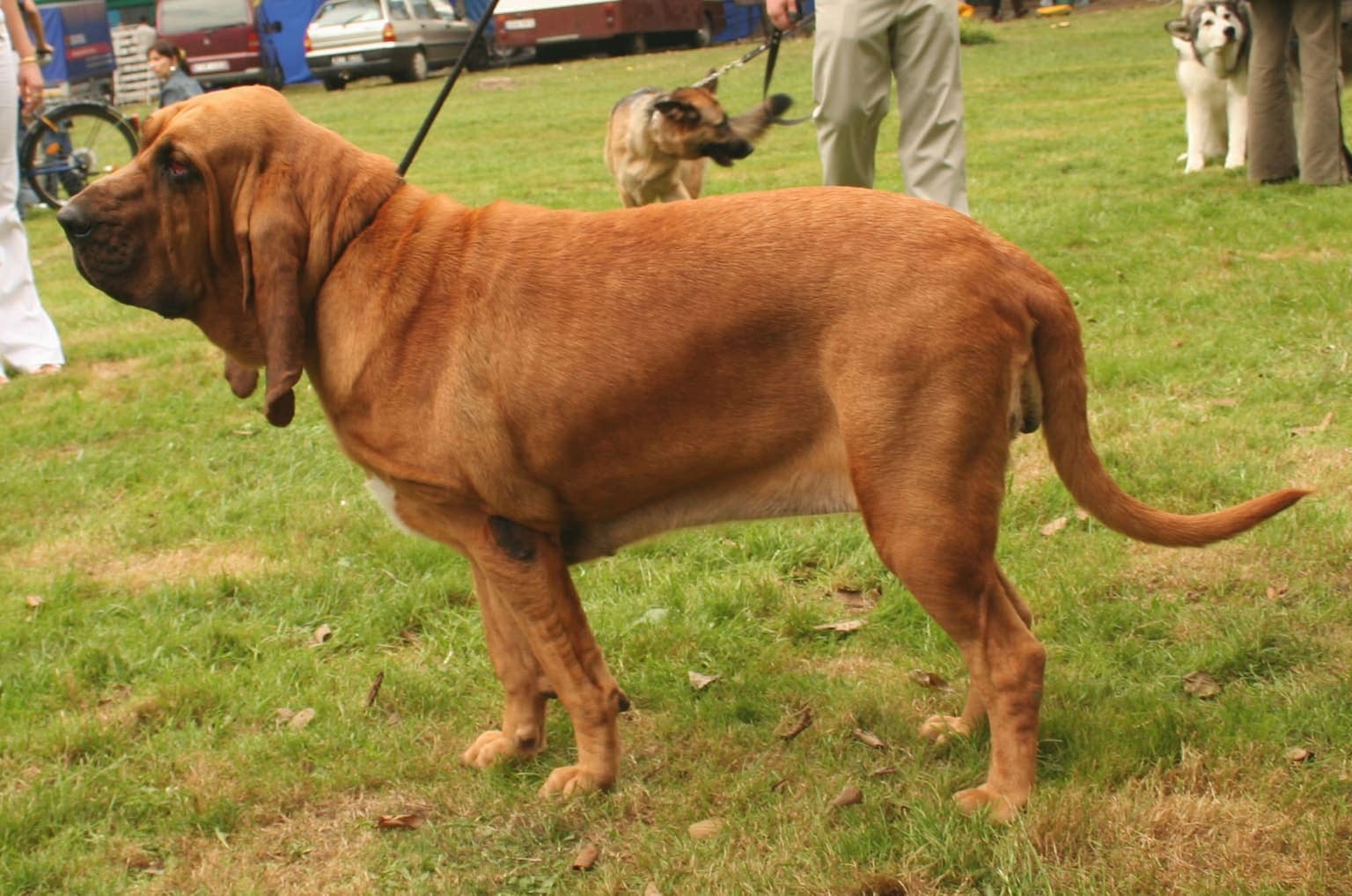
Photo by Pleple2000 · CC BY-SA 3.0
Quick facts
| Fact | Basset Hound | Bloodhound |
|---|---|---|
| Group | Hound | Hound |
| Size | medium | large |
| Height | up to 15 in | 23-27 in |
| Weight | 40-65 lbs | 80-110 lbs |
| Lifespan | 12-13 years | 10-12 years |
| Temperament | Easygoing, Stubborn, Friendly, Scent-driven | Gentle, Determined, Independent, Friendly |
How to tell them apart
Read the rows top to bottom. The first two or three traits usually settle it; the rest confirm.
| Trait | Basset Hound | Bloodhound |
|---|---|---|
| Size | 40 to 65 lbs. The AKC standard says height should not exceed 14 in, and a height over 15 in is a disqualification. | 23 to 27 in and 80 to 110 lbs. The AKC standard gives 25 to 27 in for males and 23 to 25 in for females. |
| Legs and feet | Short, powerful forelegs that are heavy in bone, with wrinkled skin and massive paws turned a trifle outward. The chest is no more than one-third of the dog's height off the ground. | Straight forelegs that are large in bone, with strong, well-knuckled feet. The standard describes a dog that stands over more ground than is usual for a hound. |
| Head | Large, of medium width, with a well-domed skull, a pronounced occiput and a deep, heavy muzzle. | Long and narrow, tapering only slightly from temples to muzzle and flattened at the sides. The standard gives a head length of 12 in or more for males and 11 in or more for females. |
| Colour and markings | Any recognised hound colour. The standard states that the distribution of colour and markings is of no importance. | Black and tan, liver and tan, or red. A small amount of white is permitted on the chest, feet and tip of the tail. |
| Eyes | Soft, sad and slightly sunken, showing a prominent haw. Brown, with dark brown preferred. | Deeply sunk, with diamond-shaped lids because the heavy flews drag the lower lids down. Colour ranges from deep hazel to yellow. |
| Tail and gait | Tail set in line with the spine, slightly curved and carried gaily. Movement is deliberate, with the nose held low to the ground. | Long, tapering tail set rather high and carried high. The gait is elastic, swinging and free. |
| AKC group and origin | Hound Group, recognised in 1885. Bred in France and Belgium as a low-built scenting hound that hunters could follow on foot. | Hound Group, recognised in 1885. Developed in Western Europe, where the AKC credits medieval monasteries in England and France, and later used to trail people. |
What the photo detector sees
Any photo that shows the whole dog standing settles this pair, because the leg length cannot be missed. In the saved benchmark runs for this project, none of the tested AI models gave the other breed as its first answer for either breed's reference photos. The Bloodhound was the second suggestion in twelve of the fifteen saved answers for Basset Hound photos, while the Basset Hound was not suggested for any Bloodhound photo.
The hard pictures are close portraits and dogs lying down, where the wrinkles, ears and dewlap fill the frame and the legs are hidden. In those, check the width of the head and look for white: a large white blaze, collar or white legs fit the Basset standard and not the Bloodhound's. A black-and-tan hound on long legs is not always a Bloodhound either. The AKC history says the Bloodhound contributed to later breeds such as the Black and Tan Coonhound.
Living with them
The Basset standard describes a mild temperament, never sharp or timid, and the Bloodhound standard an extremely affectionate dog that is somewhat shy and sensitive to correction. The AKC describes both as pack dogs that enjoy company, and both as independent dogs whose training takes patience and consistency. The difference is scale and energy. The AKC says a daily walk at a moderate pace usually suits a Basset. It calls the Bloodhound an active dog that needs long daily walks on a lead and a securely fenced garden, because Bloodhounds dig and escape.
Both have short coats that the AKC advises brushing weekly, and both have long ears that need frequent checks for infection. The AKC adds that Bloodhounds drool, need regular baths and should have their skin wrinkles checked daily, and that, like other large, deep-chested dogs, they can experience bloat. The profiles list a lifespan of 12 to 13 years for the Basset Hound and 10 to 12 years for the Bloodhound.
Not sure which one you have?
Upload a clear photo and the detector returns a ranked shortlist, so you can check the top matches against the tells above instead of guessing from one label.
Upload a photo and get a ranked shortlistFAQ
What is the difference between a Basset Hound and a Bloodhound?
Leg length and size. A Basset Hound is a short-legged hound of 40 to 65 lbs whose standard asks for a height of no more than 14 in. A Bloodhound stands 23 to 27 in on straight legs, weighs 80 to 110 lbs and has a longer, narrower head.
Are Basset Hounds and Bloodhounds related?
Both are scent hounds from Western Europe, and the AKC links the early breeding of each to the church: the friars of the Abbey of St. Hubert for the Basset, and monasteries in England and France for the Bloodhound. The AKC texts used for this page do not name one breed as the ancestor of the other.
Which is bigger, a Basset Hound or a Bloodhound?
The Bloodhound, by a wide margin. It stands 23 to 27 in and weighs 80 to 110 lbs. The Basset Hound weighs 40 to 65 lbs, and its standard says height should not exceed 14 in.
Do Basset Hounds and Bloodhounds come in the same colours?
Partly. The AKC standard lists black and tan, liver and tan, and red for the Bloodhound, with only a small amount of white allowed on the chest, feet and tail tip. The Basset standard accepts any recognised hound colour and any distribution of markings, so a hound with large white areas fits the Basset standard only.
Which needs more exercise?
The Bloodhound. The AKC describes it as an active dog bred to follow a scent for hours, needing long daily walks on a lead. It says a Basset Hound needs regular, moderate exercise, usually a daily walk at a moderate pace.
Full profiles
More look-alikes
Other comparisons that include one of these breeds or come from the same look-alike group:
Browse every pair in the breed comparison index.