Basset Hound vs Dachshund
The Basset Hound and the Dachshund have the same outline: a long body carried low on short legs, drop ears, a breastbone that stands out in front of the forelegs and front feet that may turn a trifle outward. Both are in the AKC Hound Group, and the smooth Dachshund's short coat matches the Basset's. A side-on photo with nothing for scale shows a long, low hound and little else.
Bulk is the fastest tell. A Basset Hound weighs 40 to 65 lbs and its standard describes it as heavier in bone, size considered, than any other breed. A standard Dachshund weighs 16 to 32 lbs, and a miniature weighs 11 lbs or less. Even the heaviest standard Dachshund is lighter than a Basset, and it is a far lighter-boned dog.
If the size is unclear, look at the skin and the ears. A Basset's skin is loose, with wrinkles over the brow, hanging lips and a very pronounced dewlap, and its ears are extremely long and set low and far back. A Dachshund's skin fits without excessive wrinkling, its neck has no dewlap, and its ears are of moderate length, rounded and set near the top of the head.
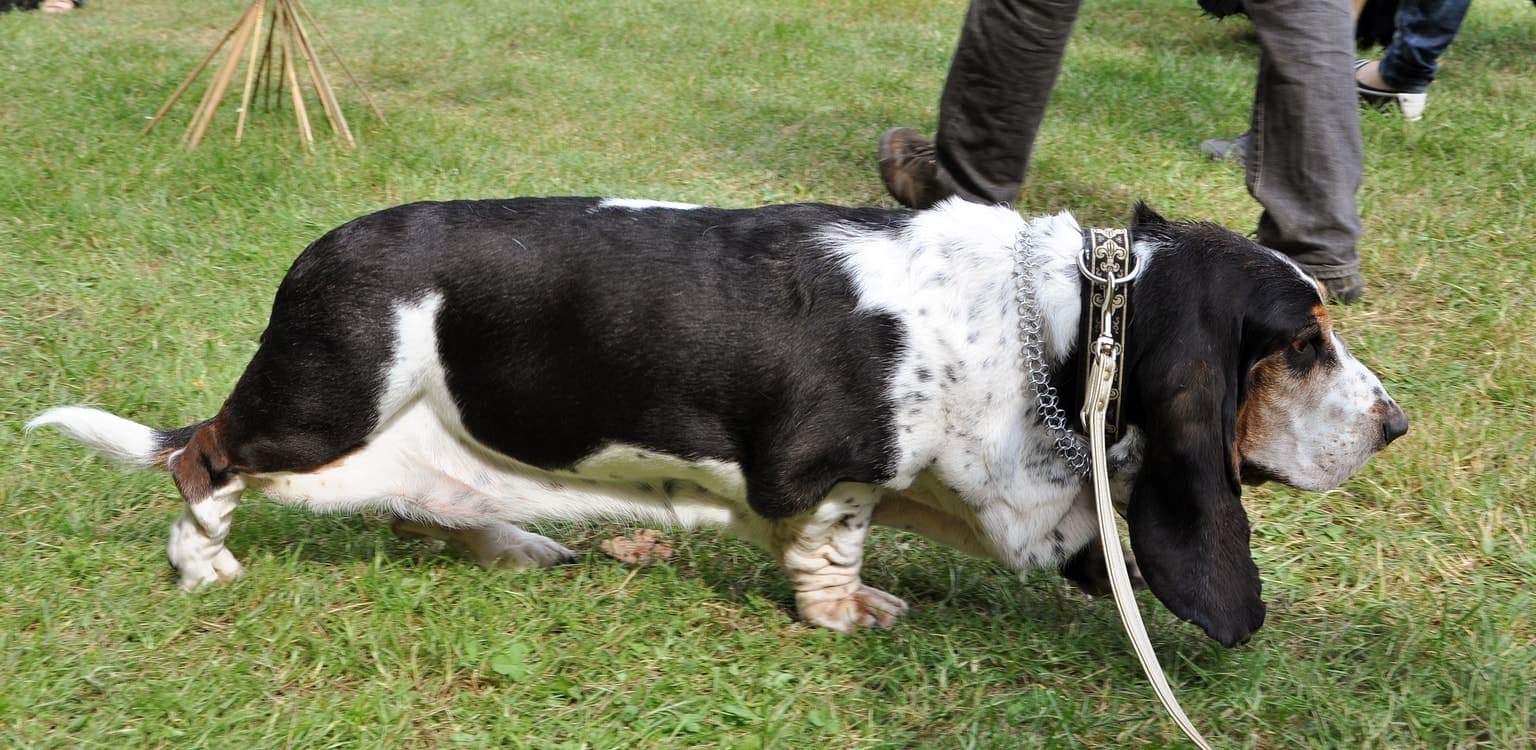
Photo by Amada44 · CC BY-SA 3.0
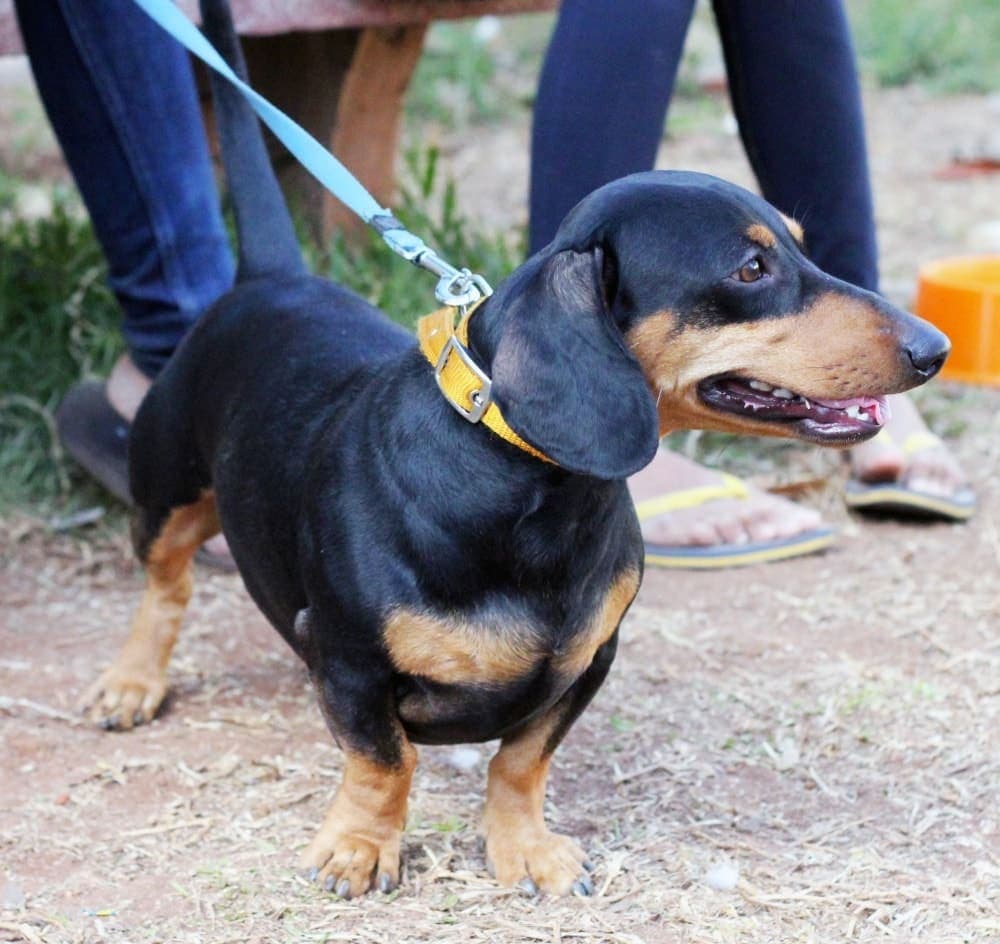
Photo by Pdpics · CC BY-SA 3.0
Quick facts
| Fact | Basset Hound | Dachshund |
|---|---|---|
| Group | Hound | Hound |
| Size | medium | small |
| Height | up to 15 in | 8-9 in |
| Weight | 40-65 lbs | 16-32 lbs |
| Lifespan | 12-13 years | 12-16 years |
| Temperament | Easygoing, Stubborn, Friendly, Scent-driven | Bold, Curious, Clever, Devoted |
How to tell them apart
Read the rows top to bottom. The first two or three traits usually settle it; the rest confirm.
| Trait | Basset Hound | Dachshund |
|---|---|---|
| Size | 40 to 65 lbs. The AKC standard says height should not exceed 14 in, and a height over 15 in is a disqualification. | 16 to 32 lbs in the standard size and 11 lbs or less in the miniature. The AKC standard gives no height; the site's breed profile lists 8 to 9 in. |
| Skin and dewlap | Loose and elastic, falling in distinct wrinkles over the brow when the head is lowered, with pendulous lips, loose flews and a very pronounced dewlap. The forelegs have wrinkled skin. | Elastic and pliable without excessive wrinkling. Lips are tightly stretched and the neck is clean-cut, without dewlap. |
| Ears | Extremely long, velvety and hanging in loose folds, set low and far back so that they appear to be set on the neck. Drawn forward, they fold well over the end of the nose. | Moderate in length and rounded, set near the top of the head. When the dog is alert the forward edge just touches the cheek, so the ears frame the face. |
| Head and eyes | Large, with a well-domed skull, a moderately defined stop and a deep, heavy muzzle. Eyes are soft, sad and slightly sunken, showing a prominent haw. | Tapers evenly to the tip of the nose, with little visible stop and a fine, slightly arched muzzle. Eyes are almond-shaped, very dark and dark-rimmed, with an energetic expression. |
| Coat | One coat: hard, smooth and short. A distinctly long coat is a disqualification. | Three coat varieties: smooth, wirehaired with a beard and eyebrows, and longhaired with feathering on the ears, chest, underside, legs and tail. |
| Colour | Any recognised hound colour, with the distribution of colour and markings of no importance. | Red or cream; black, chocolate, wild boar, grey or fawn with tan or cream markings; and the dapple, brindle, piebald and sable patterns. Other colours or patterns are a disqualification. |
| AKC group and origin | Hound Group, recognised in 1885. Bred in France and Belgium to trail rabbit and deer at a pace hunters could follow on foot. | Hound Group, recognised in 1885. Developed in Germany, where the name means badger dog, to dig into badger dens. |
What the photo detector sees
With something for scale in the frame, weight and bone separate the two. In the saved benchmark runs for this project, none of the tested AI models gave the other breed as its first answer for either breed's reference photos. The Basset Hound was the second suggestion in twelve of the fifteen saved answers for Dachshund photos, and the Dachshund was not suggested for any Basset Hound photo.
The pictures that mislead are side views with no scale, and Dachshunds with white in the coat. The Dachshund standard accepts a piebald pattern, with clearly defined patches of white on a one-coloured or two-coloured dog, and the Basset standard accepts any hound colour with any distribution of markings, so colour cannot separate them. Check the ear set and the skin in those cases. Coat is a one-way clue: a wirehaired or longhaired dog is not a Basset, but a smooth coat fits either breed.
Living with them
The two standards describe different characters. The Basset is mild, never sharp or timid, and the AKC notes that it was developed to work in a pack and enjoys the company of other dogs. The Dachshund is clever, lively and courageous to the point of rashness, and the AKC calls it a vigilant watchdog with a big-dog bark. The AKC describes both as independent and a challenge to train, because each was bred to follow a trail without distraction.
A daily walk at a moderate pace suits a Basset, and the AKC suggests two moderate walks a day for a Dachshund. To protect the Dachshund's long back from disc damage, it advises keeping the dog lean and not letting it run on stairs or jump on and off furniture. The Basset's short coat can shed profusely and needs weekly brushing, and Dachshund grooming depends on the coat variety. Both have drop ears that need to be kept clean. The profiles list a lifespan of 12 to 13 years for the Basset Hound and 12 to 16 years for the Dachshund.
Not sure which one you have?
Upload a clear photo and the detector returns a ranked shortlist, so you can check the top matches against the tells above instead of guessing from one label.
Upload a photo and get a ranked shortlistFAQ
What is the difference between a Basset Hound and a Dachshund?
A Basset Hound is a heavy-boned hound of 40 to 65 lbs with loose, wrinkled skin, a dewlap and extremely long, low-set ears. A Dachshund weighs 16 to 32 lbs, or 11 lbs or less as a miniature, and has close-fitting skin, a tapering head and shorter ears set near the top of the head.
Are Basset Hounds and Dachshunds related?
The AKC gives them separate origins. It traces the Basset Hound to France and Belgium, as a low scenting hound for trailing rabbit and deer, and the Dachshund to Germany, as a dog bred to go underground after badgers. The AKC texts used for this page do not describe a common ancestor.
Which is bigger, a Basset Hound or a Dachshund?
The Basset Hound. It weighs 40 to 65 lbs, and its standard says height should not exceed 14 in. A standard Dachshund weighs 16 to 32 lbs, and the site's breed profile lists its height as 8 to 9 in.
Can a Dachshund have white patches like a Basset Hound?
Yes. The AKC Dachshund standard accepts the piebald pattern, which has clearly defined areas of white on a one-coloured or two-coloured dog, and it disqualifies a head that is more than half white. Ear set, skin and weight still separate a piebald Dachshund from a Basset.
Do both breeds need their backs protected?
The AKC raises it for the Dachshund: it advises keeping the dog from becoming overweight and avoiding stairs and jumping, to prevent disc damage to the long back. Its Basset Hound health text does not single out the back, but it does say regular exercise helps prevent a Basset becoming overweight. A vet can advise on an individual dog.
Full profiles
More look-alikes
Other comparisons that include one of these breeds or come from the same look-alike group:
Browse every pair in the breed comparison index.