Chow Chow vs Chinese Shar-Pei
The Chow Chow and the Chinese Shar-Pei are both medium-sized Chinese breeds that are square in profile, with a broad muzzle, small ears, a high-set tail, a scowling expression and a blue-black tongue. The AKC breed page for the Shar-Pei describes them as the only two breeds with that tongue colour. The pair is hardest to separate when the Chow is a smooth-coated one, which has no ruff, or when either dog is a puppy.
Coat is the fastest tell. The usual rough-coated Chow has an abundant, dense, stand-off coat with a profuse ruff framing the head and a well-feathered tail. A Shar-Pei has an extremely harsh, short coat that the standard limits to 1 in at the withers, over loose skin that forms wrinkles on the head, neck and withers.
When the coat does not settle it, look at the ears. A Chow's ears are carried stiffly erect with a slight forward tilt. A Shar-Pei's ears are extremely small and lie flat against the head, pointing toward the eyes. Each standard disqualifies the other breed's ear carriage: a drop ear on a Chow and a pricked ear on a Shar-Pei.
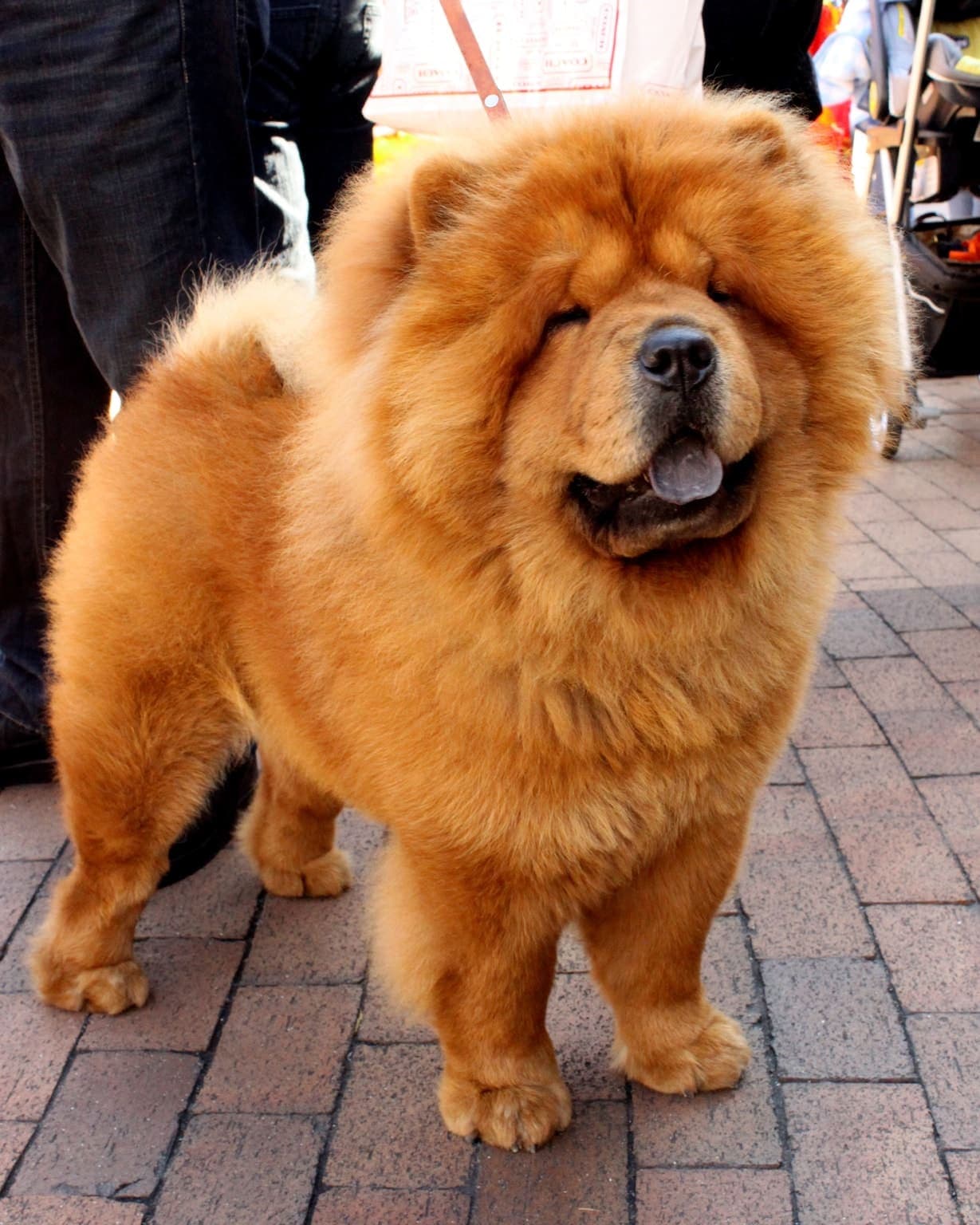
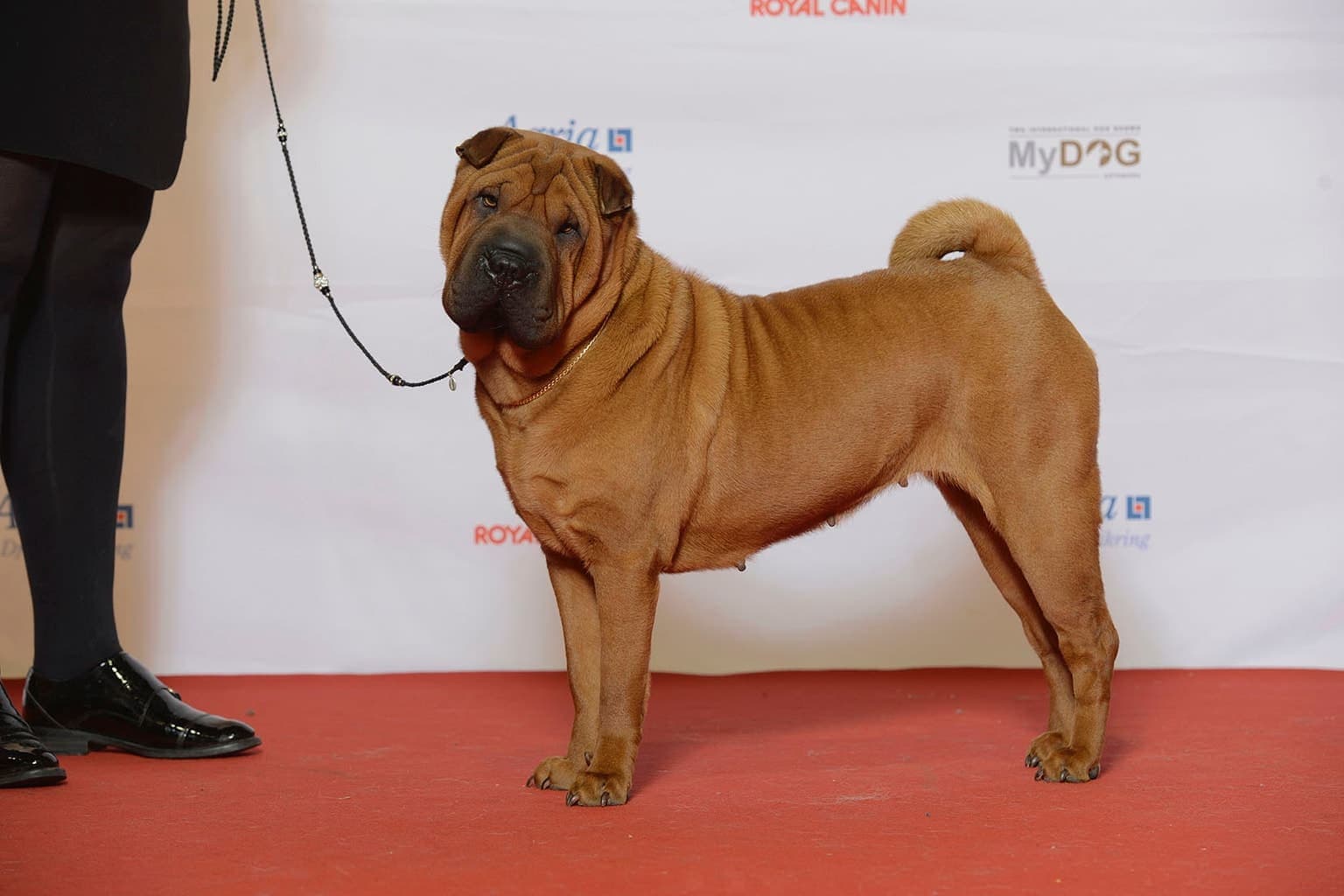
Quick facts
| Fact | Chow Chow | Chinese Shar-Pei |
|---|---|---|
| Group | Non-Sporting | Non-Sporting |
| Size | medium | medium |
| Height | 17-20 in | 18-20 in |
| Weight | 45-70 lbs | 45-60 lbs |
| Lifespan | 8-12 years | 8-12 years |
| Temperament | Independent, Reserved, Dignified, Loyal | Loyal, Reserved, Calm, Independent |
How to tell them apart
Read the rows top to bottom. The first two or three traits usually settle it; the rest confirm.
| Trait | Chow Chow | Chinese Shar-Pei |
|---|---|---|
| Coat | Two coat types, both double. Rough: abundant, dense, straight and stand-off, with a profuse ruff around the head and neck and a feathered tail. Smooth: hard, dense and smooth with a definite undercoat and no obvious ruff or feathering. | Extremely harsh, absolutely straight and stand-off on the body, from a very short horse coat up to a brush coat of no more than 1 in at the withers. A soft, wavy or trimmed coat is a major fault. |
| Ears | Small, moderately thick and triangular with slightly rounded tips, carried stiffly erect with a slight forward tilt. A drop ear is a disqualification. | Extremely small, rather thick equilateral triangles that lie flat against the head, set high and forward and pointing toward the eyes. A pricked ear is a disqualification. |
| Skin and wrinkles | A marked brow and a furrow between the eyes create the scowl. The standard says excessive loose skin is not desirable and wrinkles on the muzzle are not required. | Loose skin covers the head and body. Profuse wrinkles on the forehead continue into side wrinkles framing the face, with folds and an abundant dewlap at the neck and throat. The wrinkles are heaviest in puppies. |
| Tail and topline | Tail set high and carried closely to the back at all times. The topline is straight and level from the withers to the root of the tail. | Tail thick and round at the base, tapering to a fine point and curling over or to either side of the back. The topline dips slightly behind the withers and rises slightly over the loin. |
| Size | 17 to 20 in and 45 to 70 lbs. The AKC standard gives the height as an average for adults and gives no weight. Heavy bone. | 18 to 20 in and 45 to 60 lbs, as given in the AKC standard. Bone is substantial but never heavy. |
| Colour and tongue | Five solid colours: red, black, blue, cinnamon and cream, sometimes with lighter shading in the ruff, tail and feathering. The top of the tongue is solid blue-black; any red or pink on it is a disqualification. | Solid colours and sable only; a solid dog may have darker shading down the back and on the ears. The tongue is preferably solid bluish-black, or solid lavender in dilute colours. A spotted pink tongue is a major fault and a solid pink tongue is a disqualification. |
| AKC group and origin | Non-Sporting Group, recognised in 1903. The standard describes an ancient breed of northern Chinese origin used for hunting, herding, pulling and protection of the home. | Non-Sporting Group, recognised in 1992. The AKC history places it in China's southern provinces as a farm dog used for hunting, herding and guarding livestock. |
What the photo detector sees
A photo of an adult rough-coated Chow beside an adult Shar-Pei is easy to read from the coat alone. In the saved benchmark runs for this project, none of the tested AI models gave the other breed as its first answer for either breed's reference photos. The Chow Chow was the usual second suggestion on Shar-Pei photos, appearing in thirteen of the fifteen saved answers, and the Shar-Pei was the second suggestion in two of the fifteen saved answers for Chow photos.
The pictures that hide the difference are smooth-coated Chows, which have no ruff, and puppies: a Chow puppy's coat is soft and woolly all over, and a Shar-Pei puppy is covered in wrinkles that an adult may keep only on the head, neck and withers. The tongue does not separate the two, since both standards ask for blue-black, and it is only visible with the mouth open. A still photo also cannot show the Chow's short, stilted rear gait. Ear carriage is the feature to look for in every case.
Living with them
Both standards describe a dignified, independent dog that keeps its distance from strangers. The Chow standard calls for a dog that is reserved and discerning with strangers, and the AKC describes it as aloof with strangers and loyal to its own people. The Shar-Pei standard describes a dog that is somewhat standoffish with strangers but extreme in devotion to its family, and the AKC adds that the breed is suspicious of strangers and other dogs. The AKC recommends early socialisation and puppy classes for both and describes each as intelligent but stubborn.
Coat care differs most. The AKC advises thorough brushing at least twice a week and a monthly bath for a Chow, rough or smooth, and says the breed does not tolerate high heat or humidity well. It describes the Shar-Pei as needing only minimal grooming, with a bath about once a month and weekly ear cleaning. The AKC lists eyelid entropion among the conditions seen in both breeds, along with hip and elbow dysplasia in the Chow and a range of eye and skin disorders in the Shar-Pei. The profiles list a lifespan of 8 to 12 years for both breeds.
Not sure which one you have?
Upload a clear photo and the detector returns a ranked shortlist, so you can check the top matches against the tells above instead of guessing from one label.
Upload a photo and get a ranked shortlistFAQ
What is the difference between a Chow Chow and a Chinese Shar-Pei?
Coat, ears and skin. A Chow Chow has a dense double coat, usually with a ruff around the head, and small erect ears. A Chinese Shar-Pei has a harsh coat no longer than 1 in, loose wrinkled skin, and tiny ears that lie flat against the head.
Are Chow Chows and Shar-Pei related?
Both are old Chinese breeds, and the AKC traces each back to the Han Dynasty. The AKC standard gives the Chow a northern Chinese origin, and the AKC history places the Shar-Pei in the southern provinces. The AKC texts used for this page do not describe a shared ancestor, so this page does not claim one.
Which is bigger, a Chow Chow or a Shar-Pei?
They are close. The Chow Chow stands 17 to 20 in and weighs 45 to 70 lbs, and the Shar-Pei stands 18 to 20 in and weighs 45 to 60 lbs. The Chow standard asks for heavy bone, while the Shar-Pei standard asks for substantial but never heavy bone.
Do both breeds have a blue-black tongue?
Yes. The Chow standard requires a solid blue-black tongue and disqualifies any red or pink on its top surface or edges. The Shar-Pei standard prefers solid bluish-black, accepts solid lavender in dilute colours, and disqualifies a solid pink tongue.
Which needs more grooming?
The Chow Chow. The AKC advises brushing a Chow thoroughly at least twice a week because the coat around the head and the puppy coat can mat badly. It describes the Shar-Pei as needing only minimal grooming, with regular ear cleaning and nail trimming.
Full profiles
Browse every pair in the breed comparison index.