Coton de Tulear vs Bichon Frise
The Coton de Tulear and the Bichon Frise overlap in almost every measurement. Both are sturdy white dogs of about 9 to 11.5 in at the shoulder, both sit in the AKC Non-Sporting Group, and both have round dark eyes, a black nose and lips, drop ears and a tail that curves over the back. Size will not separate them, so the answer is in the coat.
Look at how the hair behaves. A Bichon has a soft, dense undercoat under a coarser, curlier outer coat that stands off the body and springs back when patted, and it is scissored into a rounded powder-puff shape with a rounded head. A Coton has a long coat with the texture of cotton that may be very slightly wavy; in the show ring it is left natural, with the head hair falling over the eyes or brushed back. Tight curls are a severe fault in a Coton, and a limp coat that lies down is a very serious fault in a Bichon.
If both dogs are clipped short, check the tail and the outline. A Bichon's tail is set level with the back and stays curved over it. A Coton's tail is set low and, when the dog is standing at rest, hangs down with the tip hooked upward. The Coton is also the longer dog for its height, and the Bichon carries its head on a long, arched neck.
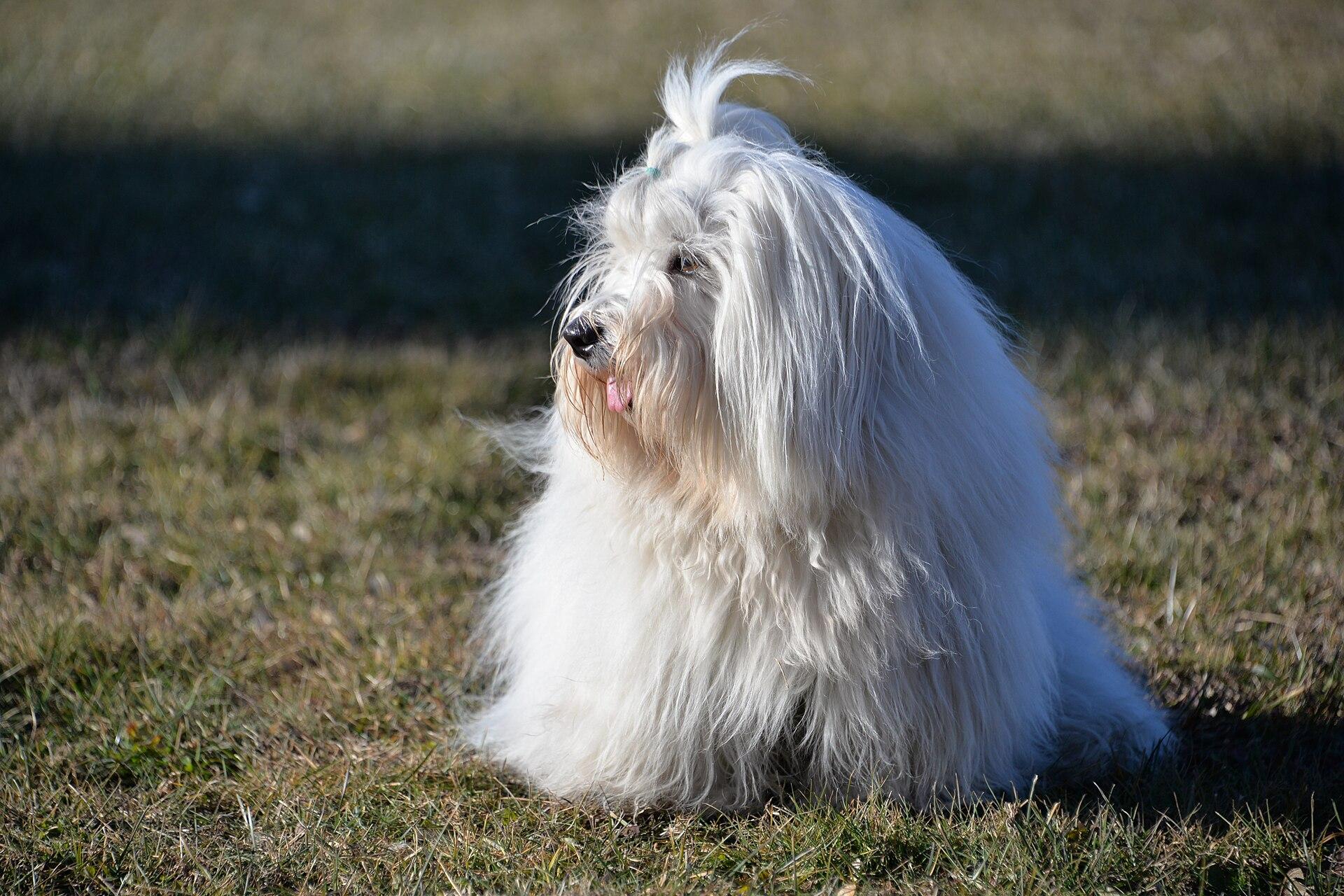
Photo by Sbrandner · CC BY-SA 4.0
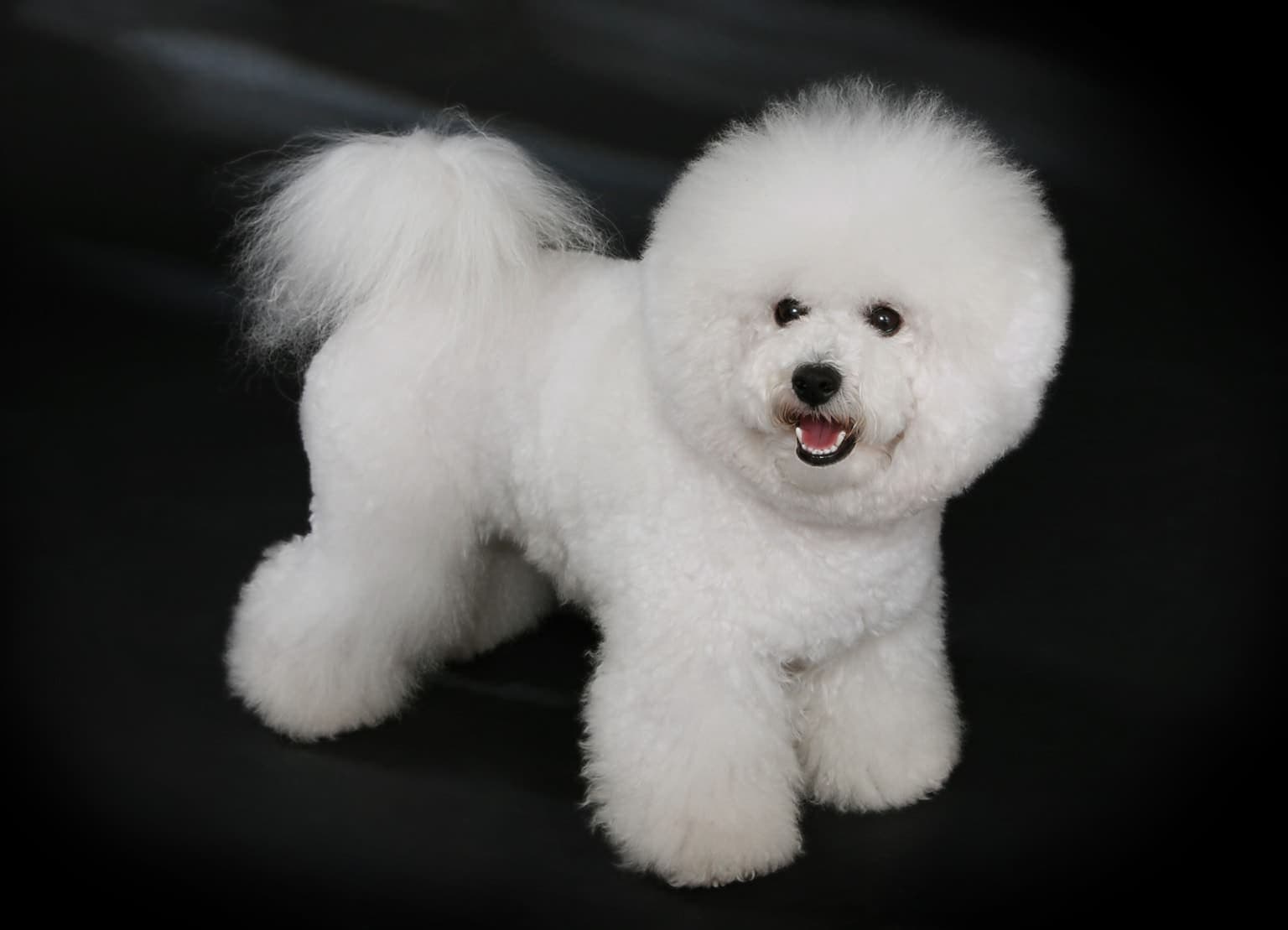
Photo by Heike Andres · CC BY-SA 3.0 de
Quick facts
| Fact | Coton de Tulear | Bichon Frise |
|---|---|---|
| Group | Non-Sporting | Non-Sporting |
| Size | small | small |
| Height | 9-11 in | 9.5-11.5 in |
| Weight | 8-15 lbs | 12-18 lbs |
| Lifespan | 15-19 years | 14-15 years |
| Temperament | Affectionate, Cheerful, Social, Gentle | Cheerful, Affectionate, Social, Playful |
How to tell them apart
Read the rows top to bottom. The first two or three traits usually settle it; the rest confirm.
| Trait | Coton de Tulear | Bichon Frise |
|---|---|---|
| Coat texture | Soft and supple like cotton, dense and profuse, sometimes very slightly wavy. Never hard or rough; tightly curled, woolly or silky hair is a severe fault. | Soft, dense undercoat with a coarser, curlier outer coat; feels like plush or velvet and springs back when patted. A limp, silky coat or one that lies down is a very serious fault. |
| Trim and head hair | Shown naturally. Long, untrimmed head hair falls over the eyes or is brushed back, and sculpting the coat is severely penalised. | Trimmed to follow the body's outline and rounded off from every direction, with the head hair shaped to a rounded impression and the beard, moustache, ears and tail left longer. |
| Tail | Set low. At rest it is carried below the hock with the tip raised; on the move it curves over the back. | Set level with the topline and curved over the back so the plume rests on it. A low set or a tail that droops behind is severely penalised. |
| Body outline | Height at the withers is two-thirds of body length, giving a rectangular outline. The topline arches slightly from the loin over the croup. | Body one-quarter longer than the height at the withers. The topline is level except for a slight arch over the loin, and the neck is long and arched. |
| Eyes and ears | Rather rounded, dark brown or black eyes set wide apart, with black rims. Ears set high and reaching the corners of the lips. | Round, black or dark brown eyes looking directly forward, surrounded by halos of black or very dark brown skin. Ear leathers reach about halfway along the muzzle. |
| Size | 9 to 11 in and 8 to 15 lbs. Males over 12 in and females over 11 in are disqualified. | 9.5 to 11.5 in and 12 to 18 lbs. The standard allows no latitude beyond 12 in or under 9 in for adults. |
| AKC group and origin | Non-Sporting Group, recognised in 2014. A companion dog from Madagascar, named for the port of Tulear. | Non-Sporting Group, recognised in 1972. A Mediterranean breed descended from the Bichon Tenerife of the Canary Islands, long kept at the courts of Spain, Italy and France. |
What the photo detector sees
Grooming decides how hard this pair is in a photo. A Bichon in a full rounded trim and a Coton in a long natural coat are two different silhouettes. A short pet clip takes away both, and what is left is two white dogs of the same height. In the saved benchmark runs for this project, none of the answers for Bichon Frise reference photos named the Coton de Tulear first, but it was the runner-up in eleven of the fifteen.
For a clipped dog, the best photo is taken from the side while the dog stands relaxed, so that the tail set and body length are visible, and in even light, because white coats lose their texture in strong sun. A close photo of the face can show the Bichon's dark halos around the eyes. Tan or grey patches on a puppy do not settle it, since both standards accept colour in young dogs. The Maltese is another small white breed that the saved answers pair with the Coton.
Living with them
Temperament is close. The Bichon standard asks for a gentle-mannered, sensitive, playful and affectionate dog and calls a cheerful attitude the hallmark of the breed. The Coton standard describes a happy, stable dog that is very sociable with people and other dogs, clownish and lighthearted. The AKC says a Bichon regularly left alone is likely to develop undesirable behaviours, that a Coton needs plenty of attention from its owner, and that both respond best to positive training. It also notes that Bichons have a reputation for being difficult to housebreak, while describing Cotons as naturally territorial and alert.
The coats set different routines. The AKC says a Bichon should be brushed at least two or three times a week and needs a bath and clipping at least monthly, with most pet owners using a groomer every four to six weeks. It says a Coton kept in long coat needs daily brushing down to the skin, and that a short puppy clip is the alternative. Both need daily walks or play. The AKC lists luxating patellas among the conditions seen in both breeds. The profiles list a lifespan of 15 to 19 years for the Coton de Tulear and 14 to 15 years for the Bichon Frise.
Not sure which one you have?
Upload a clear photo and the detector returns a ranked shortlist, so you can check the top matches against the tells above instead of guessing from one label.
Upload a photo and get a ranked shortlistFAQ
What is the difference between a Coton de Tulear and a Bichon Frise?
The coat and the tail. A Bichon Frise has a curly, springy double coat trimmed into a rounded shape, and its tail stays curved over the back. A Coton de Tulear has a loose, cotton-textured coat left natural, and its low-set tail hangs with a hooked tip when the dog is at rest. They are about the same height.
Is a Coton de Tulear a type of Bichon?
Not in AKC terms. The AKC registers them as separate breeds and places the Bichon Frise among the Barbichon types together with the Bolognese, Havanese and Maltese; that list does not name the Coton. The Coton's early history on Madagascar is not documented, so these sources do not establish a family link.
Which is bigger, a Coton de Tulear or a Bichon Frise?
They are about the same height: 9 to 11 in for the Coton de Tulear and 9.5 to 11.5 in for the Bichon Frise. The profiles list the Bichon as slightly heavier, 12 to 18 lbs against 8 to 15 lbs. Size is not a reliable way to tell them apart.
Does a Coton de Tulear have curly hair like a Bichon?
No. The Coton standard describes a cotton-textured coat that can be very slightly wavy, and it lists tightly curled or woolly hair as a severe fault. The Bichon standard describes a curlier outer coat over a dense undercoat that stands off the body. A small white dog with tight curls all over is unlikely to be a Coton.
Which needs more professional grooming?
The Bichon Frise. The AKC says it needs a bath and clipping at least once a month and that most pet owners visit a groomer every four to six weeks. A Coton's coat is not sculpted, but the AKC says it needs daily brushing to the skin unless it is kept in a short puppy clip.
Full profiles
More look-alikes
Other comparisons that include one of these breeds or come from the same look-alike group:
Browse every pair in the breed comparison index.