German Shepherd vs Belgian Sheepdog
The German Shepherd Dog and the Belgian Sheepdog are large herding breeds of the same height, 22 to 26 in, with erect ears, a wedge-shaped head, a deep chest and a tail that reaches the hock. The German Shepherd standard says most colours are permissible and does not list black among its colour faults, so a black German Shepherd fits it, and a black shepherd with upright ears is where the two get confused.
Colour and coat settle most cases. A Belgian Sheepdog is always black, with white allowed only in small areas such as the forechest, the toes and the chin, and its coat is long, straight and abundant, with a collarette around the neck, a fringe down the back of the forelegs, breeches on the hindquarters and heavy hair on the tail. A German Shepherd has a medium-length coat that lies close to the body. Any dog with tan, sable or other colour in the coat is not a Belgian Sheepdog.
If the dog is black and the coat length is hard to judge, look at the outline from the side. A Belgian Sheepdog is square: its length equals its height, and it carries its head and neck very proudly. A German Shepherd is longer than tall, in a proportion of about 10 to 8.5, with a long, gradually sloping croup and an outline of smooth curves.
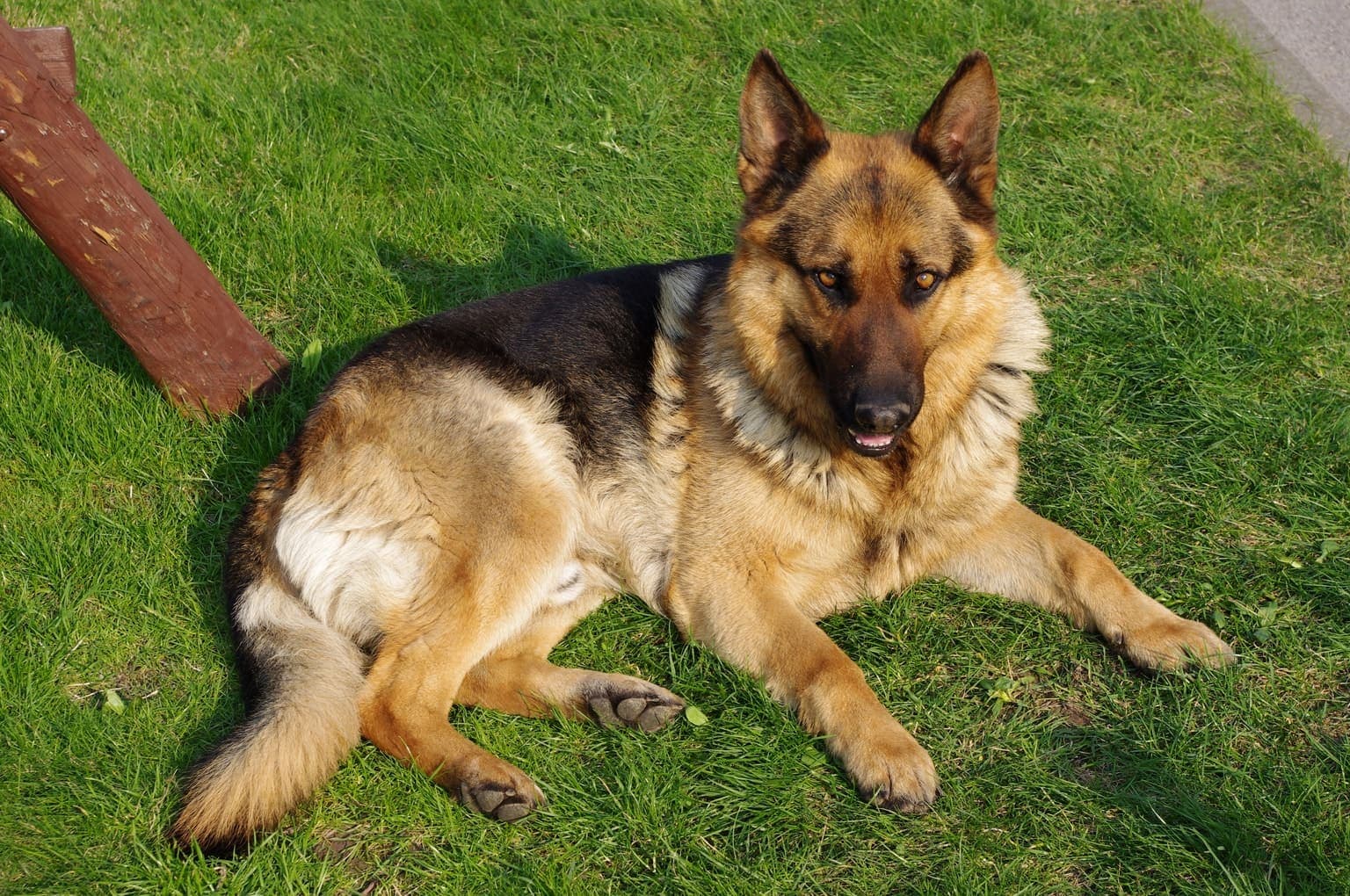
Photo by Jakub Hałun · CC BY-SA 4.0
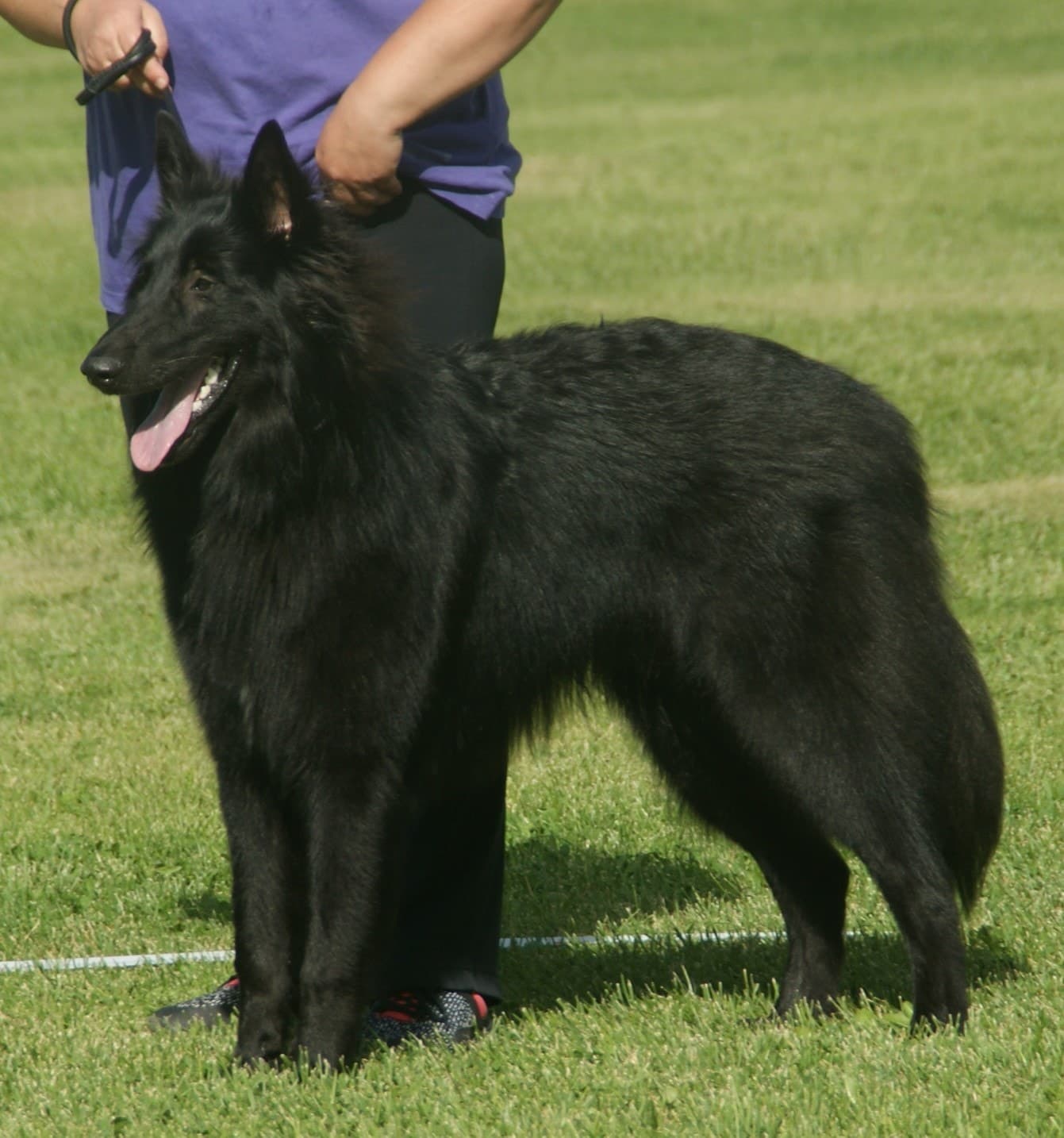
Photo by Canarian · CC BY-SA 4.0
Quick facts
| Fact | German Shepherd Dog | Belgian Sheepdog |
|---|---|---|
| Group | Herding | Herding |
| Size | large | large |
| Height | 22-26 in | 22-26 in |
| Weight | 50-90 lbs | 45-75 lbs |
| Lifespan | 12-14 years | 12-14 years |
| Temperament | Loyal, Confident, Courageous, Highly trainable | Intelligent, Driven, Loyal, Alert |
How to tell them apart
Read the rows top to bottom. The first two or three traits usually settle it; the rest confirm.
| Trait | German Shepherd Dog | Belgian Sheepdog |
|---|---|---|
| Colour | Varies; most colours are permissible and strong, rich colours are preferred. Pale, washed-out colours, blues and livers are serious faults, and a white dog is disqualified. | Black only. White is limited to a small to moderate patch or strip on the forechest, between the pads, on the tips of the toes, and as frost on the chin and muzzle. Any other colour is a disqualification. |
| Coat | Medium-length double coat with a dense, straight, harsh outer coat lying close to the body; short on the head, legs and paws, longer and thicker on the neck. A soft, silky or too long outer coat is a fault. | Long, straight, abundant guard hairs of medium harshness over an extremely dense undercoat, with a collarette, a fringe on the forearms, breeches and a heavily coated tail. Shorter on the head and lower legs. |
| Outline | Longer than tall, about 10 to 8.5, and deep-bodied, with withers higher than the back and a long, gradually sloping croup. The head is carried forward rather than up when the dog is moving. | Square, with length from breastbone to rump equal to height at the withers. Level, straight back and an exceedingly proud carriage of the head and neck. |
| Size | 22 to 26 in and 50 to 90 lbs. Males 24 to 26 in, females 22 to 24 in. | 22 to 26 in and 45 to 75 lbs. Males 24 to 26 in, females 22 to 24 in; males under 22.5 in or over 27.5 in and females under 20.5 in or over 25.5 in are disqualified. |
| Head and ears | Strong and cleanly chiselled, with a moderately arched forehead sloping into a long, wedge-shaped muzzle without an abrupt stop. Ears moderately pointed, open toward the front and carried erect. | Clean-cut, with a flattened top to the skull, a moderate stop and a moderately pointed muzzle about as long as the topskull. Ears triangular, stiff and erect, in proportion to the head. |
| Tail and movement | Bushy tail set low, hanging in a slight sabre curve at rest. A trotting dog with a long, outreaching, ground-covering stride. | Tail held low at rest with the tip bent back level with the hock, raised with a curl toward the tip in action. Moves smoothly and easily rather than with a hard driving action, and tends to move in a circle rather than a straight line. |
| AKC group and origin | Herding Group. Developed in Germany at the end of the 1800s, when Captain Max von Stephanitz and other breeders crossed herding strains from the northern and central districts. | Herding Group. The long-haired black variety of Belgium's shepherd dogs, classified in the 1890s and also called the Groenendael after the Chateau Groenendael near Brussels, run by the breeder Nicolas Rose. |
What the photo detector sees
A side view in good light shows everything that matters here: coat length, the collarette and breeches, and whether the outline is square or long. Black coats are hard to photograph. In shade or against a dark background the feathering and the edge of the dog disappear, and a head-on portrait removes the proportions altogether. The Belgian Sheepdog standard also notes that a black coat can redden with climatic conditions, so a reddish tinge does not by itself mean another breed. In the saved benchmark runs for this project, none of the Belgian Sheepdog reference photos was answered as a German Shepherd Dog, but the German Shepherd was the second choice in all but one of those answers. The German Shepherd reference photos were not answered as Belgian Sheepdog, and it was not offered as their second choice.
The breeds closest to the Belgian Sheepdog are the other Belgian shepherds. The AKC breed history describes the Belgian Sheepdog, Malinois, Tervuren and Laekenois as anatomically identical but varied in coat texture, colour and length, so a square, long-coated shepherd that is fawn rather than black points to a Belgian Tervuren, and a short-coated fawn one to a Belgian Malinois. A black shepherd with a medium, close-lying coat and a longer body is more likely a German Shepherd. The detector reports visual similarity, not ancestry.
Living with them
Both are intelligent herding dogs that bond closely with their people and need training and daily work. The German Shepherd standard describes a self-confident dog with a certain aloofness that does not make immediate friendships, and the AKC calls it a very active breed that requires lots of exercise. The Belgian Sheepdog standard asks for a dog that is observant and vigilant with strangers but not apprehensive, and affectionate and possessive with those it knows well. The AKC describes it as a sensitive breed that craves human company, so its owner should expect to take part in its daily exercise rather than leave it in a yard.
The German Shepherd needs a quick brushing every few days and sheds more heavily once or twice a year. The Belgian Sheepdog needs a weekly brushing for most of the year and a thorough daily brushing when it sheds heavily, at least once a year. The AKC lists degenerative myelopathy and elbow and hip dysplasia among the conditions German Shepherd breeders screen for, and says owners should learn the signs of bloat. For the Belgian Sheepdog it lists epilepsy, elbow and hip dysplasia, eye conditions and certain cancers, and notes a particular sensitivity to anaesthesia. The profiles list a lifespan of 12 to 14 years for each breed.
Not sure which one you have?
Upload a clear photo and the detector returns a ranked shortlist, so you can check the top matches against the tells above instead of guessing from one label.
Upload a photo and get a ranked shortlistFAQ
What is the difference between a German Shepherd and a Belgian Sheepdog?
A Belgian Sheepdog is always black, with a long, abundant coat and a square outline in which length equals height. A German Shepherd has a medium-length, close-lying coat in a range of colours and is longer than tall. Both stand 22 to 26 in; the profiles list 50 to 90 lbs for the German Shepherd and 45 to 75 lbs for the Belgian Sheepdog.
Are German Shepherds and Belgian Sheepdogs related?
They are separate breeds from different countries, both shaped from local herding dogs in the late 1800s. The German Shepherd was developed from German herding strains. The Belgian Sheepdog, also called the Groenendael, is one of four Belgian shepherd types alongside the Malinois, Tervuren and Laekenois.
Which is bigger, a German Shepherd or a Belgian Sheepdog?
They are the same height: both standards ask for 24 to 26 in for males and 22 to 24 in for females. The German Shepherd is the heavier dog in the profiles, at 50 to 90 lbs against 45 to 75 lbs.
Is a black German Shepherd the same as a Belgian Sheepdog?
No. The German Shepherd standard permits most colours, so a black one is still a German Shepherd, with a medium-length coat and a body longer than it is tall. A Belgian Sheepdog has a long coat with a collarette and breeches and a square outline.
Which sheds more?
Both have double coats and shed heavily in season. The AKC suggests brushing a German Shepherd every few days, and more often during its heavier sheds once or twice a year. A Belgian Sheepdog needs weekly brushing for most of the year and daily brushing during its heavy shed.
Full profiles
More look-alikes
Other comparisons that include one of these breeds or come from the same look-alike group:
Browse every pair in the breed comparison index.