German Shorthaired Pointer vs Vizsla
The German Shorthaired Pointer and the Vizsla are medium-sized, short-coated hunting dogs of nearly the same height, with hanging ears, a chest that reaches the elbows and a docked tail. Both were bred as versatile gundogs for field and water, and the AKC notes that the Vizsla is also called the Hungarian Pointer. A solid liver German Shorthaired Pointer, a colour the AKC describes as a reddish brown, is the one closest to a Vizsla in colour.
Colour is still the fastest tell. A Vizsla is golden rust all over, and the only white its standard permits is a small mark on the forechest and white on the toes. A German Shorthaired Pointer is liver or black, and when it carries white the coat is ticked, patched or roan. Any ticking or roaning means the dog is not a Vizsla, and the German breed's standard disqualifies any area of red, orange, lemon or tan.
For a solid-coloured dog, compare the eyes with the coat. A Vizsla is self-coloured: its eyes, eye rims, lips, nose, toenails and pads blend with the golden rust coat. A liver German Shorthaired Pointer has a brown nose, and its standard prefers dark brown eyes. The tail is a further check, since the Vizsla keeps about two-thirds of its tail and the German Shorthaired Pointer about 40 percent.
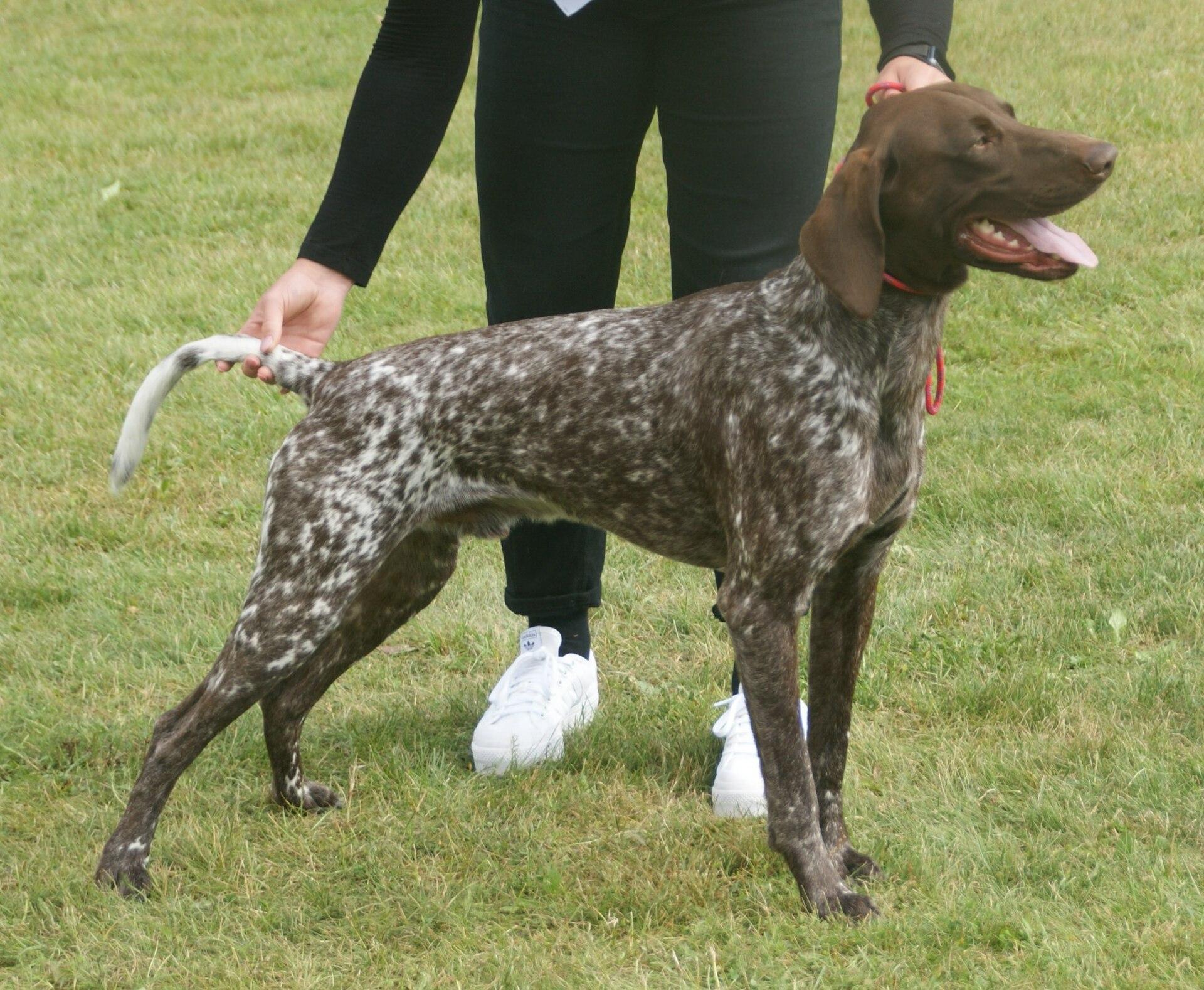
Photo by Canarian · CC BY-SA 4.0
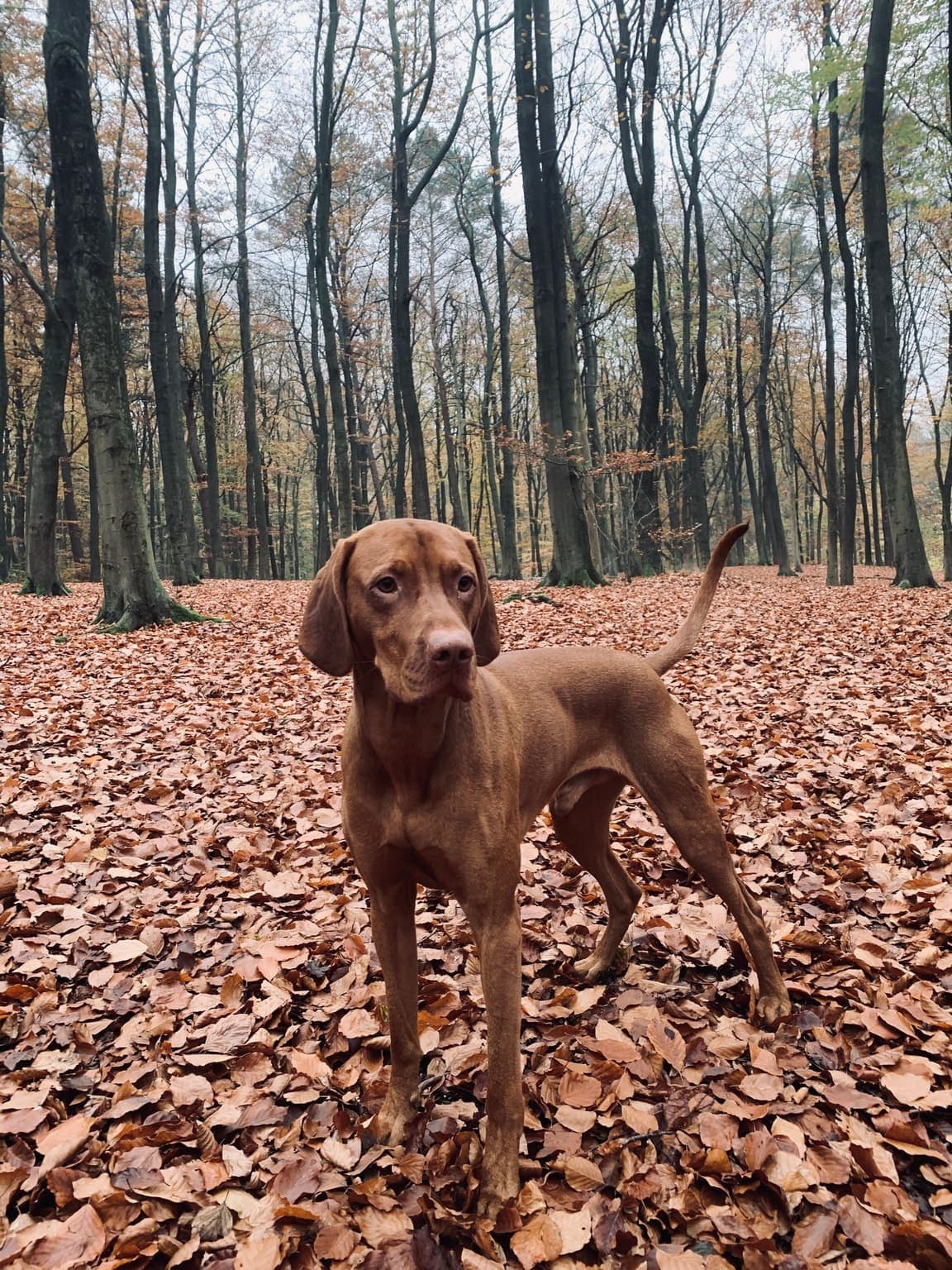
Photo by Florrez Maximal · CC BY 4.0
Quick facts
| Fact | German Shorthaired Pointer | Vizsla |
|---|---|---|
| Group | Sporting | Sporting |
| Size | medium | medium |
| Height | 21-25 in | 21-24 in |
| Weight | 45-70 lbs | 44-60 lbs |
| Lifespan | 10-12 years | 12-14 years |
| Temperament | Energetic, Athletic, Eager, Smart | Affectionate, Energetic, Sensitive, Eager |
How to tell them apart
Read the rows top to bottom. The first two or three traits usually settle it; the rest confirm.
| Trait | German Shorthaired Pointer | Vizsla |
|---|---|---|
| Colour | Solid liver or solid black, or either with white: ticked, patched and ticked, or roan. Any area of red, orange, lemon or tan, or a solid white coat, is a disqualification. | Golden rust in varying shades, often with lighter shading over the neck and shoulders. White only on the forechest and toes; white anywhere else is a disqualification. |
| Nose and eyes | Nose brown on a liver dog, black on a black dog. Almond-shaped eyes, dark brown preferred; light yellow eyes are a fault. | Nose, eye rims, lips and eyes blend with the coat. A partly or completely black nose is a disqualification, and yellow eyes are faulty. |
| Tail | Set high and docked, leaving about 40 percent of its length. | Set just below the level of the croup and docked with one-third removed, ideally reaching the back of the stifle joint. |
| Head and ears | Foreface rises gradually to the forehead with no definite stop. Broad ears set just above eye level, lying flat and reaching the corner of the mouth. | Lean and muscular with a moderate stop and a muzzle equal to or slightly shorter than the skull. Thin, silky, proportionately long ears with rounded ends, set fairly low. |
| Size | 21 to 25 in and 45 to 70 lbs. Males 23 to 25 in and 55 to 70 lbs, females 21 to 23 in and 45 to 60 lbs. | 21 to 24 in and 44 to 60 lbs. Males 22 to 24 in, females 21 to 23 in. The standard calls the breed robust but rather lightly built. |
| Coat | Short and thick, tough to the touch, slightly longer under the tail and on the back edges of the haunches. | Short, smooth, dense and close-lying, with no woolly undercoat. |
| AKC group and origin | Sporting Group, recognised in 1930. Developed by German hunters in the 1800s as an all-purpose gundog. | Sporting Group, recognised in 1960. A Hungarian hunting dog whose type was set by Hungarian nobles over centuries. |
What the photo detector sees
In the saved benchmark runs for this project, none of the fifteen answers for Vizsla reference photos named German Shorthaired Pointer first, and German Shorthaired Pointer was the second choice in eight of them. The runs did not include German Shorthaired Pointer reference photos. A ticked or roan coat removes the doubt in any photo; the difficult case is a solid liver dog.
Lighting decides how hard that case is. Warm evening light or a yellow indoor bulb can push liver toward red, and the Vizsla standard itself allows for varying shades, and lists solid dark mahogany as a fault. When the colour is in doubt, check whether the nose and eyes match the coat, look for any white beyond the forechest and toes, and compare how much tail is left. A photo that crops the tail or shows the dog from the front loses the last of these. Other solid-coloured short-coated breeds are covered on the Vizsla vs Weimaraner and Vizsla vs Rhodesian Ridgeback pages.
Living with them
Both breeds need an active owner. The AKC says the German Shorthaired Pointer has a very high energy level and a strong prey drive, does best with ample physical activity twice a day, and can be extremely challenging from six months to three years old. It describes the Vizsla as forming a tight bond with its owners and hating to be left alone; the breed standard calls it gentle-mannered, demonstrably affectionate and sensitive. For the Vizsla the AKC suggests at least 30 minutes of active exercise daily, with regular chances to run hard off the lead.
Grooming is light for both. The German Shorthaired Pointer needs a brush or grooming glove every few days and sheds more at certain times of year; the Vizsla, which has no undercoat, needs occasional brushing. The AKC notes that the German Shorthaired Pointer can be affected by bloat, and that responsible breeders of both breeds screen for conditions such as hip dysplasia and eye disorders. The profiles list a lifespan of 10 to 12 years for the German Shorthaired Pointer and 12 to 14 years for the Vizsla.
Not sure which one you have?
Upload a clear photo and the detector returns a ranked shortlist, so you can check the top matches against the tells above instead of guessing from one label.
Upload a photo and get a ranked shortlistFAQ
What is the difference between a German Shorthaired Pointer and a Vizsla?
Colour. A Vizsla is solid golden rust with a nose and eyes that blend with its coat. A German Shorthaired Pointer is liver or black, solid or with white ticking, patches or roan, with a brown or black nose. The German Shorthaired Pointer also runs heavier, and its tail is docked shorter.
Are German Shorthaired Pointers and Vizslas related?
They are separate breeds from Germany and Hungary. Both are versatile pointing dogs in the AKC Sporting Group, and the AKC notes that the Vizsla is also called the Hungarian Pointer. The AKC histories used for this page do not record one breed in the making of the other.
Which is bigger, a German Shorthaired Pointer or a Vizsla?
The German Shorthaired Pointer, slightly. Males stand 23 to 25 in against 22 to 24 in for Vizsla males, and females of both breeds stand 21 to 23 in. The profiles list 45 to 70 lbs for the German Shorthaired Pointer and 44 to 60 lbs for the Vizsla.
Can a Vizsla have white ticking or patches?
No. The AKC standard allows a Vizsla a small white mark on the forechest and white on the toes, and disqualifies white anywhere else. A rust or brown dog with a ticked, roan or patched coat is not a standard Vizsla; those patterns are in the German Shorthaired Pointer standard.
Can either breed be left alone during the day?
Neither copes well without company and activity. The AKC says Vizslas hate to be left alone, and that German Shorthaired Pointers need a purpose and can be destructive if left to their own devices. Both need daily exercise and training built into their routine.
Full profiles
More look-alikes
Other comparisons that include one of these breeds or come from the same look-alike group:
Browse every pair in the breed comparison index.