German Shorthaired Pointer vs English Pointer
The German Shorthaired Pointer and the English Pointer, which the AKC registers simply as the Pointer, are both short-coated pointing gundogs with hanging ears, a deep chest, a visible tuck-up and a coat that may be liver or black, solid or with white. They share a name and a job, and the German Shorthaired Pointer's own AKC standard describes parts of its head by saying how they differ from the Pointer's.
The tail is the fastest tell. The AKC standard for the German Shorthaired Pointer calls for a tail docked to about 40 percent of its length. The English Pointer's tail is left whole: heavier at the root, tapering to a fine point and no longer than the hock, and the standard penalises a docked one.
When the tail is out of the picture, look at the head in profile. An English Pointer has a pronounced stop, and its nose may sit slightly higher at the tip than the muzzle does at the stop. A German Shorthaired Pointer's foreface rises gradually to the forehead with no definite stop, and its standard treats a definite Pointer stop as a serious fault and a dish-shaped muzzle as a fault. Colour can rule a dog out as well: lemon or orange is an English Pointer colour and a disqualification in the German breed.
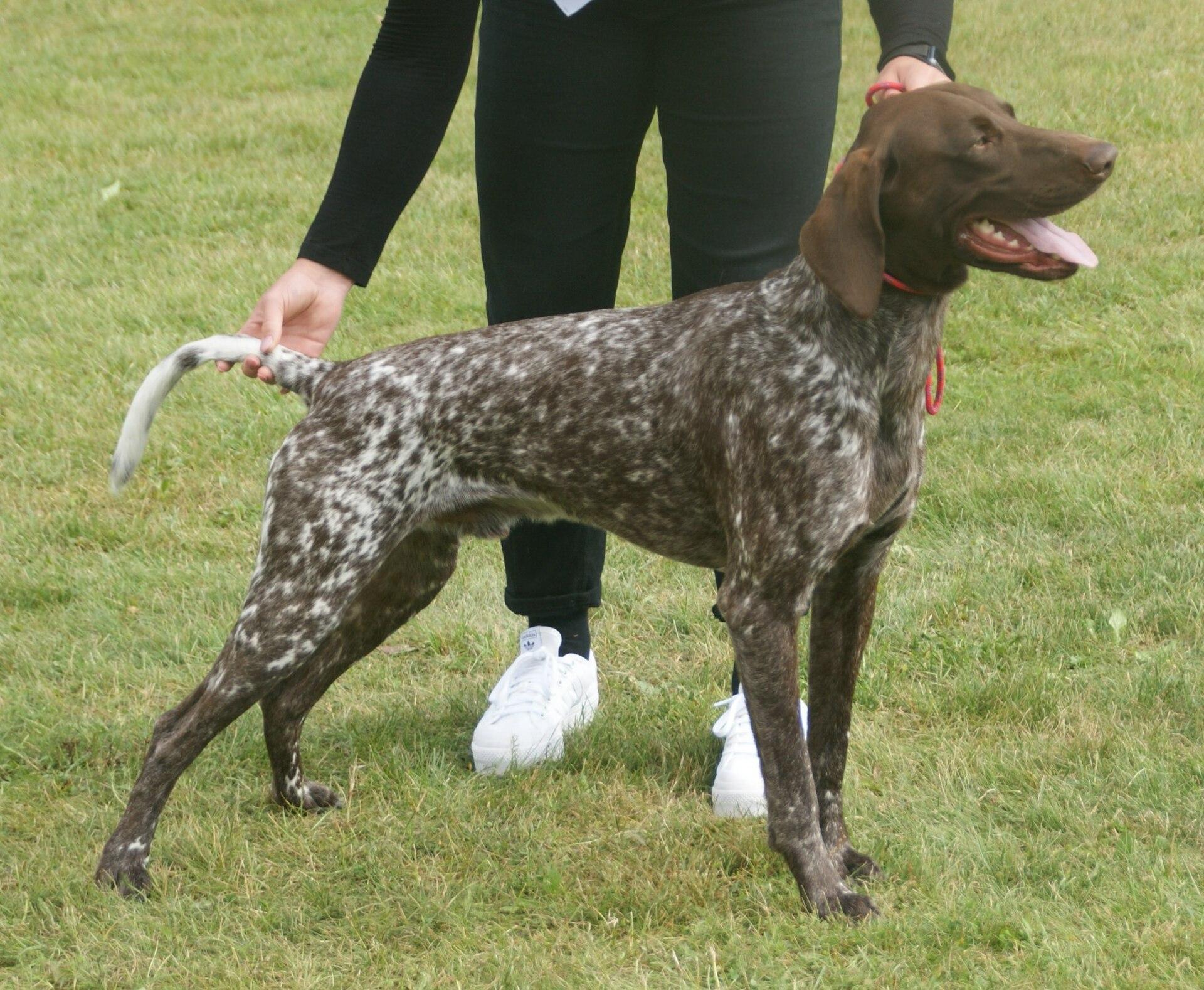
Photo by Canarian · CC BY-SA 4.0
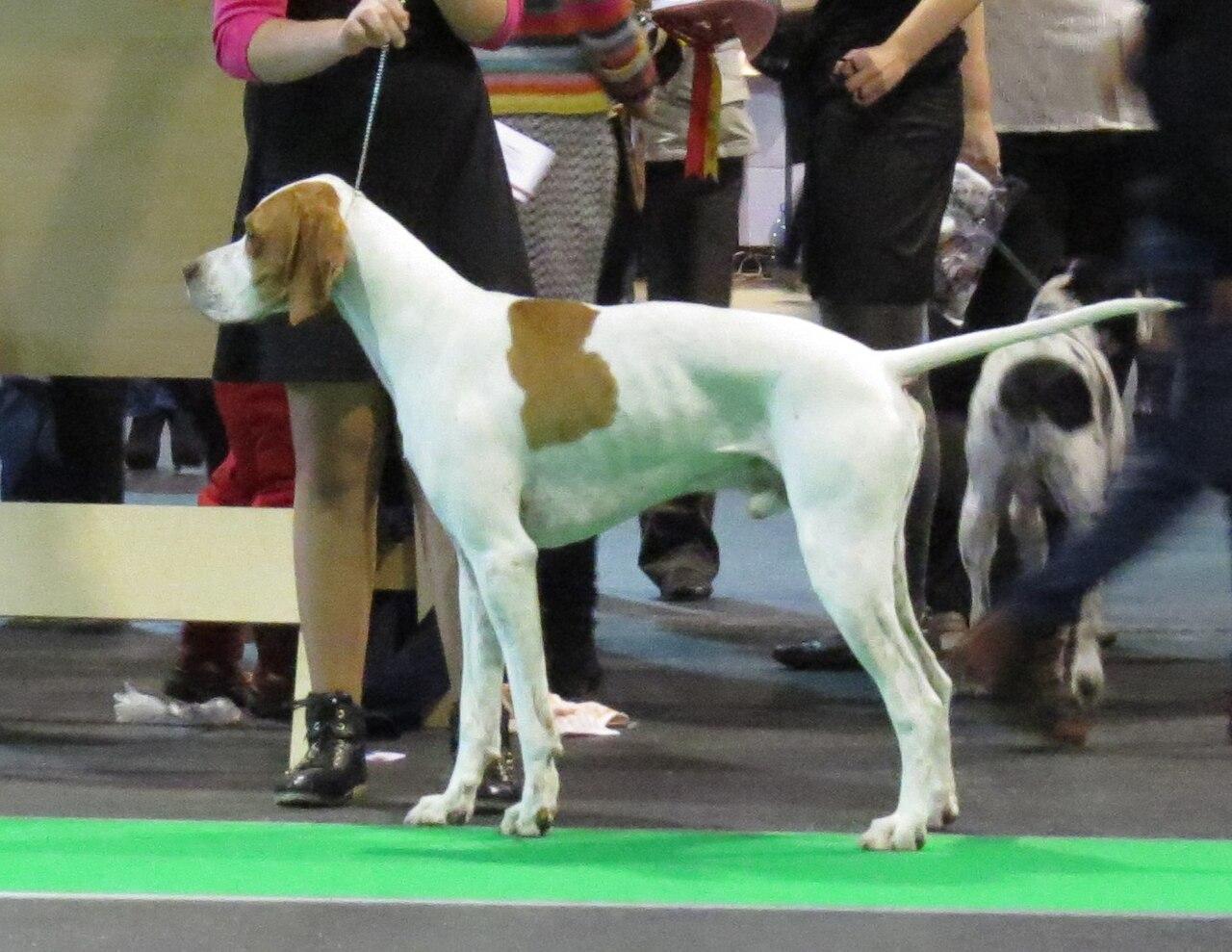
Photo by Томасина · CC BY-SA 3.0
Quick facts
| Fact | German Shorthaired Pointer | English Pointer |
|---|---|---|
| Group | Sporting | Sporting |
| Size | medium | large |
| Height | 21-25 in | 23-28 in |
| Weight | 45-70 lbs | 45-75 lbs |
| Lifespan | 10-12 years | 12-15 years |
| Temperament | Energetic, Athletic, Eager, Smart | Athletic, Even-tempered, Energetic, Focused |
How to tell them apart
Read the rows top to bottom. The first two or three traits usually settle it; the rest confirm.
| Trait | German Shorthaired Pointer | English Pointer |
|---|---|---|
| Tail | Set high and docked, leaving about 40 percent of its length; held horizontally when the dog is walking. | Undocked, heavier at the root and tapering to a fine point, no longer than the hock, carried without curl and not more than 20 degrees above the line of the back. |
| Head profile | No definite stop: the foreface rises gradually from nose to forehead, with only a stop-effect from the eyebrows. The occiput is not very conspicuous and the muzzle is as long as the skull. | A pronounced stop and a slight furrow between the eyes. The nose may be slightly higher at the tip than the muzzle at the stop, though parallel planes are equally acceptable. |
| Colour | Solid liver or solid black, or either with white: ticked, patched and ticked, or roan. Any area of red, orange, lemon or tan, or a solid white coat, is a disqualification. | Liver, lemon, black or orange, either solid or in combination with white. The standard says a good Pointer cannot be a bad colour. |
| Ears and eyes | Broad ears set just above eye level, lying flat and reaching the corner of the mouth. Almond-shaped eyes, dark brown preferred. | Thin ears set at eye level, reaching just below the lower jaw and somewhat pointed at the tip, never round. Rounded eyes of ample size, the darker the better. |
| Size | 21 to 25 in and 45 to 70 lbs. Males 23 to 25 in and 55 to 70 lbs, females 21 to 23 in and 45 to 60 lbs. | 23 to 28 in and 45 to 75 lbs. Males 25 to 28 in and 55 to 75 lbs, females 23 to 26 in and 44 to 65 lbs by the standard. |
| Coat, nose and feet | Short, thick hair that feels tough to the hand. Nose brown on a liver dog and black on a black dog; a flesh-coloured nose disqualifies. Compact feet, round to spoon-shaped. | Short, dense and smooth with a sheen. Nose black or brown in the darker colours, and it may be lighter or flesh-coloured in the lighter shades. Oval feet with long toes. |
| AKC group and origin | Sporting Group, recognised in 1930. Developed in Germany in the 1800s as an all-purpose gundog for field and water. | Sporting Group, recognised in 1878. A British pointing dog; the AKC dates the first Pointers in England to about 1650. |
What the photo detector sees
A photo answers this pair quickly if it shows the tail or a clean side view of the head. Many pet photos show neither: a sitting dog hides its tail, and a face-on portrait flattens the stop that separates the two profiles. Liver and white and black and white coats are allowed in both breeds, so colour only helps when it is lemon or orange, which points to the English Pointer. The saved benchmark runs for this project did not include reference photos of either breed, so they record nothing about this pair.
Those runs do show both breeds turning up beside other short-coated dogs. English Pointer was the second choice in eight of the fifteen saved answers for Dalmatian photos, and German Shorthaired Pointer was the second choice in eight of the fifteen for Vizsla photos. The detector reports visual similarity, not ancestry.
Living with them
Both are athletic Sporting dogs that need a great deal of daily exercise. The AKC standard describes the German Shorthaired Pointer as friendly, intelligent and willing to please, and the AKC warns that the breed has a very high energy level and a strong prey drive, can be extremely challenging from six months to three years old, and can be destructive without a purpose. It suggests ample physical activity twice a day. The English Pointer's standard stresses an even temperament and alert good sense, and the AKC says a securely fenced yard where it can run full out makes for a calmer companion indoors.
Both coats are easy to keep. The AKC suggests a brush or grooming glove every few days for the German Shorthaired Pointer, which still sheds, and a weekly brushing for the English Pointer. It notes that both breeds can experience bloat and that responsible breeders screen for conditions such as hip dysplasia and eye disorders. The profiles list a lifespan of 10 to 12 years for the German Shorthaired Pointer and 12 to 15 years for the English Pointer.
Not sure which one you have?
Upload a clear photo and the detector returns a ranked shortlist, so you can check the top matches against the tells above instead of guessing from one label.
Upload a photo and get a ranked shortlistFAQ
What is the difference between a German Shorthaired Pointer and an English Pointer?
The tail and the head. The German Shorthaired Pointer's standard calls for a docked tail and a head with no definite stop. The English Pointer has a full, tapering tail and a pronounced stop, stands taller, and also comes in lemon and orange, which the German breed does not.
Are German Shorthaired Pointers and English Pointers related?
They are separate breeds from Germany and Britain. The AKC's history of the German Shorthaired Pointer describes German breeders crossing tracking hounds with pointing dogs and names the German Bird Dog as the main foundation stock; it does not name the English Pointer. Both breeds are in the AKC Sporting Group.
Which is bigger?
The English Pointer is taller. Its standard gives 25 to 28 in for males and 23 to 26 in for females, against 23 to 25 in and 21 to 23 in for the German Shorthaired Pointer. Weights are close: up to 75 lbs for the English Pointer and up to 70 lbs for the German Shorthaired Pointer.
Can a German Shorthaired Pointer be orange or lemon and white?
Not under the AKC standard. A German Shorthaired Pointer is liver or black, solid or with white, and any area of red, orange, lemon or tan is a disqualification. Lemon and orange are standard English Pointer colours, so a short-coated pointing dog in those colours is more likely an English Pointer.
Do they shed?
Yes, both have short coats that drop hair. The AKC notes that the German Shorthaired Pointer sheds, more heavily at certain times of the year, and that the hairs can become embedded in fabric and carpet. For the English Pointer it recommends a weekly brushing to remove dirt and loose hair.
Full profiles
More look-alikes
Other comparisons that include one of these breeds or come from the same look-alike group:
Browse every pair in the breed comparison index.