Golden Retriever vs Nova Scotia Duck Tolling Retriever
The Golden Retriever and the Nova Scotia Duck Tolling Retriever, or Toller, are both retrievers with a water-repellent double coat, drop ears, feathering on the legs and body, and a well-feathered tail. Their colours meet in the middle: a Golden is a shade of gold, and a Toller is a shade of red that starts at golden red. A darker Golden and a lighter Toller can be very close in colour.
Size is the first tell. The Toller is the smallest of the retrievers at 17 to 21 in and 35 to 50 lbs. A Golden stands 21.5 to 24 in and weighs 55 to 75 lbs, so an adult Golden is clearly the taller and heavier dog.
In a photo with nothing for scale, look for white. A Toller usually has at least one white marking: the tip of the tail, the feet, the chest or a blaze on the face. On a Golden, any white marking beyond a few white hairs on the chest is penalised. The head differs too. A Toller's head is slightly wedge-shaped with a tapering muzzle, high-set triangular ears and almond eyes, while a Golden has a broad skull with a deep, wide foreface.
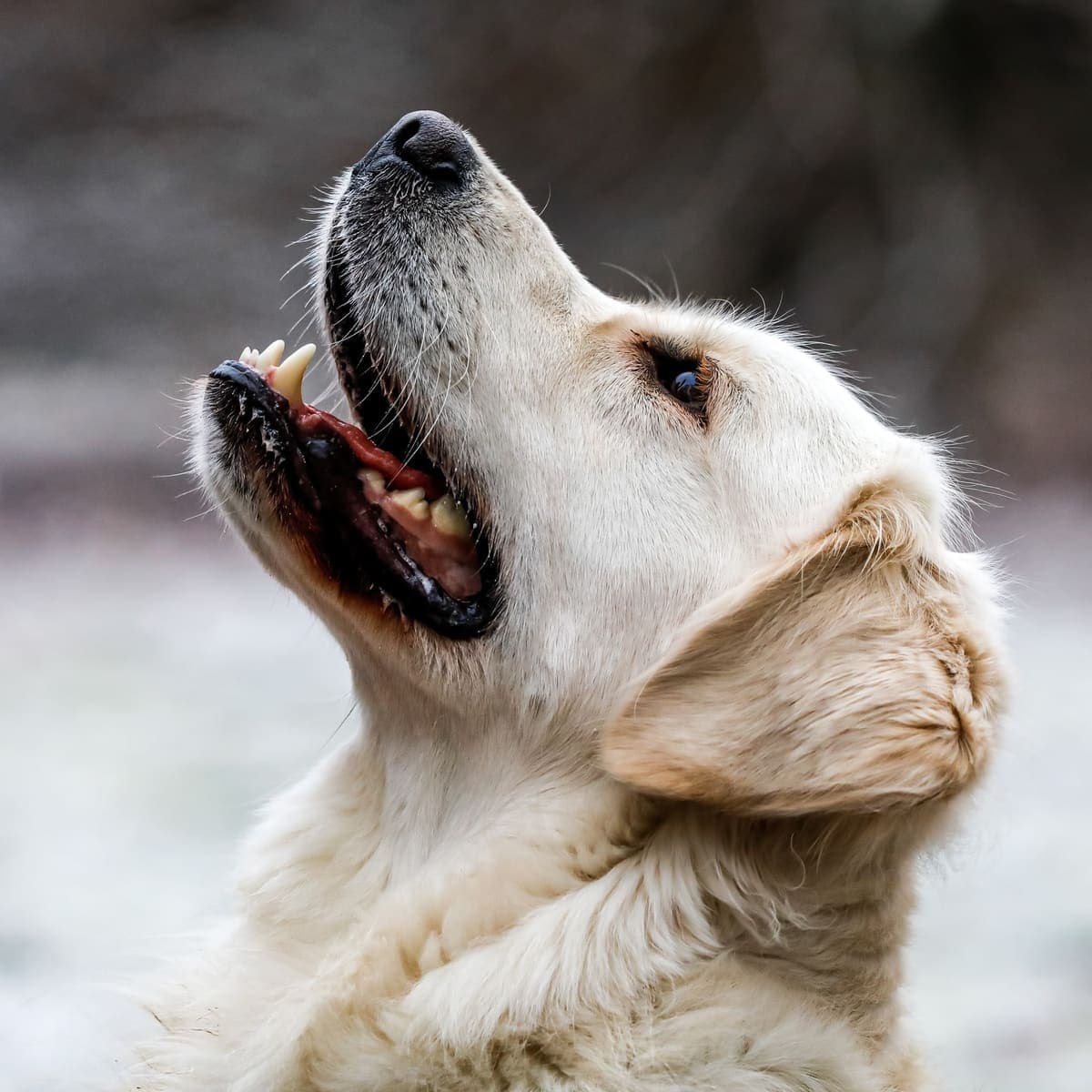
Photo by Dietmar Rabich · CC BY-SA 4.0
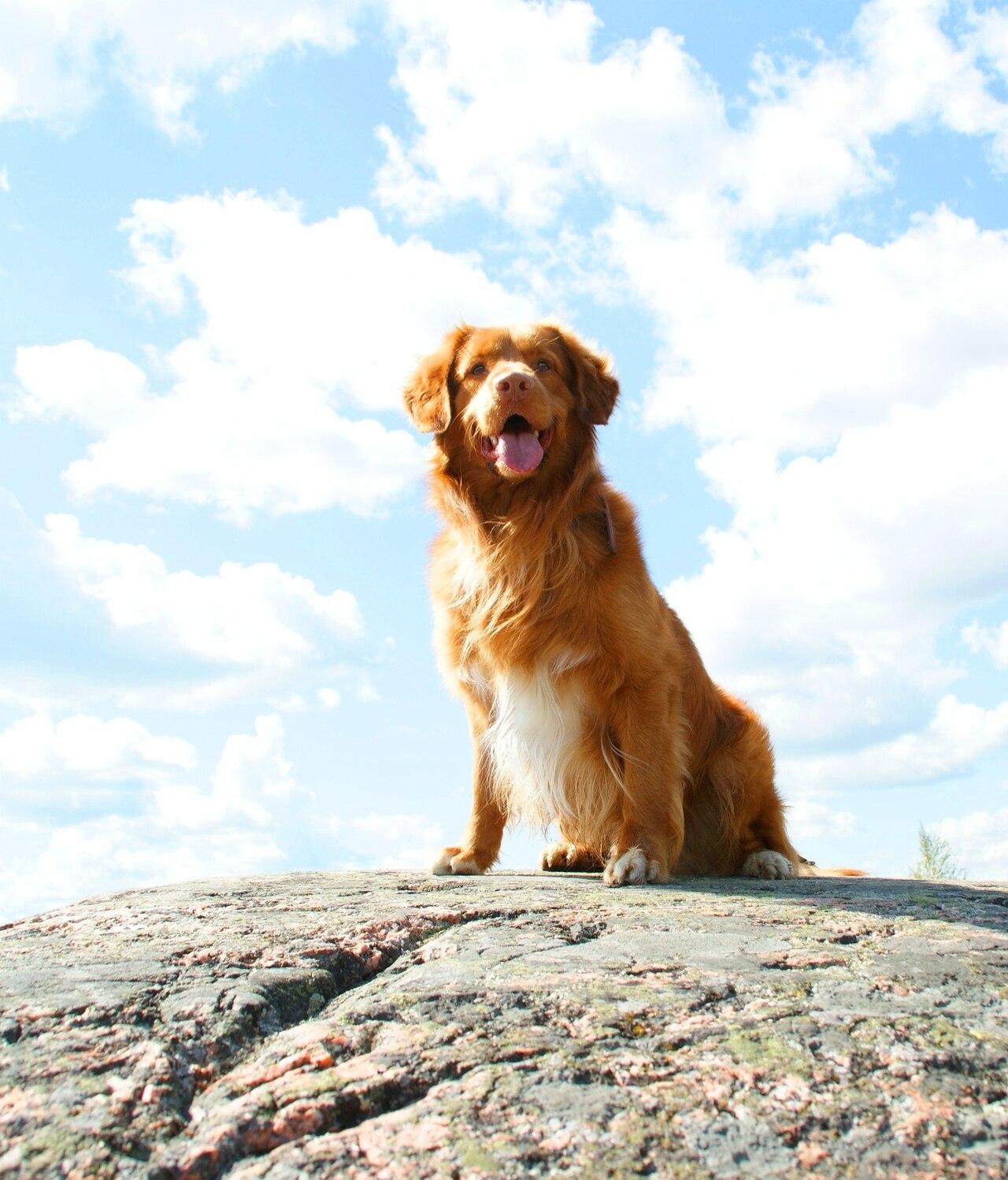
Nova Scotia Duck Tolling Retriever
Photo by Canarian · CC BY-SA 3.0
Quick facts
| Fact | Golden Retriever | Nova Scotia Duck Tolling Retriever |
|---|---|---|
| Group | Sporting | Sporting |
| Size | large | medium |
| Height | 21.5-24 in | 17-21 in |
| Weight | 55-75 lbs | 35-50 lbs |
| Lifespan | 10-12 years | 12-14 years |
| Temperament | Gentle, Intelligent, Friendly, Reliable | Energetic, Smart, Playful, Eager |
How to tell them apart
Read the rows top to bottom. The first two or three traits usually settle it; the rest confirm.
| Trait | Golden Retriever | Nova Scotia Duck Tolling Retriever |
|---|---|---|
| Size | 21.5 to 24 in and 55 to 75 lbs. Males 23 to 24 in and 65 to 75 lbs, females 21.5 to 22.5 in and 55 to 65 lbs. | 17 to 21 in and 35 to 50 lbs. Males 18 to 21 in with an ideal of 19 in, females 17 to 20 in with an ideal of 18 in. |
| White markings | None expected. Apart from greying of the face or body with age, any white marking other than a few white hairs on the chest is penalised. | Usually at least one of: white tip of tail, white feet, white chest, white blaze. A dog without white is not penalised. White on the shoulders, around the ears, on the back of the neck or across the flanks is a disqualification. |
| Colour | Rich, lustrous golden of various shades, with feathering that may be lighter. An extremely pale or extremely dark body colour is undesirable. | Any shade of red, from golden red to dark coppery red, with lighter feathering under the tail, on the pantaloons and on the body. Brown, buff and black areas are disqualifications. |
| Head and ears | Broad skull with a well-defined stop and a deep, wide foreface nearly as long as the skull. Rather short ears set just above and well behind the eye, falling close to the cheek. | Clean-cut and slightly wedge-shaped, with a broad, only slightly rounded skull, a moderate stop and a muzzle that tapers from stop to nose. High-set triangular ears with rounded tips, held slightly erect at the base. |
| Eyes and nose | Medium large eyes, preferably dark brown, with dark rims. Nose black or brownish black. | Almond-shaped, slightly oblique eyes whose colour blends with the coat or is darker. Nose blends with the coat or is black. |
| Coat and tail | Firm, resilient outer coat, straight or wavy, with an untrimmed natural ruff and heavier feathering on the front of the neck, back of the thighs and underside of the tail. Tail carried level or with a moderate upward curve. | Medium-length coat of medium softness, straight apart from a slight wave on the back, with soft, moderate feathering. Luxuriant tail held high in a curve when the dog is alert. |
| AKC group and origin | Sporting Group. Developed in the Scottish Highlands by the first Lord Tweedmouth between 1840 and 1890 as a gundog for his Guisachan estate. | Sporting Group. Bred in the Little River district of Yarmouth County, Nova Scotia, in the 19th century to toll, or lure, ducks within range and then retrieve them. |
What the photo detector sees
Scale is what a photo most often hides. A portrait or a dog alone on grass gives no height, and a half-grown Golden passes through the Toller's size on its way to adult height. White markings carry most of the weight in those pictures, but the feet can be hidden in grass or water, the tail tip can be out of frame, and an older Golden's face whitens with age, which can read as a blaze. Warm evening light pushes a gold coat toward red.
The saved benchmark runs for this project record no confusion in the direction they cover: none of the Golden Retriever reference photos was answered as a Nova Scotia Duck Tolling Retriever, and the Toller was not offered as the second choice. The Toller is not among the benchmark's reference photos, so there is no record in the other direction. When both breeds appear in a ranked result, check the white markings and the shape of the muzzle against the table. The detector reports visual similarity, not ancestry.
Living with them
Both are active sporting dogs that swim, retrieve and enjoy working with their owners. The AKC describes Goldens as outgoing, trustworthy and eager to please, very easy to train, and in need of plenty of daily exercise. It describes Tollers as a mixture of stubborn and soft, which can make them challenging to train; most respond well to reward-based training in short, fun sessions. Tollers have a medium to high energy level, and the AKC says a brisk 30-minute walk or a couple of ball-chasing sessions a day will do for many, though some need more. The Toller standard notes that some individuals are reserved in new situations.
A Golden sheds continuously and heavily once or twice a year, and needs brushing once or twice a week, daily during heavy sheds. A Toller needs weekly brushing, daily in shedding season, with attention to the fine coat around and under the ears. The AKC lists elbow and hip dysplasia, several eye conditions and certain heart diseases among the conditions Golden breeders screen for, and names Addison's disease and autoimmune-related issues as health concerns in Tollers. The profiles list a lifespan of 10 to 12 years for the Golden Retriever and 12 to 14 years for the Nova Scotia Duck Tolling Retriever.
Not sure which one you have?
Upload a clear photo and the detector returns a ranked shortlist, so you can check the top matches against the tells above instead of guessing from one label.
Upload a photo and get a ranked shortlistFAQ
What is the difference between a Golden Retriever and a Nova Scotia Duck Tolling Retriever?
Size, white markings and head shape. A Golden stands 21.5 to 24 in, weighs 55 to 75 lbs, is a shade of gold without white markings and has a broad head. A Toller stands 17 to 21 in, weighs 35 to 50 lbs, is a shade of red, usually with white on the tail tip, feet, chest or face, and has a slightly wedge-shaped head.
Are Golden Retrievers and Tollers related?
They are separate breeds from different countries, and a Toller is not a small Golden. The Golden was developed in Scotland from a yellow retriever and the Tweed Water Spaniel. The AKC says the Toller's exact origins are not known and may include spaniel, setter and retriever-type dogs and farm collie.
Which is bigger, a Golden Retriever or a Toller?
The Golden Retriever. It stands 21.5 to 24 in and weighs 55 to 75 lbs. The Toller, the smallest of the retrievers, stands 17 to 21 in and weighs 35 to 50 lbs.
Is a red retriever with white feet a Golden or a Toller?
White feet, a white tail tip, a white chest or a blaze point to a Toller, whose standard says the breed usually has at least one of them. The Golden standard penalises any white marking beyond a few hairs on the chest. Check size as well: a Toller stands 17 to 21 in.
Which is easier to train?
The AKC describes Golden Retrievers as eager to please and very easy to train. It describes Tollers as a mixture of stubborn and soft that can be challenging, and recommends reward-based training in short, productive sessions.
Full profiles
More look-alikes
Other comparisons that include one of these breeds or come from the same look-alike group:
Browse every pair in the breed comparison index.