Labrador Retriever vs Chesapeake Bay Retriever
The Labrador Retriever and the Chesapeake Bay Retriever are strongly built, short-coated water retrievers with broad skulls and drop ears, and their standards give the same weights: 65 to 80 lbs for males and 55 to 70 lbs for females. A chocolate Labrador and a brown Chesapeake are close in colour as well.
The coat is the fastest tell. A Labrador's coat is short, straight and very dense. A Chesapeake's outer coat is short, harsh and wavy, with the wave on the shoulders, neck, back and loins and very short, straight hair on the face and legs, and the AKC describes it as oily to the touch. Ripples across the shoulders and along the back point to a Chesapeake. The Labrador standard allows only a slight wave down the back.
Then check the eyes and the topline. A Chesapeake's eyes are very clear and yellowish or amber. A Labrador's are brown, or brown or hazel in a chocolate, and its standard calls yellow eyes undesirable. Side-on, a Labrador's back is level from the withers to the croup, while a Chesapeake's hindquarters stand as high as, or a trifle higher than, its shoulders. A black dog is not a Chesapeake: black is a disqualification in that breed.
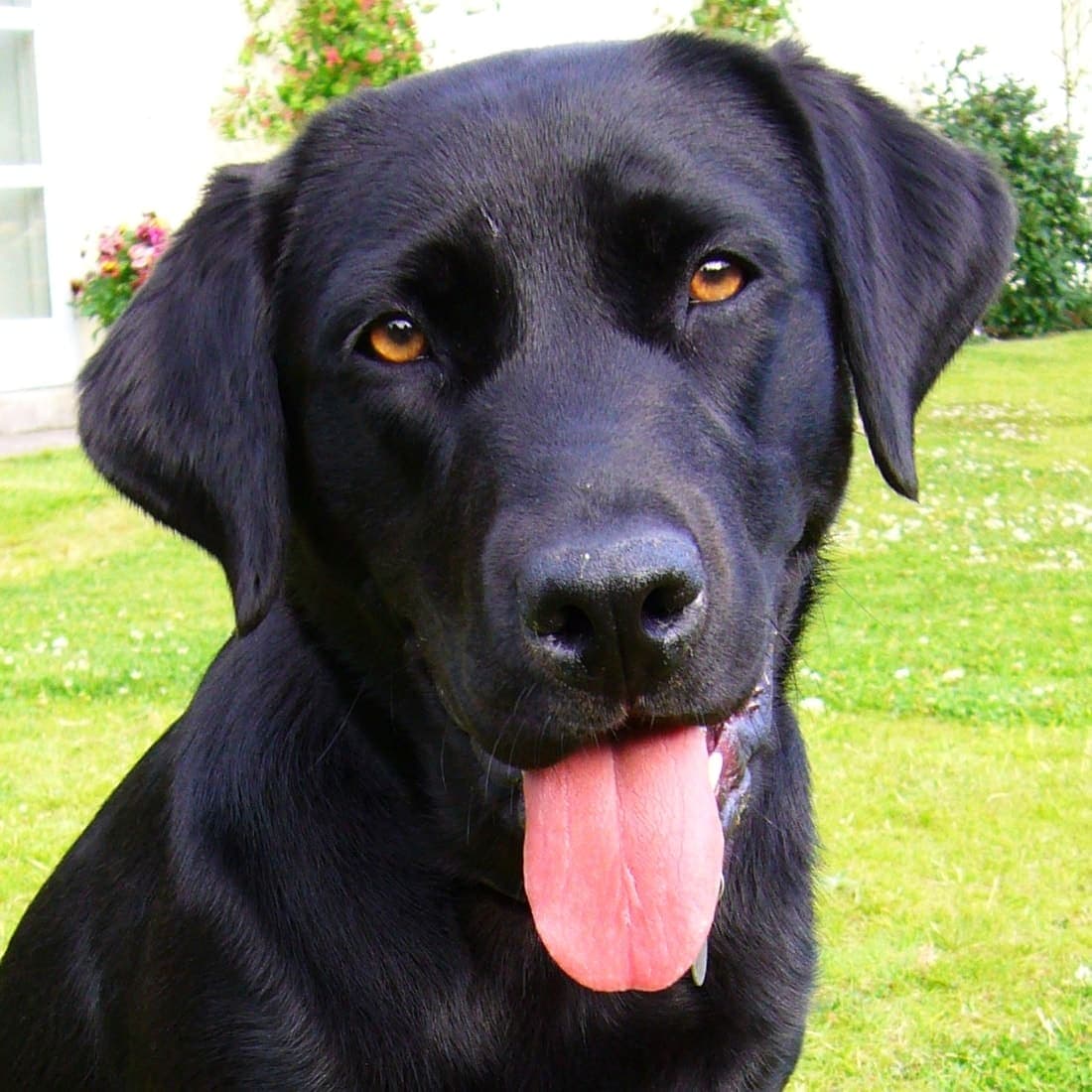
Photo by Jason Oatman · CC BY-SA 3.0
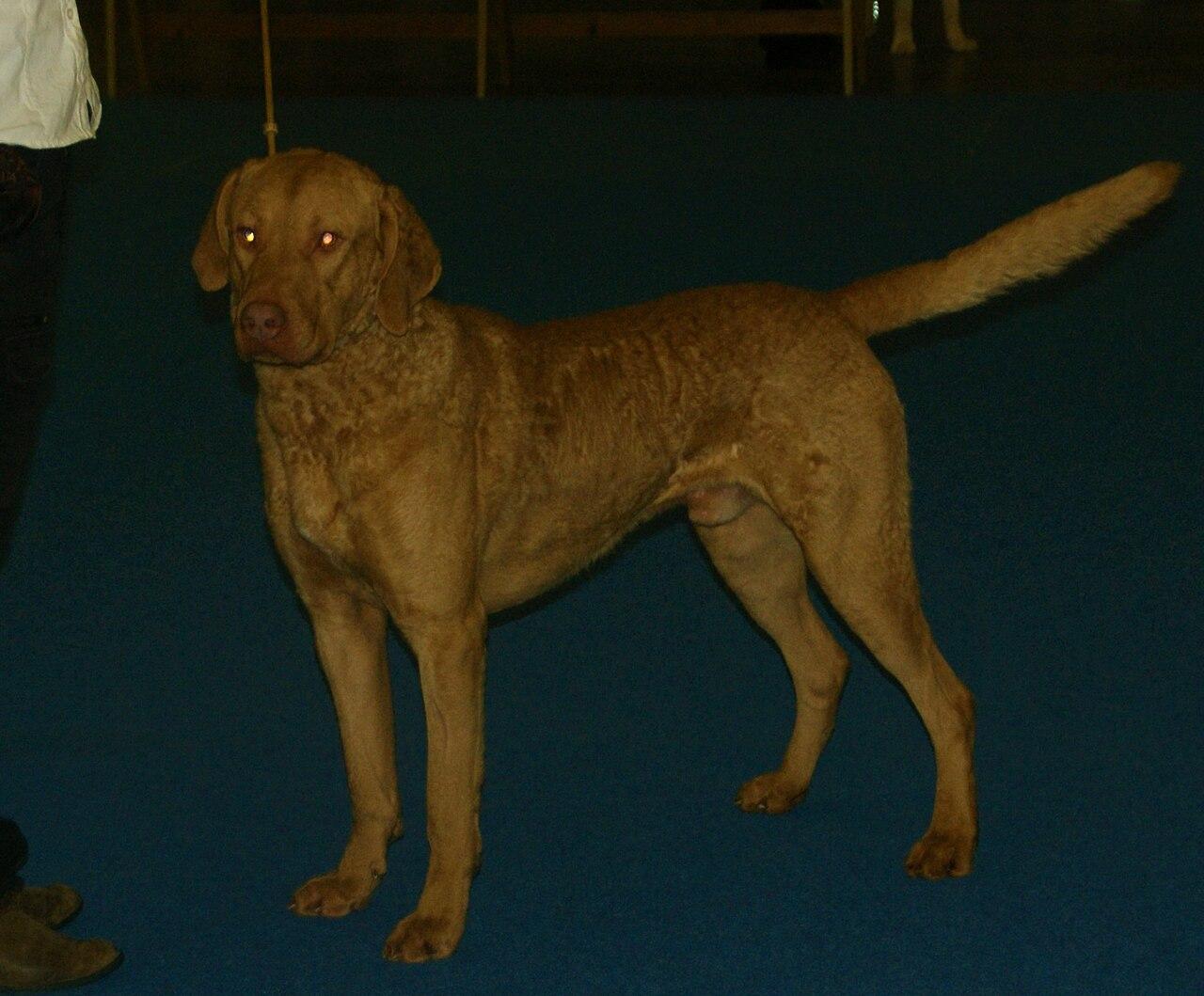
Photo by Canarian · CC BY-SA 4.0
Quick facts
| Fact | Labrador Retriever | Chesapeake Bay Retriever |
|---|---|---|
| Group | Sporting | Sporting |
| Size | large | large |
| Height | 21.5-24.5 in | 21-26 in |
| Weight | 55-80 lbs | 55-80 lbs |
| Lifespan | 11-13 years | 10-13 years |
| Temperament | Friendly, Outgoing, Trainable, Eager-to-please | Loyal, Hardworking, Protective, Athletic |
How to tell them apart
Read the rows top to bottom. The first two or three traits usually settle it; the rest confirm.
| Trait | Labrador Retriever | Chesapeake Bay Retriever |
|---|---|---|
| Coat | Short, straight and very dense, fairly hard to the hand, with a soft, weather-resistant undercoat. A slight wave down the back is permissible. | Thick and short, nowhere over 1.5 in, harsh and oily over a dense, fine, woolly undercoat. Wavy on the shoulders, neck, back and loins only; a coat that curls all over is a disqualification. |
| Eyes | Brown in black and yellow dogs, brown or hazel in chocolates. Yellow eyes are undesirable. | Medium large, very clear, yellowish or amber, set wide apart. |
| Colour | Black, yellow (from fox-red to light cream) or chocolate. Any other colour or a combination of colours is a disqualification. | Any colour of brown, sedge or deadgrass, with solid colours preferred. Black is a disqualification. |
| Topline and tail | Level topline from withers to croup, with little or no tuck-up. The otter tail is very thick at the base, tapering to the tip, free from feathering and clothed all round in short, dense coat. | Hindquarters as high as or a trifle higher than the shoulders, with flanks well tucked up. Tail of medium length, medium heavy at the base, straight or slightly curved; moderate feathering on it is permissible. |
| Head and ears | Wide skull and a moderate stop, with skull and foreface of about equal length; the muzzle is neither long and narrow nor short and stubby. Ears set rather far back and somewhat low, hanging moderately close to the head. | Broad, round skull with a medium stop and a tapered muzzle about as long as the skull, pointed but not sharp, with thin lips. Small ears set well up on the head, hanging loosely. |
| Size | 21.5 to 24.5 in and 55 to 80 lbs. Males 22.5 to 24.5 in, females 21.5 to 23.5 in. | 21 to 26 in and 55 to 80 lbs. Males 23 to 26 in, females 21 to 24 in. |
| AKC group and origin | Sporting Group. The traditional waterdog of Newfoundland, refined and standardised by British breeders in the second half of the 19th century. | Sporting Group. Developed along the Chesapeake Bay in the United States in the 19th century to retrieve waterfowl from cold, rough water. |
What the photo detector sees
A dry coat in even light shows the Chesapeake's wave, and a photo that includes the face shows the eye colour. Both clues are easy to lose. A soaked coat lies flat on either breed, strong sun or flash can lighten brown eyes, and a chocolate Labrador may have hazel eyes, so judge eye colour and coat together. A side-on stance is needed to compare the topline. In the saved benchmark runs for this project, none of the Labrador Retriever reference photos was answered as a Chesapeake Bay Retriever, although the Chesapeake was the second choice in most of those answers.
Colour only helps in one direction. Black rules out a Chesapeake, whose standard accepts any colour of brown, sedge or deadgrass. A brown dog fits both standards, so a chocolate-coloured retriever has to be judged on coat texture, eyes and topline. The detector reports visual similarity, not ancestry.
Living with them
Temperament separates these two more than size does. The Labrador standard asks for a kindly, outgoing, tractable dog that is eager to please and non-aggressive toward people or animals. The AKC describes the Chesapeake as protective of its people, polite but not overtly friendly to strangers, and a dog that takes to training but has a mind of its own, and it calls obedience training a must. Both are high-energy breeds that need plenty of daily exercise, and both love swimming and retrieving.
Neither coat takes much work. The Labrador sheds and needs occasional baths, and the Chesapeake sheds and needs a good brushing about once a week, with little bathing. The AKC lists elbow and hip dysplasia, heart disorders, hereditary myopathy, eye conditions and exercise induced collapse among the conditions Labrador breeders screen for, and notes that Labradors can develop bloat. For the Chesapeake it names hip dysplasia as a concern and says tests exist for other hereditary diseases. The profiles list a lifespan of 11 to 13 years for the Labrador Retriever and 10 to 13 years for the Chesapeake Bay Retriever.
Not sure which one you have?
Upload a clear photo and the detector returns a ranked shortlist, so you can check the top matches against the tells above instead of guessing from one label.
Upload a photo and get a ranked shortlistFAQ
What is the difference between a Labrador Retriever and a Chesapeake Bay Retriever?
The coat and the eyes. A Labrador has a short, straight coat, brown or hazel eyes and a level back, and comes in black, yellow and chocolate. A Chesapeake Bay Retriever has a harsh, oily coat that waves over the shoulders and back, yellowish or amber eyes and hindquarters as high as or slightly higher than its shoulders, and is brown, sedge or deadgrass.
Are Labradors and Chesapeake Bay Retrievers related?
They are separate breeds developed in different places. The AKC describes the Labrador as the traditional waterdog of Newfoundland, later refined in Britain, and says Newfoundlands, Irish Water Spaniels and hounds are thought to be in the Chesapeake's background. The Chesapeake itself was developed in the United States.
Which is bigger, a Labrador or a Chesapeake Bay Retriever?
They weigh the same in their standards: 65 to 80 lbs for males and 55 to 70 lbs for females. The Chesapeake can be taller, with males at 23 to 26 in against 22.5 to 24.5 in for a male Labrador.
Is a Chesapeake Bay Retriever a chocolate Lab?
No. Both can be brown, but a Chesapeake has a wavy, oily coat and yellowish or amber eyes, while a chocolate Labrador has a straight coat and brown or hazel eyes. They are separate breeds with separate AKC standards.
Which is easier to train?
The Labrador standard describes a tractable dog that is eager to please. The AKC says Chesapeakes take to training but have a mind of their own, and recommends obedience training and early socialisation for the breed. Both need training and plenty of exercise from puppyhood.
Full profiles
More look-alikes
Other comparisons that include one of these breeds or come from the same look-alike group:
Browse every pair in the breed comparison index.