Lhasa Apso vs Shih Tzu
The Lhasa Apso and the Shih Tzu are small, long-coated dogs of Tibetan and Chinese background with hair falling over the face, drop ears buried in coat and a plumed tail carried over the back. Both come in almost any colour. In full coat they are two floor-length curtains of hair, and in a short pet trim they are two small shaggy dogs with dark eyes and a beard.
The face is the fastest tell. A Shih Tzu has a round, broad, domed head with a short, square muzzle that is ideally no longer than 1 in from the nose to the stop, and large, round eyes set wide apart. A Lhasa Apso has a narrower skull that is not domed and a longer muzzle, about one-third of the total length of the head, with almond-shaped eyes. In profile the Shih Tzu's face is nearly flat, while the Lhasa has a visible length of foreface.
Coat texture is the second tell if you can touch the dog. Both are double-coated. A Lhasa's coat is heavy, straight and hard, neither woolly nor silky. A Shih Tzu's is luxurious, dense and flowing, and may have a slight wave. The Lhasa is also slightly larger and longer in body, 10 to 11 in and 12 to 18 lbs against 9 to 10.5 in and 9 to 16 lbs, though the ranges overlap.
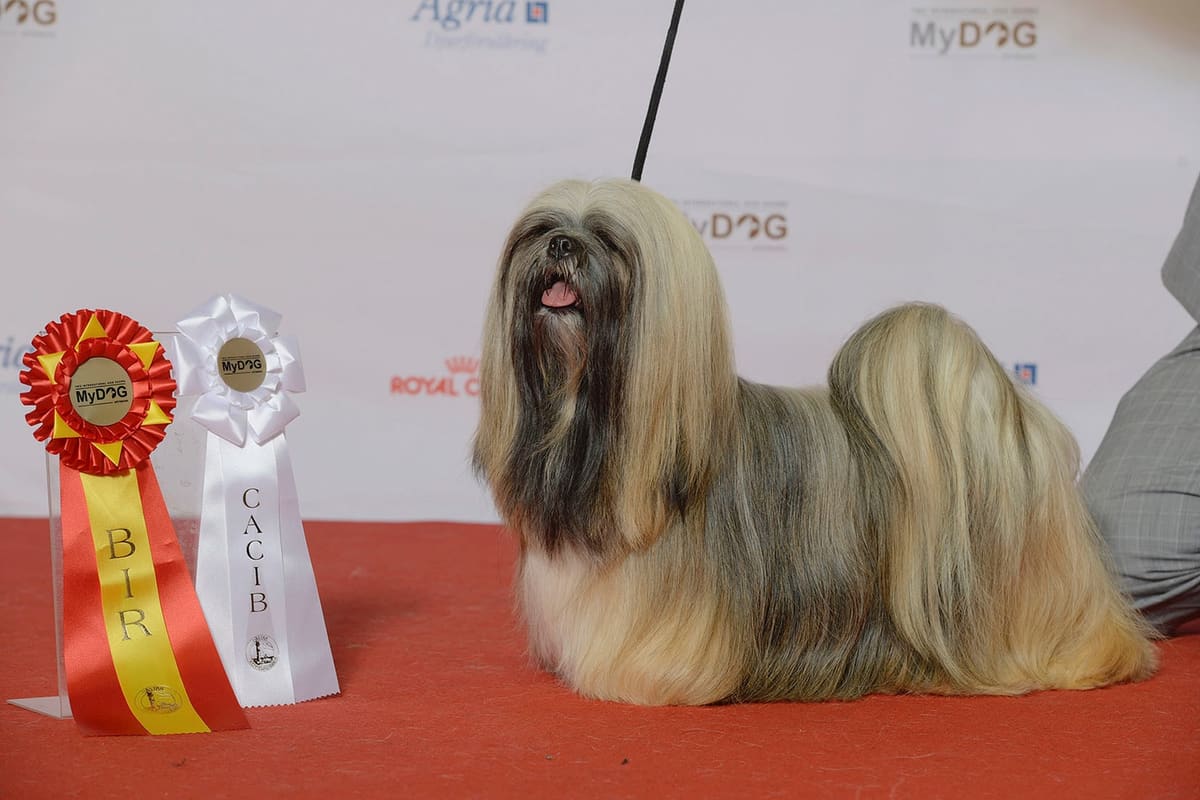
Photo by Svenska Mässan from Sweden · CC BY 2.0
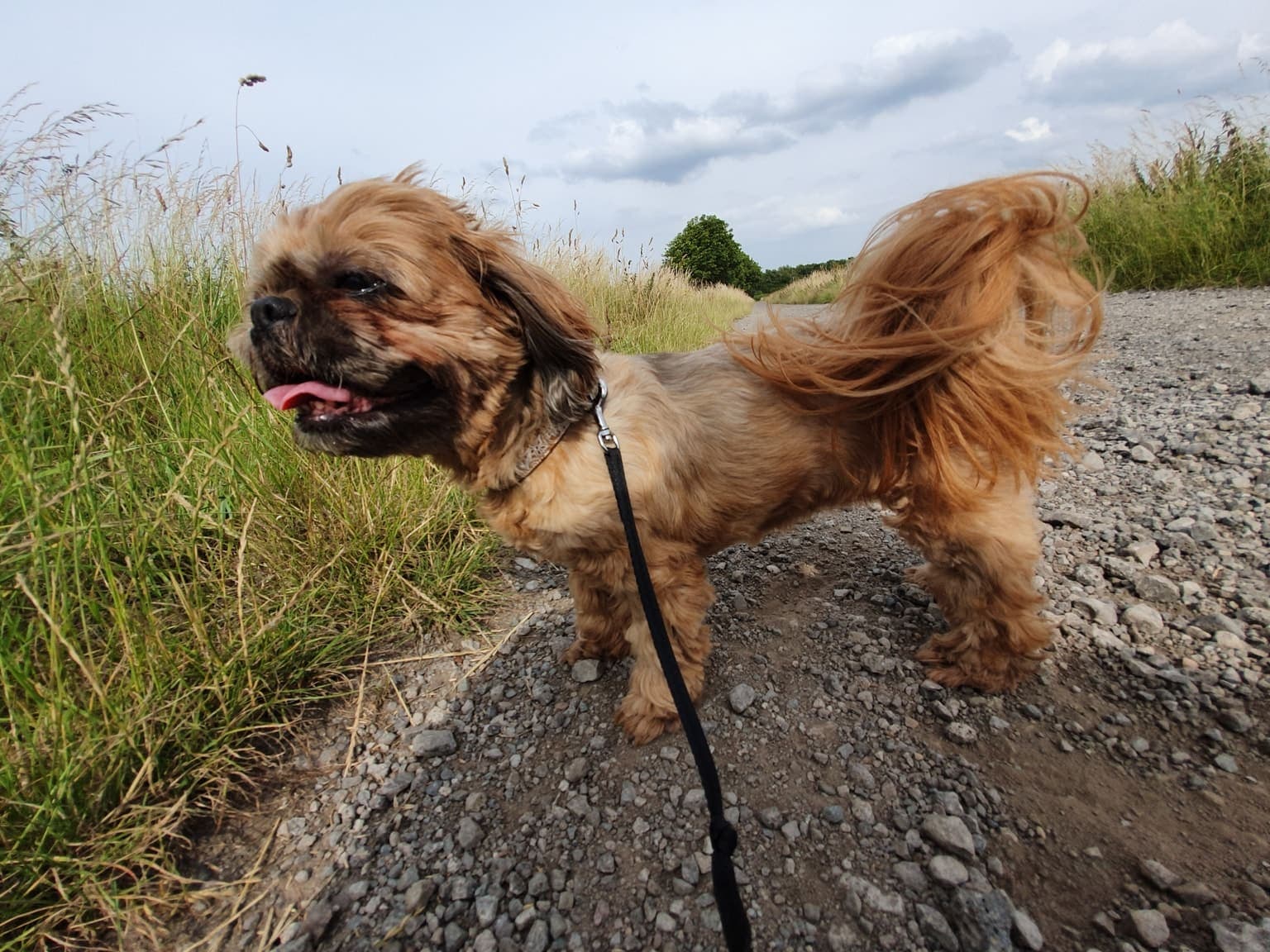
Photo by H.A.W.C 101 · CC BY-SA 4.0
Quick facts
| Fact | Lhasa Apso | Shih Tzu |
|---|---|---|
| Group | Non-Sporting | Toy |
| Size | small | small |
| Height | 10-11 in | 9-10.5 in |
| Weight | 12-18 lbs | 9-16 lbs |
| Lifespan | 12-15 years | 10-18 years |
| Temperament | Alert, Independent, Affectionate, Confident | Affectionate, Outgoing, Sweet-natured, Adaptable |
How to tell them apart
Read the rows top to bottom. The first two or three traits usually settle it; the rest confirm.
| Trait | Lhasa Apso | Shih Tzu |
|---|---|---|
| Muzzle | Medium length, about one-third of the total length from nose to back of skull; straight, not square. | Short, square and unwrinkled, set no lower than the bottom of the eye rim; ideally no longer than 1 in from nose tip to stop. |
| Skull | Narrow, falling away behind the eyes; not quite flat, but not domed or apple-shaped. | Round, broad and wide between the eyes, with a domed skull and a definite stop. |
| Eyes | Dark brown and almond-shaped; round, full eyes and very small, sunken eyes are undesirable. | Large, round and very dark, set well apart and looking straight ahead, with a warm, wide-eyed expression. |
| Coat | Double coat: heavy, straight, hard and dense, of good length; neither woolly nor silky. | Luxurious, long, dense, flowing double coat; a slight wave is permissible. The hair on top of the head is tied up for show. |
| Size and body | About 10 to 11 in and 12 to 18 lbs; longer from shoulder to rump than tall at the withers. | 9 to 10.5 in and 9 to 16 lbs; slightly longer than tall, compact and solid, carrying good weight for its size. |
| Bite | Level or slightly undershot is preferred. | Undershot, with a broad, wide jaw. |
| AKC group | Non-Sporting Group. Developed in Tibet as an indoor sentinel dog in monasteries and homes. | Toy Group. Developed in China as a palace companion from dogs of Tibetan origin. |
What the photo detector sees
This is a recorded mix-up in the benchmark runs saved with this project, in one direction: several of the AI models we tested answered Shih Tzu for Lhasa Apso reference photos. The reverse error does not appear in those runs. Hair is the problem. A long fall of coat over the face hides muzzle length, skull shape and eye size, which are the three features that separate the breeds.
A side-on photo of the head with the hair tied up or trimmed back shows the muzzle clearly and is the most useful picture. A front-on photo of a dog in a teddy-bear trim is the least useful, because the groomer has shaped both heads into the same round outline. Crosses between the two are common and may show either face type.
Living with them
Temperament differs more than looks. The Shih Tzu was bred purely as a companion and is typically outgoing, affectionate and trusting with everyone, including strangers. The Lhasa Apso was kept as a watchdog inside Tibetan monasteries and homes, and it is typically more independent, more wary of people it does not know and quick to sound an alarm. Lhasas benefit from early socialisation, and both breeds respond to patient, reward-based training.
Both coats need daily brushing if kept long, and most pets are clipped short every few weeks. The Shih Tzu's short muzzle makes it less tolerant of heat, and its large eyes need regular checking and cleaning. Both need modest daily exercise. The profiles list a lifespan of 12 to 15 years for the Lhasa Apso and 10 to 18 years for the Shih Tzu.
Not sure which one you have?
Upload a clear photo and the detector returns a ranked shortlist, so you can check the top matches against the tells above instead of guessing from one label.
Upload a photo and get a ranked shortlistFAQ
What is the difference between a Lhasa Apso and a Shih Tzu?
The Shih Tzu has a round, domed head, a very short square muzzle and large round eyes. The Lhasa Apso has a narrower skull, a longer muzzle about one-third the length of the head and almond-shaped eyes. The Lhasa's coat is hard and straight, the Shih Tzu's dense and flowing, and the Lhasa is slightly larger.
Which is bigger, a Lhasa Apso or a Shih Tzu?
The Lhasa Apso, slightly. It stands about 10 to 11 in and weighs 12 to 18 lbs. The Shih Tzu stands 9 to 10.5 in and weighs 9 to 16 lbs. The ranges overlap, so size alone does not identify either breed.
Are Lhasa Apsos and Shih Tzus related?
They share Tibetan ancestry. The Lhasa Apso is a Tibetan breed, and the Shih Tzu was developed in China from dogs of Tibetan origin, with accounts describing crosses with Pekingese-type dogs. The AKC recognised the Shih Tzu in 1969.
Can you tell them apart in a puppy cut?
Usually, by the profile. Look at how far the nose projects in front of the eyes: a Shih Tzu's muzzle is very short and its face nearly flat, while a Lhasa Apso has a clear length of foreface. Front-on photos are much harder to judge.
Which is friendlier with strangers?
The Shih Tzu, typically. It was bred as a companion and tends to greet everyone. The Lhasa Apso was bred as a sentinel and tends to be aloof with strangers and devoted to its own household.
Full profiles
Browse every pair in the breed comparison index.