Whippet vs Greyhound vs Italian Greyhound
These three sighthounds share the same blueprint: a long narrow head, small folded ears, a deep chest, a tucked-up waist and a long tapering tail. They are essentially the same shape scaled to three sizes, and a photo of one dog on its own removes the scale. That is why a Whippet lying on a sofa can be mistaken for a Greyhound, and an Italian Greyhound standing in grass can be mistaken for a Whippet.
The fastest tell, when there is something in the frame for scale, is height. A Greyhound stands 27 to 30 in at the shoulder, a Whippet 18 to 22 in, and an Italian Greyhound only 13 to 15 in. When there is nothing for scale, look at the topline and the bone. The Greyhound has the longest, flattest back with a subtle rise over the loin. The Whippet has a clear S-curve with a pronounced arch over the loin. The Italian Greyhound has the highest, roundest curve of all, and legs so fine that the dog looks like it is standing on pencils.
Colour can rule one breed out quickly. Brindle is common in Whippets and Greyhounds but is a disqualification in Italian Greyhounds, so a brindle dog is not a purebred Italian Greyhound.
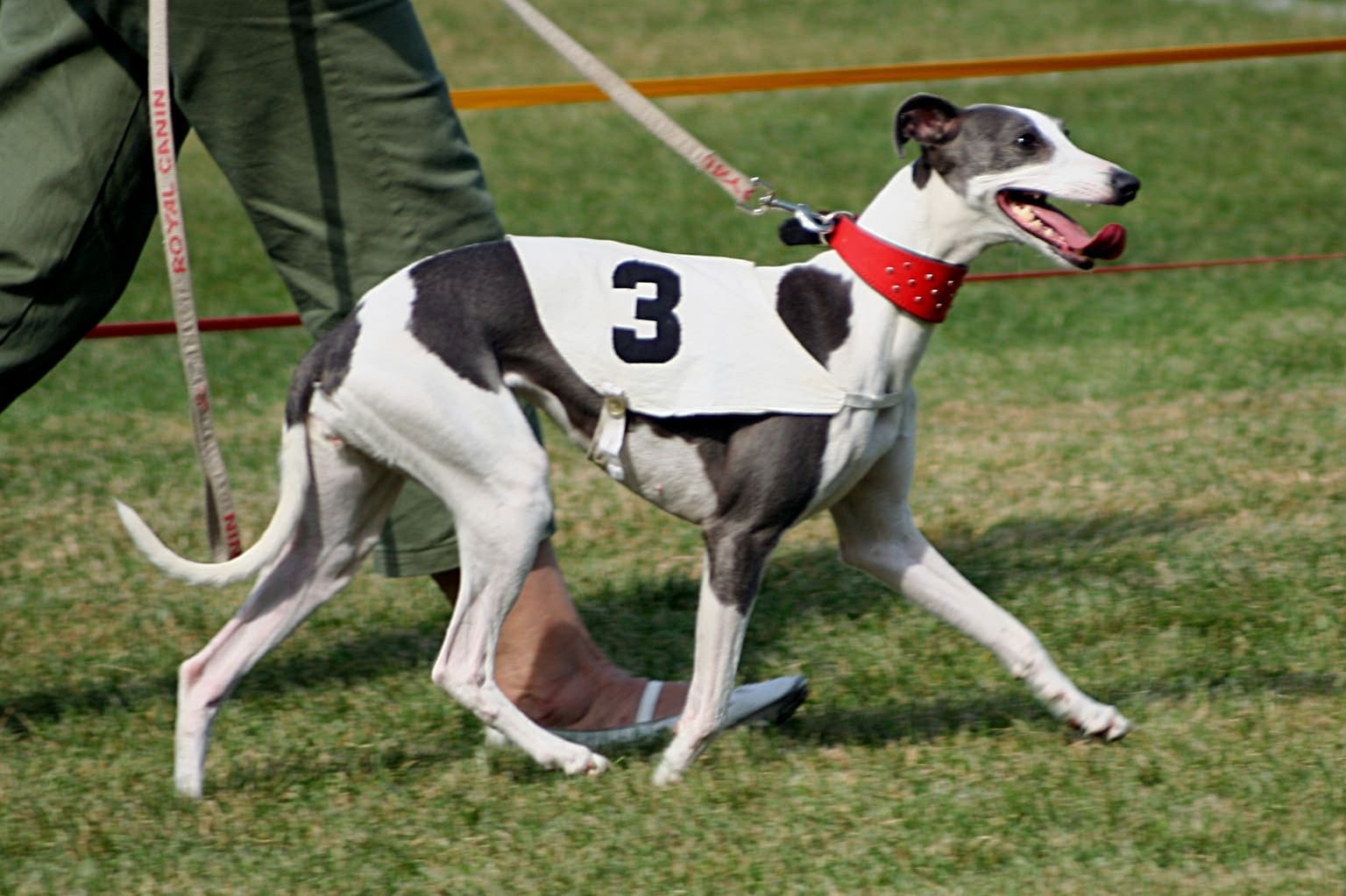
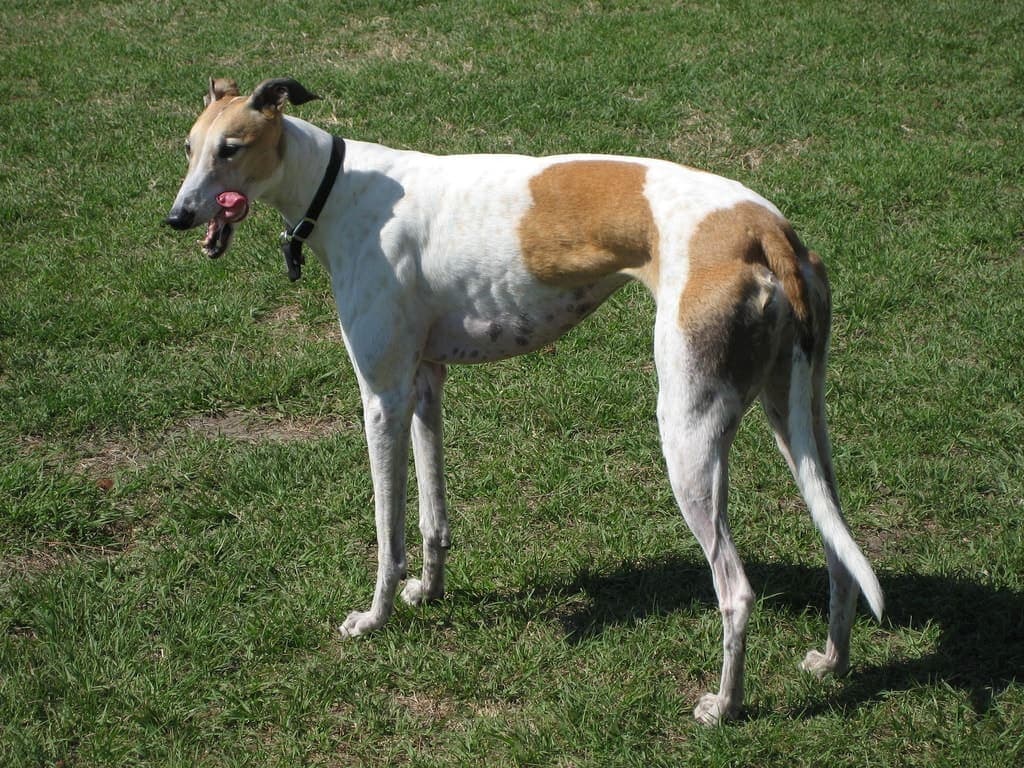
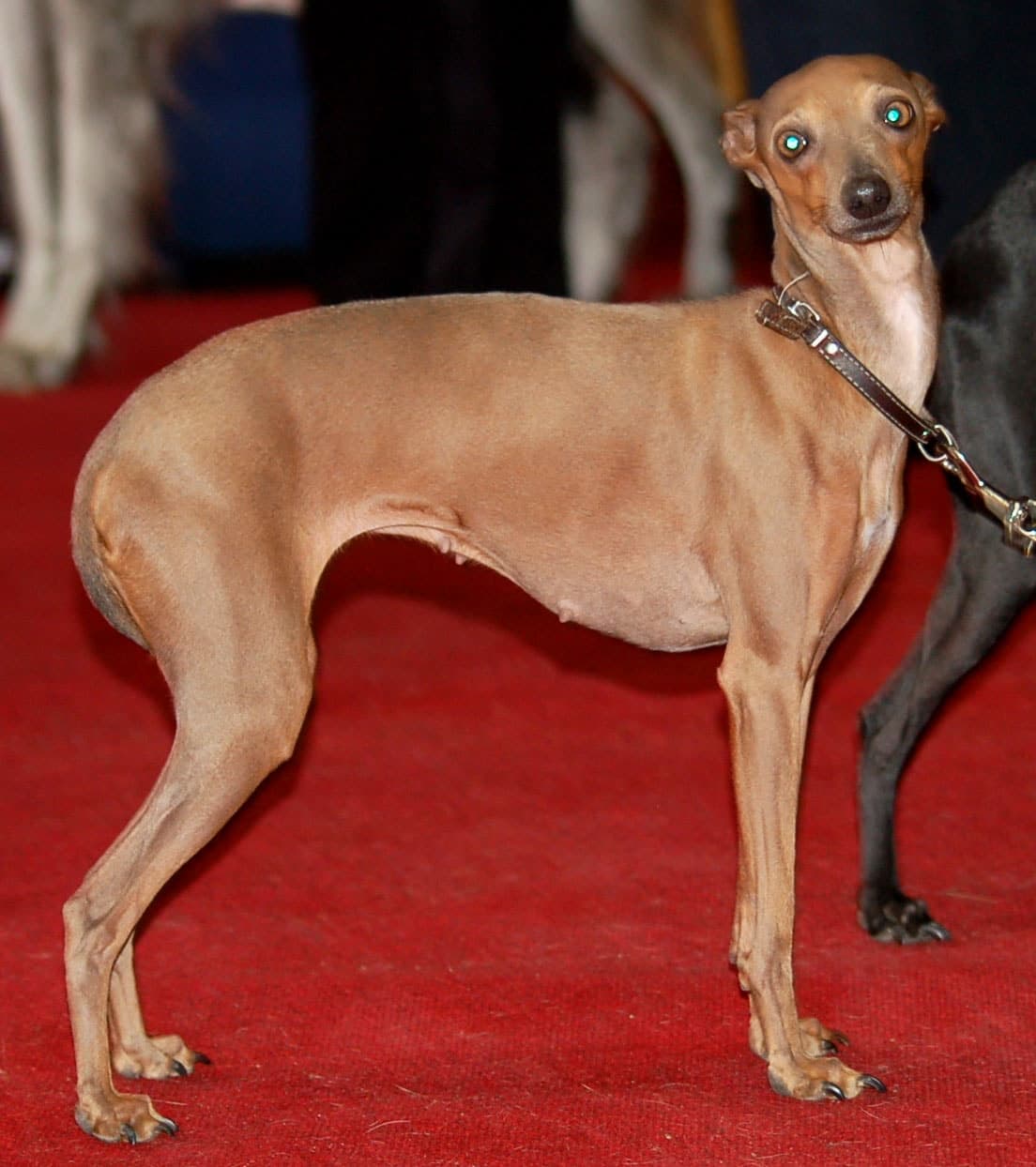
Quick facts
| Fact | Whippet | Greyhound | Italian Greyhound |
|---|---|---|---|
| Group | Hound | Hound | Toy |
| Size | medium | large | small |
| Height | 18-22 in | 27-30 in | 13-15 in |
| Weight | 25-40 lbs | 60-70 lbs | 7-14 lbs |
| Lifespan | 12-15 years | 10-14 years | 13-15 years |
| Temperament | Gentle, Quiet, Affectionate, Athletic | Gentle, Quiet, Independent, Affectionate | Affectionate, Sensitive, Playful, Graceful |
How to tell them apart
Read the rows top to bottom. The first two or three traits usually settle it; the rest confirm.
| Trait | Whippet | Greyhound | Italian Greyhound |
|---|---|---|---|
| Head and muzzle | Long, lean head that is fairly wide between the ears with a slight stop and a powerful muzzle. | Long, narrow head with a flat skull, a barely perceptible stop and strong jaws; the longest face of the three. | Narrow, delicate head with a flat skull and fine muzzle, small enough that the eyes look large by comparison. |
| Ears | Small, fine rose ears folded back along the neck, semi-pricked when the dog is alert. | Small, fine rose ears carried folded and thrown back, raised slightly when something catches the dog's eye. | Small, fine ears folded back at rest and thrown back at right angles to the head when alert, so they look like little wings. |
| Eyes and expression | Large, dark, oval eyes with a keen but gentle expression. | Dark, bright and intelligent eyes in a long face, giving a calm and dignified look. | Dark, bright, medium-sized eyes that look big in the small head, giving an alert and often slightly anxious look. |
| Body and topline | Compact and muscular, with a broad back and a graceful arch over the loin that creates a distinct S-curve from neck to tail. | Long, muscular body with a broad back that rises only gently over the loin, so the topline looks nearly level. | Slender in every proportion, with a high arched back that is highest over the loin and falls away sharply to the hindquarters. |
| Coat | Short, close, smooth and firm to the touch. | Short, smooth and firm, often showing muscle definition through the coat. | Very short, fine and glossy, described in the standard as like satin. |
| Colour and markings | Any colour or mixture, with brindle, fawn and parti-colour with white blazes and legs very common. | Any colour, with brindle, black, fawn, red, blue and white all seen, especially in retired racers. | Any colour except brindle and tan markings on black or blue, which are disqualifications. |
| Size | 18 to 22 in at the shoulder and about 25 to 40 lbs, a true medium dog. | 27 to 30 in and about 60 to 70 lbs, a large dog that stands at hip height on most adults. | 13 to 15 in and only 7 to 14 lbs, a toy breed that fits under one arm. |
| Tail and gait | Long, tapering tail reaching the hip bone, carried low with a slight upward curve; moves with a low, free stride and long reach. | Long, fine tail with a slight upward curve, carried low; moves with a powerful, ground-eating stride and a double-suspension gallop. | Slender, curved tail set and carried low; moves with a high-stepping, free gait that looks light and almost dainty. |
What the photo detector sees
With three breeds of almost identical shape, the detector keys on proportions and context rather than any single feature. Relative leg length to body depth, the amount of curve in the topline, and how fine the bone is all shift the result. Context objects matter more here than in most packs: a person's hand, a sofa cushion or a doorway gives the model the scale it needs to separate a 30 lb Whippet from a 10 lb Italian Greyhound or a 65 lb Greyhound. Coat colour is a supporting signal, with brindle pushing the result away from Italian Greyhound.
The model hesitates most on the Whippet, because it sits in the middle and shares features with both neighbours. A curled-up dog on a bed, a tight face crop, or a puppy with baby proportions removes the cues that would decide it. Very fine, small Whippets overlap with large Italian Greyhounds, and heavy, tall Whippets overlap with small Greyhounds. Lurchers and other sighthound crosses, and Whippet Italian Greyhound mixes, will return two or three of these breeds in the ranked results. The detector reports visual likeness in confidence order; it does not determine ancestry.
Living with them
All three are gentle, quiet, sensitive dogs that sprint hard for a few minutes and sleep for hours, and all three need a coat in cold weather and a soft bed for their thin skin. The practical differences are size and fragility. A Greyhound is a large dog that needs a big sofa and a car with room, but is famously calm indoors, and many come from racing kennels as adults who need patient help with stairs and slippery floors. A Whippet is the easy middle: small enough for a flat, sturdy enough for family life, and usually the most playful of the three. An Italian Greyhound is a toy breed with fine legs that can break from a jump off furniture, so it suits calm households and needs careful handling around children and larger dogs.
Exercise is similar in kind for all three: daily walks plus safe, fenced chances to run, with careful recall because prey drive can override training. Grooming is minimal for all of them. The Italian Greyhound needs the most attention to dental care and to warmth, and is the hardest to house-train. Lifespans in the profiles run 12 to 15 years for the Whippet, 10 to 14 for the Greyhound and 13 to 15 for the Italian Greyhound.
Not sure which one you have?
Upload a clear photo and the detector returns a ranked shortlist, so you can check the top matches against the tells above instead of guessing from one label.
Upload a photo and get a ranked shortlistFAQ
Can a photo tell a Whippet from a Greyhound or an Italian Greyhound?
It can when there is something in the frame for scale, or when the dog is standing side-on so the topline and bone are visible. A lone dog curled on a bed with nothing beside it is genuinely hard, and the detector will often list two of the three breeds close together. Adding a photo with a person or furniture in it helps a lot.
Is a Whippet just a small Greyhound?
Not quite. Whippets were developed in England from small Greyhounds and terrier-type dogs for racing and rabbit coursing, so they are related, but they are a separate breed with their own standard. The Whippet has a more pronounced S-curve to its back and a slightly wider skull with a visible stop.
Can Italian Greyhounds be brindle?
No. Brindle, and tan markings on a black or blue dog, are disqualifications in the Italian Greyhound standard. A brindle sighthound of any size is a Whippet, a Greyhound or a mix.
What does a Whippet Italian Greyhound mix look like?
Typically a dog of about 15 to 25 lbs with a Whippet's head and a finer, more arched body. These crosses are common enough that the detector will usually return both breeds near the top of its results. A DNA test is the only way to confirm the parents.
Which one is best for an apartment?
Any of them can work, because all three are quiet and sleep most of the day. The Whippet is the most common choice for a flat since it is small, robust and easy to walk. A Greyhound needs more floor space but is often the calmest, and an Italian Greyhound needs a warm home and a household that will protect its fragile legs.
Full profiles
Browse every pair in the breed comparison index.