Dalmatian vs English Pointer
A Dalmatian and a black and white or liver and white English Pointer can look like the same dog at a glance: a short, glossy coat with dark colour on white, hanging ears, a deep chest and a long, tapering, undocked tail that reaches about to the hock. The English Pointer is the breed the AKC registers as the Pointer.
The markings are the fastest tell. A Dalmatian's colour comes only as round, well-defined spots on a pure white ground, from the size of a dime to the size of a half-dollar, spread evenly over the whole dog. Its standard disqualifies a patch, meaning a solid mass of colour appreciably larger than a spot. The English Pointer's standard sets no rule on the shape of its markings and accepts a solid-coloured dog, so a short-coated white dog with a solid-coloured head or large blocks of colour does not fit the Dalmatian standard.
If the markings leave you unsure, look at the head from the side and at the ear tips. An English Pointer has a pronounced stop, and its muzzle may tilt up slightly toward the nose; a Dalmatian's stop is moderate and the top of its muzzle is level and parallel to the skull. A Dalmatian's ear ends in a rounded tip, and an English Pointer's is somewhat pointed and never round.
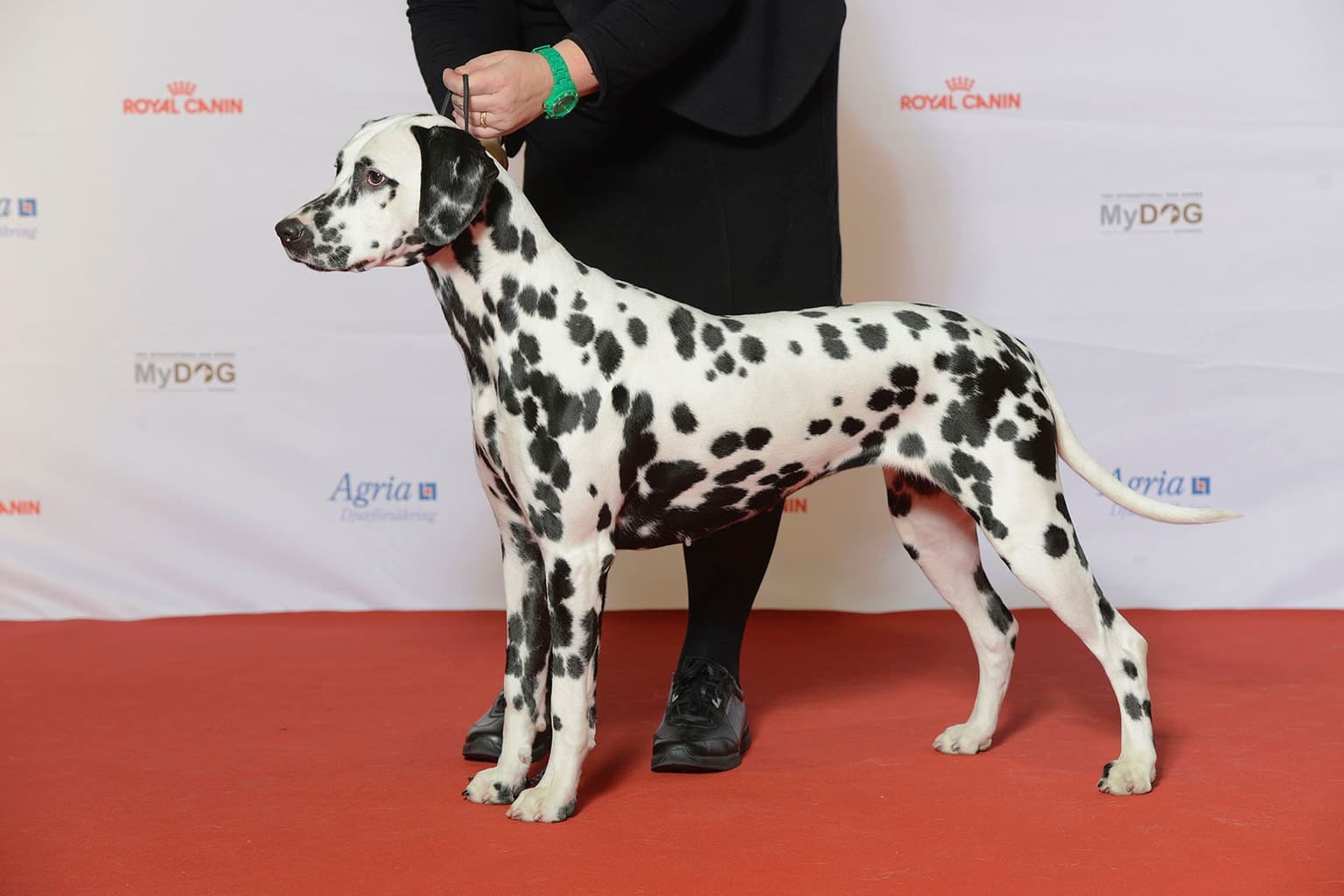
Photo by Svenska Mässan from Sweden · CC BY 2.0
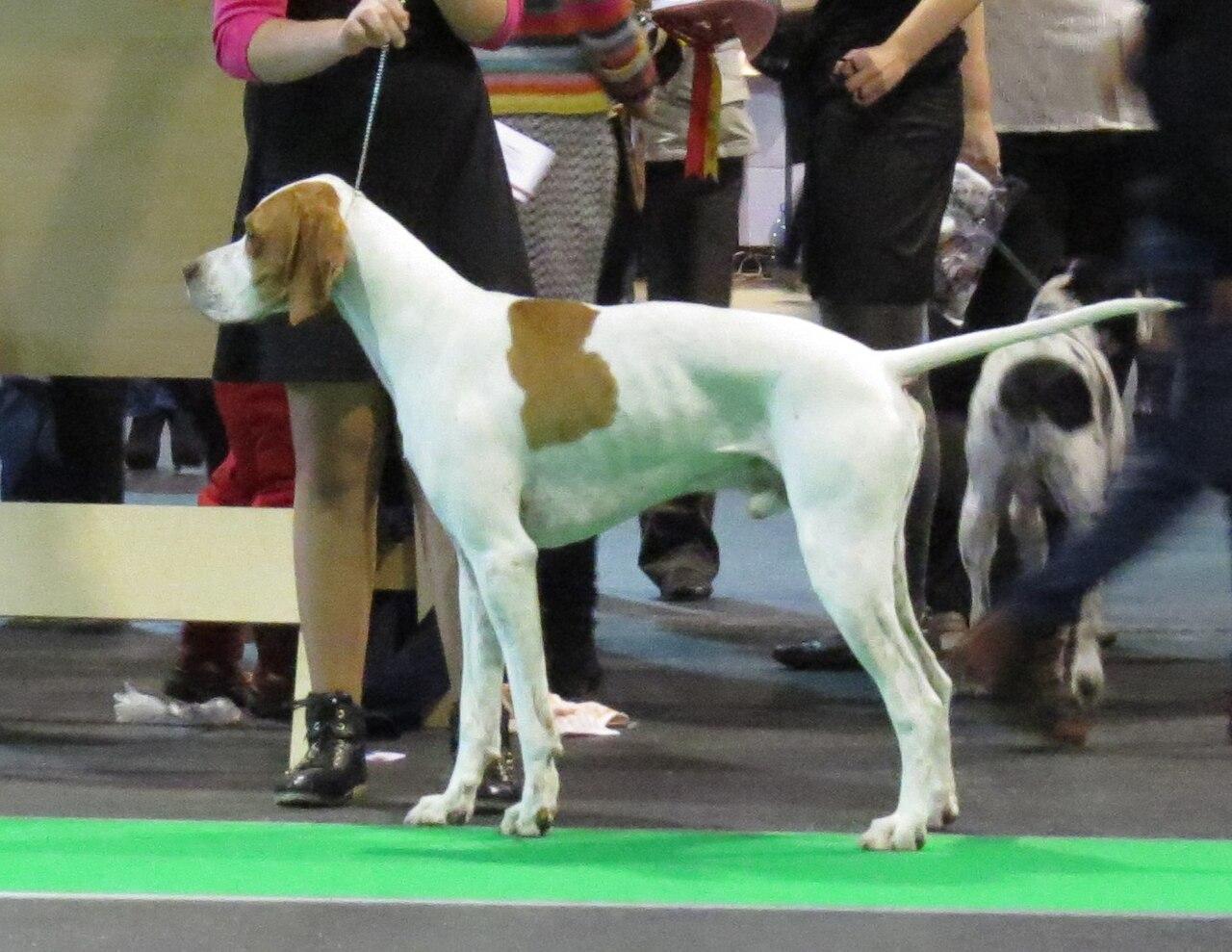
Photo by Томасина · CC BY-SA 3.0
Quick facts
| Fact | Dalmatian | English Pointer |
|---|---|---|
| Group | Non-Sporting | Sporting |
| Size | medium | large |
| Height | 19-24 in | 23-28 in |
| Weight | 45-70 lbs | 45-75 lbs |
| Lifespan | 11-13 years | 12-15 years |
| Temperament | Energetic, Smart, Alert, Outgoing | Athletic, Even-tempered, Energetic, Focused |
How to tell them apart
Read the rows top to bottom. The first two or three traits usually settle it; the rest confirm.
| Trait | Dalmatian | English Pointer |
|---|---|---|
| Markings | Round, well-defined spots, dime to half-dollar size, evenly distributed on pure white and usually smaller on the head, legs and tail. Patches are a disqualification. | Colour in combination with white, or a solid-coloured coat. The standard does not regulate the size or shape of the markings. |
| Colour | Black spots or liver brown spots only. Any other colour of marking, and tan markings on a spotted dog (tricolour), are disqualifications. | Liver, lemon, black or orange. The standard says a good Pointer cannot be a bad colour. |
| Head profile | Moderately well defined stop; the top of the muzzle is level and parallel to the flat top of the skull, and muzzle and skull are about equal in length. | Pronounced stop with a slight furrow between the eyes. The nose may be slightly higher at the tip than the muzzle at the stop, or the planes may be parallel. |
| Ears | Set rather high, wide at the base and tapering to a rounded tip, reaching the bottom line of the cheek. Preferably spotted. | Set at eye level, reaching just below the lower jaw, thin and somewhat pointed at the tip, never round. |
| Size | 19 to 24 in and 45 to 70 lbs. The standard's desirable height is 19 to 23 in, and any dog over 24 in is disqualified. Body length about equals height. | 23 to 28 in and 45 to 75 lbs. Males 25 to 28 in and 55 to 75 lbs, females 23 to 26 in and 44 to 65 lbs by the standard. |
| Eyes, nose and feet | Eyes brown or blue, or any combination. Nose fully pigmented, black on black-spotted dogs and brown on liver-spotted dogs. Round, compact feet. | Rounded eyes, dark in contrast with the markings. Nose black or brown in the darker colours, possibly lighter or flesh-coloured in the lighter shades. Oval feet; a cat foot is a fault. |
| AKC group and origin | Non-Sporting Group, recognised in 1888. A coach dog that trotted beside horse-drawn carriages and guarded them; its origins are disputed, but by the early 1800s it was associated with Dalmatia on the Adriatic. | Sporting Group, recognised in 1878. A British pointing dog bred to find and indicate game; the AKC dates the first Pointers in England to about 1650. |
What the photo detector sees
In the saved benchmark runs for this project, none of the fifteen answers for Dalmatian reference photos named English Pointer first, but English Pointer was the second choice in eight of them. The runs did not include English Pointer reference photos.
Photos can blur the markings. The Dalmatian standard notes that spots may intermingle or overlap into larger masses of colour, which differ from true patches by their uneven edges and scattered white hairs. A small or soft image hides that detail. The AKC also notes that Dalmatian puppies are born without spots, so a very young puppy can look plain white. With nothing in the frame for scale, the English Pointer's extra height is lost, and a face-on portrait hides the stop. A side view of the head and a clear look at the ear tips help most.
Living with them
Both are high-energy dogs built for stamina. The Dalmatian's standard asks for a stable, outgoing yet dignified temperament, and the AKC describes Dalmatians as reserved, sometimes aloof with strangers and dependable watchdogs, a legacy of guarding horses and coaches. It calls them very sensitive and says positive, reward-based training is a must. The English Pointer's standard stresses an even temperament and alert good sense, and the AKC says the breed needs lots of exercise every day and benefits from a securely fenced yard where it can run full out.
Both short coats need little more than a weekly brushing. On health, the AKC says deafness is present in the Dalmatian, that responsible breeders have parents and whole litters hearing tested, and that kidney stones also occur in the breed. For the English Pointer it notes that bloat can occur and that breeders screen for hip dysplasia and eye disorders. The profiles list a lifespan of 11 to 13 years for the Dalmatian and 12 to 15 years for the English Pointer.
Not sure which one you have?
Upload a clear photo and the detector returns a ranked shortlist, so you can check the top matches against the tells above instead of guessing from one label.
Upload a photo and get a ranked shortlistFAQ
What is the difference between a Dalmatian and an English Pointer?
The pattern. A Dalmatian is pure white with separate round black or liver spots all over and no solid patches. An English Pointer's colour is not limited to spots, and it also comes in lemon, orange and solid colours. The English Pointer is the taller dog and has a more pronounced stop.
Are Dalmatians and English Pointers related?
The AKC material this page relies on records no link. It describes the Dalmatian's origins as obscure and disputed and its traditional job as coach dog, while the English Pointer is a British pointing dog from the Sporting Group. The AKC places the Dalmatian in the Non-Sporting Group.
Which is bigger, a Dalmatian or an English Pointer?
The English Pointer is taller: 23 to 28 in, against 19 to 24 in for the Dalmatian, whose standard disqualifies any dog over 24 in. Their weights are similar, 45 to 75 lbs for the English Pointer and 45 to 70 lbs for the Dalmatian.
Can a Dalmatian have lemon or orange spots?
Not under the AKC standard, which accepts only black or liver spots and disqualifies markings of any other colour. Lemon and orange are standard English Pointer colours, so lemon or orange on a short white coat points away from a standard Dalmatian.
Which needs more exercise?
Both need a lot. The AKC says Dalmatians can be very high-energy and get into mischief without enough physical and mental exercise, and that the English Pointer requires lots of exercise every day. For Dalmatians it advises caution with strenuous exercise until the dog is about two years old.
Full profiles
More look-alikes
Other comparisons that include one of these breeds or come from the same look-alike group:
Browse every pair in the breed comparison index.