Pekingese vs Shih Tzu
The Pekingese and the Shih Tzu are small, long-coated toy dogs from the Chinese imperial court with a short muzzle, an undershot jaw, large, round, very dark eyes set wide apart, heavily coated ears and a tail carried over the back. Both standards allow every colour and marking. The AKC also considers them related, since the Shih Tzu most likely descends in part from the Pekingese.
The body is the fastest tell from a distance. A Pekingese is low to the ground and pear-shaped, heavy in front with a narrow waist, on short, thick forelegs that are moderately bowed, and it moves with a slight roll over the shoulders. Its coat stands off the body and forms a mane on the neck and shoulders. A Shih Tzu stands on straight legs with a level back and no waist, carries its head well up, and has a long coat that flows downward, with the hair on the head tied up in a topknot.
Close up, look at the face. A Pekingese has a massive, broad, flat topskull and a face that is flat in profile, with a hair-covered wrinkle running in an inverted V from cheek to cheek over the bridge of the nose. A Shih Tzu has a round, domed skull with a definite stop and a short, square muzzle that is unwrinkled.
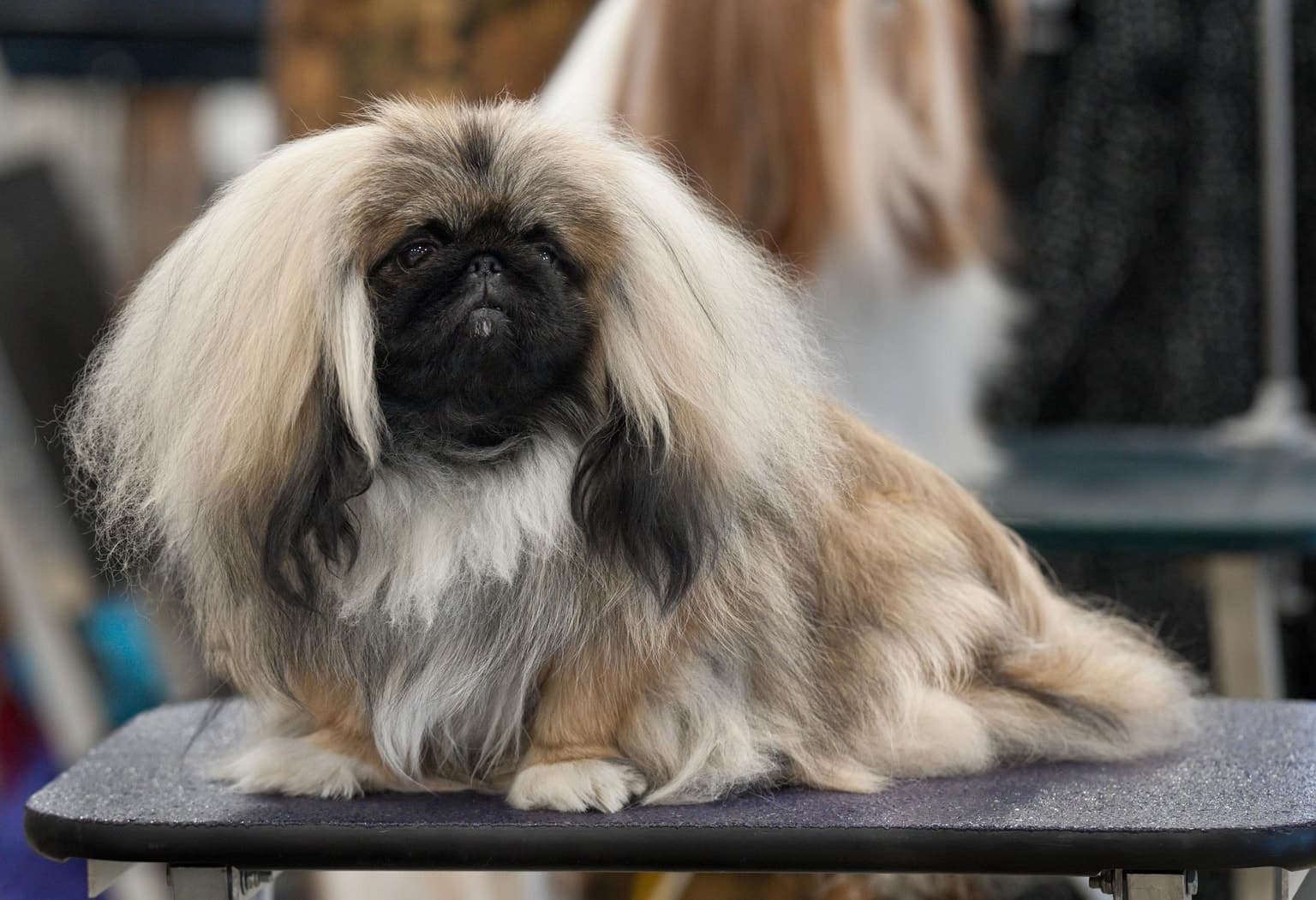
Photo by SheltieBoy · CC BY 2.0
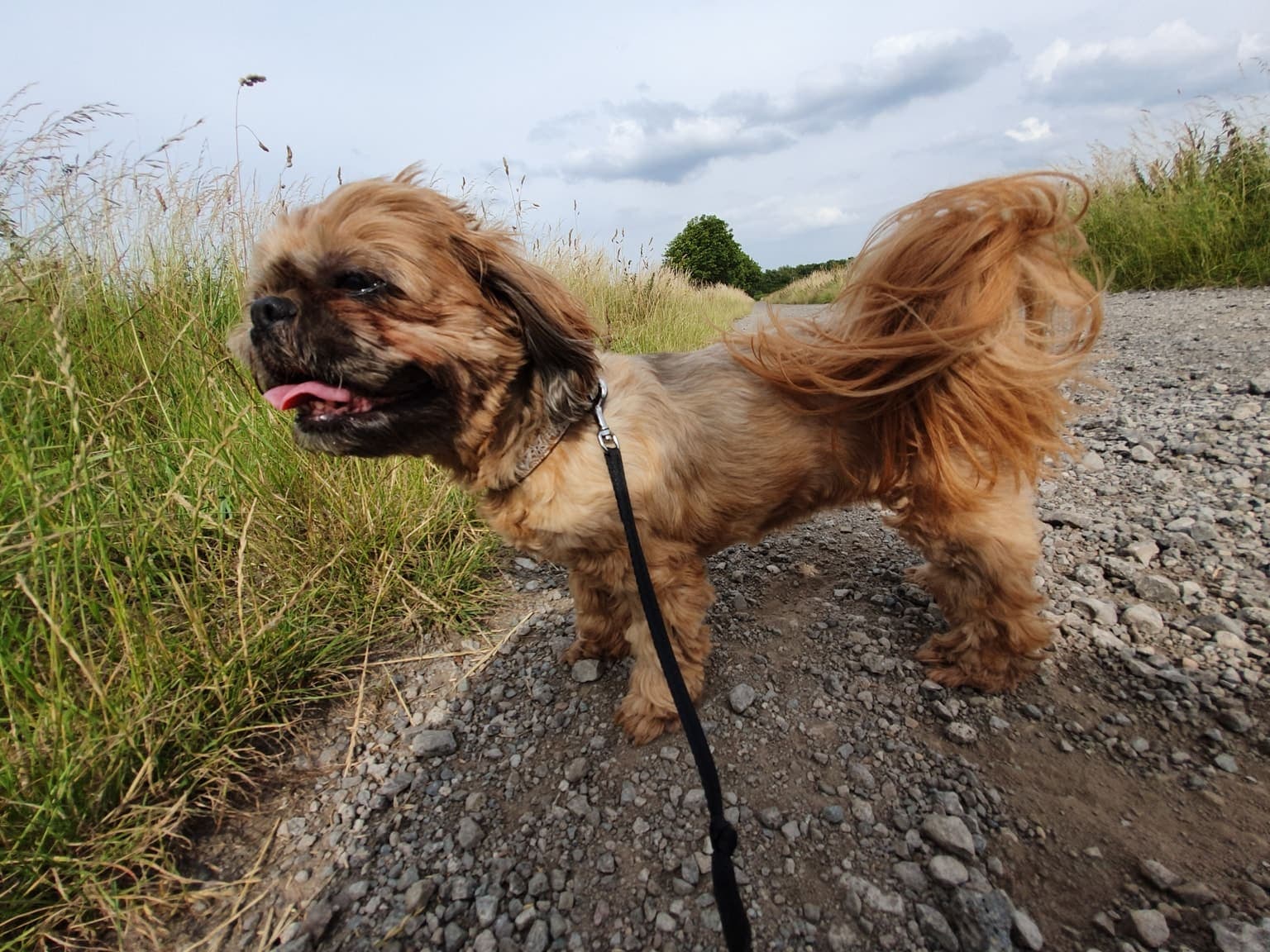
Photo by H.A.W.C 101 · CC BY-SA 4.0
Quick facts
| Fact | Pekingese | Shih Tzu |
|---|---|---|
| Group | Toy | Toy |
| Size | small | small |
| Height | 6-9 in | 9-10.5 in |
| Weight | up to 14 lbs | 9-16 lbs |
| Lifespan | 12-14 years | 10-18 years |
| Temperament | Affectionate, Independent, Alert, Dignified | Affectionate, Outgoing, Sweet-natured, Adaptable |
How to tell them apart
Read the rows top to bottom. The first two or three traits usually settle it; the rest confirm.
| Trait | Pekingese | Shih Tzu |
|---|---|---|
| Face | Flat in profile, with chin, nose and brow in one plane. A hair-covered wrinkle crosses the bridge of the nose in a wide inverted V and hides the stop. | Short, square, unwrinkled muzzle, ideally no longer than 1 in from nose tip to stop, with a definite stop and a flat front. |
| Skull and ears | Massive, broad, flat topskull, wider than deep, giving a rectangular, envelope-shaped head. Heart-shaped ears lie flat against the head and frame the face. | Round, broad, domed skull, wide between the eyes. Large ears set slightly below the crown of the skull. |
| Body and legs | Pear-shaped, compact and low: heavy in front with a narrow waist and lighter hindquarters, about 3 high to 5 long. Forelegs short, thick and moderately bowed, with the front feet turned slightly out. | Compact and solid with a level topline and no waist or tuck-up, slightly longer than tall. Legs straight and set well apart; never so low as to look squat. |
| Coat | Long, coarse, straight, stand-off outer coat over a thick, soft undercoat, with a noticeable mane on the neck and shoulders and shorter coat on the rest of the body. | Luxurious, dense, long, flowing double coat; a slight wave is permissible. The hair on top of the head is tied up. |
| Size | Up to 14 lbs and 6 to 9 in; over 14 lbs is a disqualification. The standard gives no height and notes the dog is surprisingly heavy for its size when lifted. | 9 to 16 lbs and 9 to 10.5 in. The standard allows no less than 8 in and no more than 11 in. |
| Gait and carriage | Unhurried and dignified with a slight roll over the shoulders. The high-set tail is slightly arched and carried well over the back. | Smooth, flowing and straight, with the head carried high and a heavily plumed tail curved well over the back. |
| AKC group and origin | Toy Group, recognised in 1906. A lapdog of the Chinese emperors and their courts, unknown in the West until 1860. | Toy Group, recognised in 1969. Developed by imperial breeders in the Chinese palace from Tibetan stock, most likely from Lhasa Apso and Pekingese crosses. |
What the photo detector sees
Hair and angle cause the trouble with this pair. A front-on portrait shows two flat faces with large dark eyes, and facial hair can cover the Pekingese's nose wrinkle and the shape of either skull. A Shih Tzu in a short puppy trim loses its flowing coat and topknot. In the saved benchmark runs for this project, none of the answers for Pekingese reference photos named the Shih Tzu first, though it was the runner-up in eight of the fifteen. In the other direction, two of the fifteen answers for Shih Tzu reference photos named the Pekingese first, and it was the runner-up in six others.
A standing side-on photo is the most useful, because it shows the legs, the waist and the height from the ground: bowed forelegs and a body slung low between them indicate a Pekingese. A profile of the head helps next. The Lhasa Apso, which the AKC names with the Pekingese as a likely ancestor of the Shih Tzu, is the other long-coated breed that gets mixed into this pair, and the AKC groups the Pug with both as flat-faced lapdogs bred by Chinese nobles.
Living with them
Temperament separates them more than appearance. The Shih Tzu standard requires a temperament that is outgoing, happy, affectionate, friendly and trusting towards all, and the AKC describes the breed as especially affectionate with children. The Pekingese standard describes directness, independence and individuality, and a good-natured, opinionated companion to those who have earned its respect. The AKC says Pekes bond closely with their people and make alert watchdogs, and that they may tolerate children but are not suited to roughhousing.
Both need little exercise: the AKC describes modest requirements for the Pekingese and short daily walks and indoor play for the Shih Tzu. A long Shih Tzu coat needs daily brushing and a bath every three or four weeks, or a short trim from a groomer; the AKC advises at least an hour of brushing a week for the Pekingese. The AKC notes that Shih Tzu do not tolerate heat well because of their heavy coats and short faces, that Pekingese appreciate cold temperatures, and that a Pekingese's eyes, with no long muzzle in front of them, need protecting from anything that could jab or irritate them. The profiles list a lifespan of 12 to 14 years for the Pekingese and 10 to 18 years for the Shih Tzu.
Not sure which one you have?
Upload a clear photo and the detector returns a ranked shortlist, so you can check the top matches against the tells above instead of guessing from one label.
Upload a photo and get a ranked shortlistFAQ
What is the difference between a Pekingese and a Shih Tzu?
A Pekingese is low and pear-shaped with bowed forelegs, a flat topskull, a wrinkle over the nose and a stand-off coat with a mane. A Shih Tzu stands on straight legs with a level back, has a round, domed head and an unwrinkled muzzle, and wears a long, flowing coat with a topknot.
Are Pekingese and Shih Tzus related?
Most likely, yes. The AKC describes the Shih Tzu as developed in the Chinese emperor's palace from Tibetan breeding stock and as most likely the product of crosses between the Lhasa Apso and the Pekingese. It also lists the Pekingese, Pug and Shih Tzu together as flat-faced lapdogs bred by Chinese nobles.
Which is bigger, a Pekingese or a Shih Tzu?
The Shih Tzu is taller, 9 to 10.5 in against 6 to 9 in. Weights overlap: a Shih Tzu weighs 9 to 16 lbs and a Pekingese up to 14 lbs. The Pekingese standard notes that the breed is surprisingly heavy for its size when lifted.
Do Pekingese and Shih Tzus come in the same colours?
Yes. Both standards accept all colours and markings equally, so colour does not identify either breed. On a Pekingese the skin of the muzzle, nose, lips and eye rims is black whatever the coat colour. A Shih Tzu's is black too, except on liver and blue dogs, where it matches.
Which needs more grooming?
A Shih Tzu kept in long coat. The AKC says it needs daily brushing, a bath about every three or four weeks, and the head hair trimmed or tied up to protect the eyes; a short puppy trim reduces the work. For the Pekingese the AKC advises at least an hour of brushing a week and an occasional bath.
Full profiles
More look-alikes
Other comparisons that include one of these breeds or come from the same look-alike group:
Browse every pair in the breed comparison index.